Top Posts
Madeline’s Madeline: An Unclassifiable Panic Attack Maybe-Masterpiece
Shoplifters Steals Moments of Wonder from the Mundane
Burning and Forgetting What’s Not There
Kusama: Infinity Expands Beyond The Canvas
Mandy Risks Little, Wins Little
In We The Animals, The Children Are Away...
The Seagull Isn’t Quite Chekhov, But It’s Still...
5 Million Ways Boots Riley Isn’t Sorry To...
American Animals’ and the Queasiness of the Heist
A Star Is Born In Hearts Beat Loud
  • Reviews
  • Commentary
  • Great Movie Project
    • Great Movie Project
      Bride of Frankenstein is a movie for and…

      January 25, 2018

      Great Movie Project
      The Enduring Appeal of Nick and Nora in…

      November 29, 2017

      Great Movie Project
      The Ahistorical Fever Dream of The Scarlet Empress

      August 2, 2017

      Great Movie Project
      Dreams, Mundanity, and the Anarchist Yearnings of L’Atalante

      July 12, 2017

      Great Movie Project
      Duck Soup Is And Will Always Be A…

      April 19, 2017

  • Counter Programming
    • Great Movies: The Counter Programming
      Walking and Talking in the Shadow of Kanchenjungha

      March 7, 2018

      Great Movies: The Counter Programming
      A Brief Encounter in My Mother and Her…

      February 9, 2018

      Great Movies: The Counter Programming
      Horror’s Refusal in Farrokhzad’s The House Is Black

      October 13, 2017

      Great Movies: The Counter Programming
      The rage and beauty of The Cloud-Capped Star

      October 3, 2017

      Great Movies: The Counter Programming
      The daylight noir and social issue empathy of…

      June 22, 2017

  • Vegan Horror
    • Vegan Horror
      Julia Ducournau doesn’t think her film Raw is…

      June 7, 2017

      Vegan Horror
      Licking our wounds: The vampiric masculinity of Ravenous

      December 13, 2016

      Vegan Horror
      Eggertsson and animals: An approach to horror cinema

      September 15, 2016

      Vegan Horror
      “It’s Not My Nature” – Vegetarianism, Body Horror,…

      August 30, 2016

      Vegan Horror
      Bodies and Carcasses in Predator 2

      August 23, 2016

  • Interview
    • Interview
      Jasmine Leyva’s doc The Invisible Vegan aims to…

      May 3, 2017

      Interview
      Bridging The Abyss: An Interview With The Directors…

      November 28, 2016

      Interview
      7 Days in Ohio: An Interview with Nathan…

      September 12, 2016

      Interview
      Film Critic Phil Dy talks New Filipino Cinema

      June 17, 2016

      Interview
      “I Love Seeing Film Projected.” A Conversation with…

      March 22, 2016

Luddite Robot
Film critique, theory, and assorted nonsense.
CommentaryFilm

China Girls, Death Proof, and the Hidden Face

April 14, 2019

Old News: Old Noise Edition

April 8, 2019

Old News: April 1, 2019

Nicolas Winding Refn, Marginalia, and the Deaths of Cinema

CommentaryFilm

And now, let us praise Kanopy

January 24, 2019

Warren Sonbert and the Relief of Anti-Narrative

January 14, 2019

The World Is Ending and It Doesn’t Matter

The Best Films of 2018

FilmReviews

Madeline’s Madeline: An Unclassifiable Panic Attack Maybe-Masterpiece

December 21, 2018

Shoplifters Steals Moments of Wonder from the Mundane

December 11, 2018

Burning and Forgetting What’s Not There

Alien, Musicology, and Reading Soundtracks

CommentaryFilm

Shocktober III: Halloween 2018 Edition

October 24, 2018

Shirley Jackson’s The Lottery Traumatized Schoolkids in 16 mm

October 18, 2018

Shocktober 2018 II: Another Reshockening (of Horror)

Häxan is a movie made by a movie character

CommentaryFilm

Shocktober 2018

October 7, 2018

Unprofessional! Spring Night, Summer Night

October 3, 2018

The Wild Boys: A Luddite Robot Conversation

Kusama: Infinity Expands Beyond The Canvas

Reviews

Kuroneko (Kaneto Shindo, 1968)

by rick October 17, 2014
written by rick

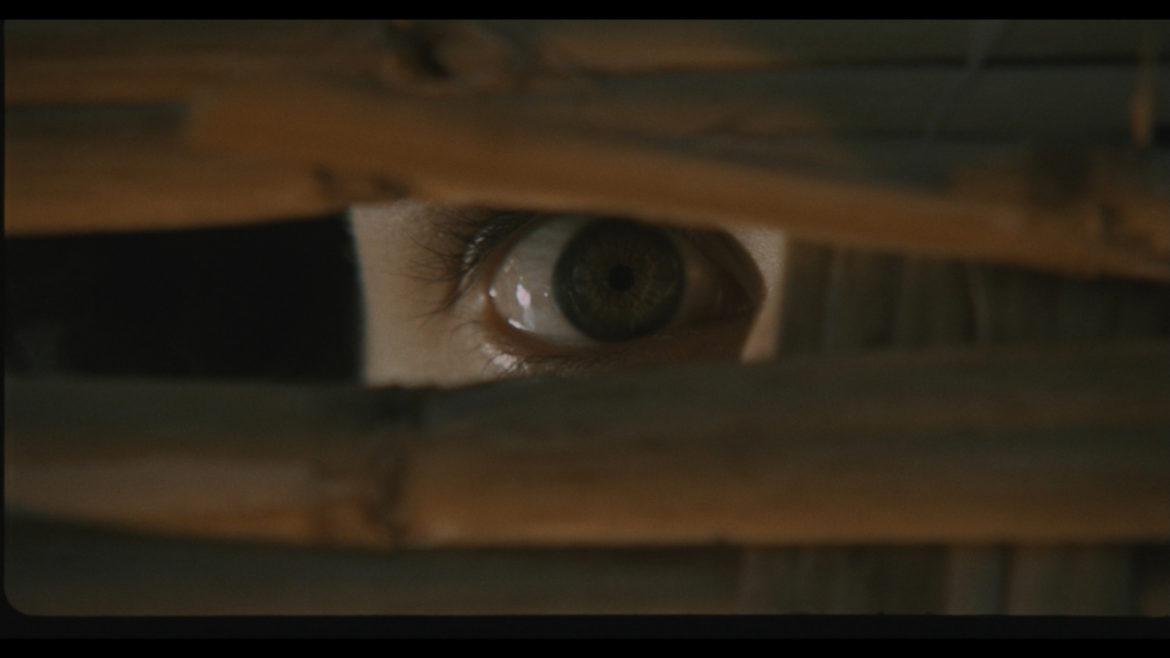
Kaneto Shindo was a remarkably prolific writer and director who dabbled in numerous genres. His horror Kuroneko (full translation of the original title: “Black Cat from the Grove”) is a surprising, eerie film, shot in haunted black and white by frequent collaborator Kiyomi Kuroda, that draws together elements of Japanese folklore and period setting with very modern sensibilities – a disdain for authority and tradition, a Freudian uncanniness, a clear attention to the plight of “commoners,” and a feminist edge.

Kuroneko shares much with other interrogations of samurai culture and myth more generally (like Shindo’s Japanese contemporaries, and also like the revisionist American Westerns of the same period), but it also resembles the creepy melodrama of classic Hollywood horror and points toward the violent revenge narratives of exploitation.

images

I knew none of this going in. I only knew that it’s a title which shows up on a lot of “important horror movie” lists. (I’ve since seen his Onibaba, which draws on the same myth to construct a very different story.) So the opening sequence – which, it should be noted, could be triggering to those who have experienced sexual violence – was pretty jarring. It’s not “I Spit On Your Grave,” but it was a lot more intense than I expected.

A group of 20-some samurai, famished from the road and far from their leader’s sight or their community’s awareness, emerge from a wooded area like a fog, like they are part of the landscape itself. They break into a secluded home occupied by a woman and her daughter-in-law, pillage their house for food and drink, rape them, and burn the house to the ground with the women inside, then fade back into the forest.

The images of different samurai grotesquely eating food with their mouths open while others assault the women are horrific, but make one thing very clear: these are not the noble warriors of myth, fighting for the common man and woman against lawless bandits. It’s an inversion of that mythology, and probably far closer to the truth of life on a battlefield in any country at war than the comforting stories of heroism we like to tell ourselves.

The women’s bodies lie, strangely intact, on the ashes of their destroyed house. A black cat walks between them, meowing, gently licking their faces. This at first seems forlorn – the cat has been abandoned, its loving keepers defiled and killed. Then the camera focuses on the cat lapping directly from their wounds. That forlornness is replaced with something eerier, and you wonder why it is, exactly, that their bodies weren’t engulfed in the fire.

Samurai start dying near Rashomon Gate, found with their throats ripped out and wounds that seem to be made by claws. A woman in white, shrouded in the darkness, asks men for help getting across a particularly shadowy and dangerous road, invites them to the secluded house she shares with her mother, gets them drunk, entices them to bed, and kills them in the heat of passion, drinking their blood from the neck. The emperor is displeased with the mysterious deaths – it’s implied that they tarnish the image of the all-powerful samurai warrior, which is unacceptable – and tells the local leader to put an end to this embarrassment.

kuroneko9

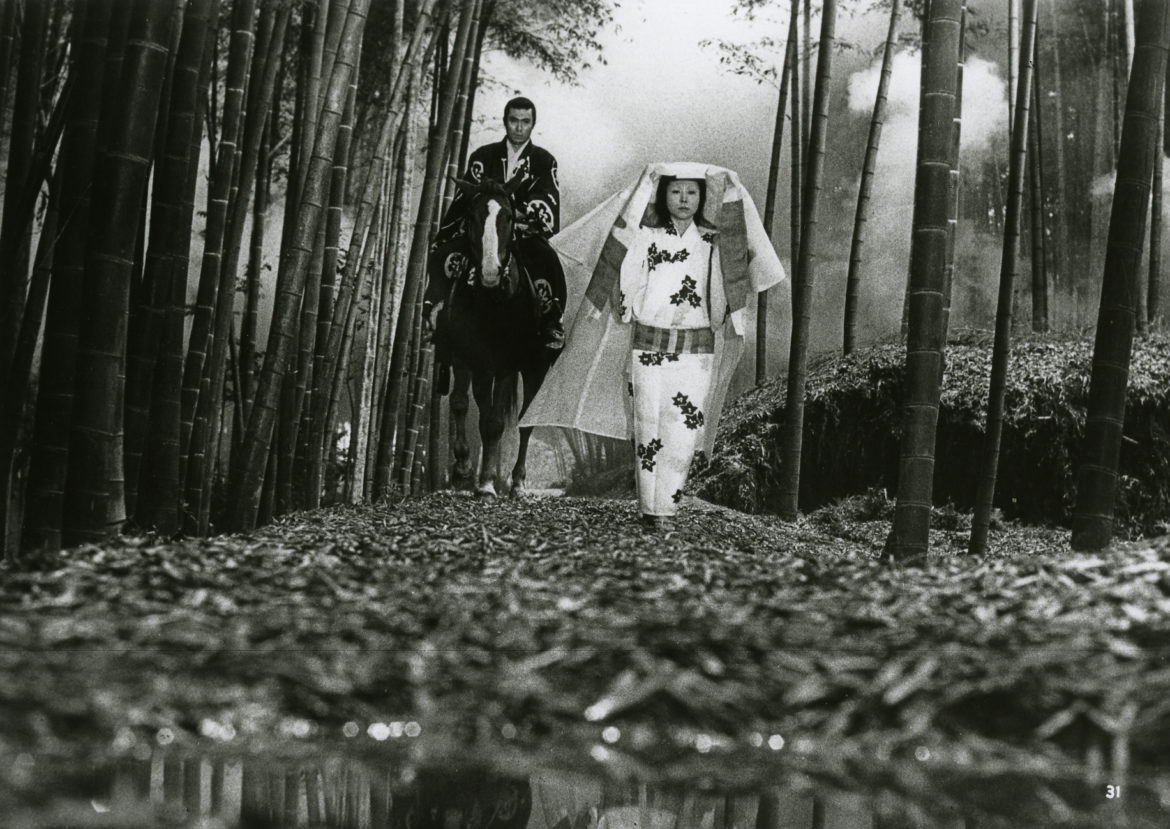
We discover that the two women from the beginning of the film had been waiting for a man named Hachi to return – son to one, husband to the other – who was conscripted into battle from the fields he was working, and it was in his absence that they met their horrible fate. Now, they’ve been granted extended life by powerful forces, contingent on them exacting vengeance on all samurai. Hachi does return, after three years. But now he too is a samurai, with a new title bestowed, somewhat cynically, on him for battlefield bravery. He’s asked to deal with the ghostly murders, and ventures into the mist and the woods …

It’s a familiar enough tale, but one that turns in on itself, with tragic implications for all involved. The horror is in the sense of inevitability, as it is in all tragedy – of course it would be this way. Shindo’s approach to these stories – the way in which he ties together different traditions and senses of the uncanny – is what gives the film its resonance, along with the stunning cinematography and believable characters.

This is all paired with a deep distrust, on the film’s part, of those in charge, not just the lower-level functionaries committing atrocities when no one is around. This distrust even extends to the stories they tell: Raiko Minamoto, the grand leader in this corner of the forest, tells Hachi they will embellish his exploits for the common man, as he has done with his own in the past, so that they will be thought all the more heroic, and consolidate power in their realm. He is both contemptuous of the commoner, who he rather dramatically deems “unfit even to live,” and at the same time oblivious to the larger forces at work that mock his petty aims and delusions of grandeur.

With this angry swipe, Shindo announces that Kuroneko is definitely a ’68 film. In an interview accompanying the Criterion version, he isn’t comfortable calling himself a Marxist, but says, “I am a believer in socialism … If you have to look at society through the eyes of those placed on the bottom level, you cannot escape the fact that you must experience and perceive everything with a sense of political struggle.” His Kuroneko is a creepy, accomplished, sly movie that should be more widely known than it is.

October 17, 2014 0 comments
0 FacebookTwitterPinterestEmail
Reviews

Bay of Blood (Mario Bava, 1971)

by rick October 17, 2014
written by rick

Bay of Blood (aka Twitch of the Death Nerve), Mario Bava’s 1971 giallo-trending-towards-slasher flick, is reportedly the goriest of all his films (definitely the goriest of those I’ve seen), and widely considered a major influence on many films to follow a decade later. It’s not hard to see why: it opens with horny kids goofing around who, one by (mostly) one, meet unpleasant ends, its camera slowly tracking victims from the killer’s POV. It devises somewhat inventive ways to dispatch its characters, with plenty of blood and horrified faces.

While the gore is pretty mild compared to fellow Italians Dario Argento or Lucio Fulci (not to mention in the genre movies to come), it’s substantial compared to classics like Bava’s own Black Sunday from a decade prior, which now seems downright stately. Bay of Blood apparently revolted plenty of critics, and previous Bava supporters, on its release.

On the other hand, while sharing the casual sexism, empty house in the woods, and POV shots of slasher movies, it’s also much more plot-driven – a good thing, in that there’s something to watch for besides the partial nudity and the death scenes at the hands of a maniac or monster, and a not-so-good thing, in that the plot driving it is kind of dumb. It’s essentially a “who gets the inheritance from the old lady?” picture, with more impalings and beheadings than usual.

It also shoehorns in something of an environmental and/or anti-capitalist subtext, with those who want to preserve the bay as it is (especially, for some reason, for its bugs) pitted against the rapacious greed of others who want to pave it over and turn it into a lucrative tourist paradise. None of this is very interesting. You also wonder how the deaths of absolutely everyone will affect getting that inheritance, since this would presumably attract suspicion that things might not be quite above board with the people left standing.

There are some effective scares, moody shots by the bay of its title, and a handful of cool effects, but the laughable dialogue doesn’t do it any favors, and the ending is absolutely ludicrous. You could do worse, but you could do far better.

October 17, 2014 0 comments
0 FacebookTwitterPinterestEmail
Reviews

SCAREFEST: Val Lewton Marathon

by rick October 16, 2014
written by rick

The Dissolve commentariat has been posting write-ups of horror movies all month (which are amazing and which you should read). Here’s mine, on Val Lewton.

SCAREFEST: Val Lewton Marathon — Cat People (Jacques Tourneur, 1942); The Curse of the Cat People (Gunther von Fritsch, Robert Wise, 1944); The 7th Victim (Mark Robson, 1943)

The original Cat People – Val Lewton’s 1942 production debut for RKO, directed by Jacques Tourneur – is justifiably famous for the absence of, well, cat people. On screen, anyway. The movie operates in shadows and insinuation, mood and dream-logic. But while the plot definitely revolves around cat people, no scary cat-person ever shows up, exactly. This was the product of necessity: there was no money for stars or costumes or effects, so monster-movie scares had to be generated without the monsters. Lewton and Tourneur delivered, through legitimate craftsmanship and two crucial insights – sometimes the creepiest thing is just out of the frame, and dread can be as effective as fright for drawing an audience.

Its nominal sequel, The Curse of the Cat People, simply dispenses with the cat people altogether. It’s a strange and surprisingly moving film, and doesn’t really register as a “horror movie” at all, despite drawing on Sleepy Hollow, creepy imaginary friends, and featuring a little kid going into an old spooky house where a weird lady lives. Whether or not it’s a horror movie per se, you’ll still notice one item missing from that list. (It’s cat people.)

What the two movies definitely share, along with 1943’s The 7th Victim (also produced by Lewton for RKO), is the mood. There’s a sense that something is off; that while everything being shown and spoken is clear and understandable enough, there’s still something just below the surface threatening to rise. Compared to the classic monster films Universal was putting out at the time – and which led RKO to launch their production in the first place, hoping to cash in – these are bizarre experiences, more lo-fi David Lynch noir than creature-feature.

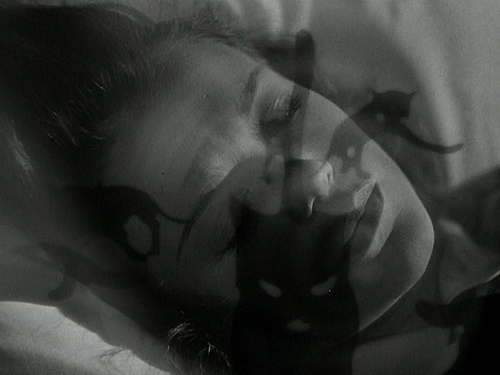
3795159538_1f5f761091In Cat People, Irena (French actress Simone Simon) draws pictures of panthers at the zoo, and surrounds herself with cat totems from her hometown in Serbia. Oliver, the man she meets and marries (but never once kisses, afraid of a prophecy that says her desire will unleash the animal inside), is an architect obsessed with boats. At dinner in a restaurant, a strange woman approaches, cloaked in furs, and addresses Irena as “sister,” before promptly leaving. (Roger Ebert’s excellent review finds a queer subtext in this exchange.) When Oliver’s co-worker Alice (the third point of their love triangle) is in danger from something unseen in the shadows, the street she runs along is simply a loop of the same brick wall, with the same lightpost again and again. She becomes frantic in fear of this invisible prowler, but is able to jump on a bus that shows up out of nowhere just in time, careening in from the right side of the screen in an early version of a fakeout jump scare. It plays extraordinarily like a bad dream.

curse0091

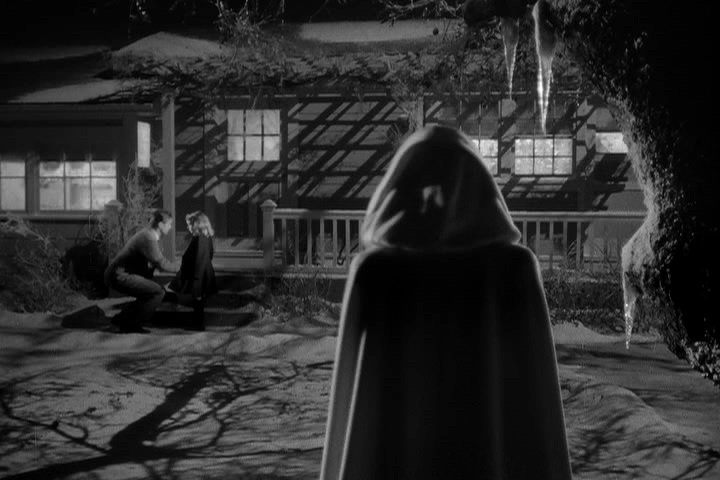
In The Curse of the Cat People, the focus shifts to a young girl, the child of two characters from the previous film, who is either sensitive or troubled, and her anxieties, attempts to fit in and do right, and her alienation from her peers. There’s a bit of a Carrie prototype here … or would be, if the film chose to go in that direction. I’m still not sure what direction it does choose – those peers, for instance, are never heard from again after roughly 20 minutes – but the evocative shadows that became the Lewton hallmark are everywhere. And there’s the added creep factor of a child protagonist: she’s a tiny person on a huge set, the staircases and dark halls are forbidding, and the camera invariably is pointing up at the looming objects or down at the small girl with whom we identify. It’s unsettling, even if nothing much seems to happen.

Of course, nothing much does happen in many childhoods, more often than not, or at least not in the ways we think. Elaborate fears prove unjustified; you usually don’t get eaten by a monster in the dark. But that doesn’t make it any less scary at the time, or any less awful when no one believes that you might. The film effectively touches on the disbelief, casual skepticism, and patronizing allowances with which adults treat children, who are certain they saw something … in the closet, under the bed, or, in this case, out in the yard by the swing.

As it turns out, the ghost lurking there in The Curse of The Cat People is more a protector from the living than a threat from beyond the grave, but what’s scary in the film is the child’s helplessness and total lack of power in a much bigger world. And her inability to explain herself, avoid misunderstanding, even when being completely honest and direct. The cat people’s curse, held over from the first film, might just be the way no one will listen to you about the presences, dangerous or otherwise, that you sense. The curse is awareness of the supernatural in a world predicated on its repression.

7thvictim2

The 7th Victim does not take place in this “Cat People minus cat people” world, although it’s kind of hard to tell if you watch all three in a row. This is especially true since Tom Conway keeps showing up, looking like Vincent Price, seeming deeply untrustworthy, and saying things like, “I prefer the left … the sinister side.” The film involves a missing sister in the big city, a curiously tolerated Satanic cult, a weird aside about evil beauty products, and a Rosemary’s Baby-esque meeting, except it’s more jury trial than baby shower. I actually don’t think much of this matters – once again, it’s the mood and the images. Particularly striking: a door is forced open and we expect something gruesome; instead it’s an empty room with a noose hanging from the ceiling above a chair. It’s a terrifying moment, and it cost exactly the price of a chair and a piece of rope to shoot. The 7th Victim’s meandering plot pays off with a brilliant, evocative, and rather disturbing ending, with the contrast of two characters, headed in different directions, going to the same place in the end.

The short documentary Shadows in the Dark: The Val Lewton Legacy points out that RKO simply handed Lewton the titles, and gave him the freedom to shoot a picture as he saw fit (although with barely any money, of course). That is, to use the technical term, fucking nuts. And even more amazing is that these idiosyncratic and sophisticated movies were the result.

October 16, 2014 0 comments
0 FacebookTwitterPinterestEmail
Uncategorized

Direct action against evictions & foreclosures in Mpls

by rick August 13, 2009
written by rick

The eviction/foreclosure resistance movement in the Twin Cities is strong and growing. It represents not only the spreading of direct action tactics against corporate greed, but also a rare and important development in community solidarity.

As nearly anyone in Minneapolis, and quite a few outside of the area, knows, a person named Rosemary Williams has become something of a touchstone for this resistance.

It’s a familiar story to anyone paying attention. Rosemary — a community-minded older person, Black and female-bodied, who, incidentally, lives not but a few minutes from me, as the bicycle rolls, over in the Central neighborhood — has lived on her block for over 50 years and in her current house for over 20. She fell on hard times and had to refinance to get by, and then found her monthly payment jacked over $1,000 a month. She couldn’t pay. She tried in vain to work out some sort of deal, but the mortgage company was having none of it. Because her story found itself on the TV and in the papers, the local councilperson intervened (or claimed to do so). For a brief period, it appeared a deal was imminent.

Last Friday, with no notice, Sheriff’s deputies arrived — along with representatives of GMAC, the lender — and locked the doors with all of Rosemary’s stuff inside, hung up no trespassing signs, threatened to mace concerned neighbors, and then left.

We — the plural is appropriate, so you know where I’m coming from — broke back into the house and removed the locks. We helped get Rosemary’s stuff out and stored off-site. And we then began an occupation of the property that continues to this moment, its sixth day.

At a time when banks and corporations receive enormous and unscrutinized amounts of public funds after years of record-breaking profits built on the backs of poor folks and made possible by nearly limitless graft, duplicity, and greed, it is unconscionable that members of my (or any) community find themselves homeless for totally reasonable inabilities to make payments.

Banks do not need a place to sleep; banks do not get hungry; banks do not have children; banks do not dream; banks do not have desires, loves, passions; banks do not hurt.

The latest word — from both reliable and less reliable sources (I’m looking at you, Elizabeth Glidden, in the latter case) — is that the cops are not interested in raiding the occupation (tough year, MPD?) and that GMAC is coming back to the table to hammer out an acceptable deal, like they would’ve done in the first fucking place if they weren’t so tone-deaf to public sentiment. So, good.

The coalition of anarchists, housing rights activists, poor folks, anti-bailout people, and concerned citizens created out of this seems to show signs of some larger possibility, though time will tell. The Sister’s Camelot truck rolling through the neighborhood, providing free organic produce and fruit; the Food Not Bombs meals; the children in the backyard or the long conversations between people who otherwise might never talk in the front. Something is happening. Its endurance is a question worth debating, its meaning something that we might have to wait and see.

But in the meantime? We fight until Rosemary and her family gets their house back for good.

And then we move on to Linda’s, and whoever’s up next.

No more dancing around the issue. No more half-steps. Occupy every home, fight every eviction, protect and defend every community member. Not another empty house!

August 13, 2009 0 comments
0 FacebookTwitterPinterestEmail
Uncategorized

RNC: Chapter 1

by rick September 9, 2008
written by rick

In every life, I imagine, there comes a moment of shock and self-awareness, a moment when one realizes it’s impossible to go on this way. Maybe not every life – perhaps some people can maintain a cool distance forever, excusing away the small incongruities and the cognitive dissonance. Perhaps even most people live that way; I don’t know. What do I know about other peoples’ lives?

But in many lives, anyway, there comes such a moment. You work hard at something, or for something, and it suddenly dawns on you that your goal isn’t worth it, or its value diminishes at least, or you question the very basis of that work. The justifications for minor tweaking dissolve. You look around and think, “But this isn’t it. This isn’t it at all. I missed it all along. Maybe I had it once, but I lost it.” And you feel very alone, and probably very angry. If circumstances conspire to compel this realization as a direct result of outrage at flagrant injustices around you, you feel angrier still, and probably even more alone.

“I knew this; I knew this. And yet I chose to ignore it.”

Guilt, complicity, rage and the kind of aimless anger that makes your skin hurt, fatigue so bad you still shake in bed awake or write at twenty to four in the morning, and despair, boredom, ennui, irritation at friends, desire, solidarity, nearly boundless love. That’s what I’ve felt in the past week, when the state unfurled itself like a flag in my city. Not, as some maintain, “the police state,” as if there were some other kind – just the regular old “state;” the arrangement of norms, protocols, disciplines, and economies that bound thought, assembly, speech, self-rule, and desire.

In my community, among my friends and my lover, on the streets we all walk, the state came and announced itself the only way it knows how.

Contrast and compare:

A roomful of dedicated young people, dreaming of a better and more egalitarian world, where norms are subverted, everything is shared and necessities are free, and a spirit of cooperation predominates.

And a street lined with barely recognizable humans encased in robotic black, insignia-free, emotionless, firing tear-gas and rubber bullets and pepper spray at children and the elderly and the idealistic and the angry, holding guns to their heads, detaining those who would report on it, confiscating evidence, pressuring the faithful to betray what they love, torturing those they imprison, tapping every phone, threatening every passerby, murdering every dream they can find.

A friend says, “I told you so, they’re cowboys,” like I’d been warned not to use a certain hot sauce. Another says, “Why not leave when they tell you to? That way, no one will be hurt.”

I stare blankly and in some amount of disbelief, before recovering enough to mumble some sort of unequivocal retort. What is there to say? How would one explain water to fish?

Our lives go on; we meet at ungodly hours to organize paper trails of lost innocence or reconfirmed suspicions. We hug each other very long and try not to cry where others can see us. We say, “Keep loving, keep fighting,” and wonder if the raids, the roundups, the mass arrests, the targeting, the surveillance have stopped for good.

And of course they haven’t. They’ve just slinked back into the shadows, they’ve just moved on a bit, and they’ve just continued in all the pockets they call home – the ally states, the “rogue” states, the communities of color and the communities of the poor and the communities of the vulnerable and every last spot where cameras aren’t. That is, where they’ve always been, for as long as we’ve sold our dreams to pen flicks or digital touch-screens, to nominate strangers who will determine the structures of our lives.

Are we a bit wiser now? Are we a bit angrier? Will this last?

I think it has to last. I think there’s no other choice. And I think if we go down, we go down swinging – and even if we don’t connect, we latch on to each other in the meanwhile. We grab what connections we can, and we love with more rage than this system’s architects and engineers ever dreamed possible.

One hand around your lover’s shoulder and the other one clenched in a fist.

Tonight at the Cabaret, she quoted a friend: “They tried to dig up the roots, but they only succeeded in planting seeds.”

So tonight, in response, with nothing left but fumes and the lingering feeling that I should be doing more, I quote a song instead: “Brick by brick, wall by wall.”

It’s not over, St. Paul.

September 9, 2008 5 comments
0 FacebookTwitterPinterestEmail
Newer Posts
Older Posts

About

About

Towards a provisional theory of the cinema, or, failing that, just some shit about movies

Authors
Rick Kelley
Lark Lundberg

Keep in touch

Facebook Twitter

Categories

  • Conversation
  • Film
  • Film By Film
  • Great Movie Project
  • Great Movies: The Counter Programming
  • Guest
  • News
  • Other
    • Commentary
    • Film
    • Interview
    • Reviews
    • Song for a Sunday
  • Streaming Selections
  • TV
  • Uncategorized
  • Vegan Horror

Archives

  • April 2019
  • March 2019
  • January 2019
  • December 2018
  • November 2018
  • October 2018
  • September 2018
  • August 2018
  • July 2018
  • June 2018
  • May 2018
  • April 2018
  • March 2018
  • February 2018
  • January 2018
  • December 2017
  • November 2017
  • October 2017
  • September 2017
  • August 2017
  • July 2017
  • June 2017
  • May 2017
  • April 2017
  • March 2017
  • February 2017
  • January 2017
  • December 2016
  • November 2016
  • October 2016
  • September 2016
  • August 2016
  • July 2016
  • June 2016
  • May 2016
  • April 2016
  • March 2016
  • February 2016
  • January 2016
  • December 2015
  • October 2015
  • September 2015
  • August 2015
  • July 2015
  • June 2015
  • May 2015
  • April 2015
  • March 2015
  • February 2015
  • January 2015
  • December 2014
  • November 2014
  • October 2014
  • August 2009
  • September 2008

Recent Posts

  • China Girls, Death Proof, and the Hidden Face
  • Old News: Old Noise Edition
  • Old News: April 1, 2019
  • Nicolas Winding Refn, Marginalia, and the Deaths of Cinema
  • And now, let us praise Kanopy

Recent Comments

  • Franklin Kat on Michael Shannon shines again in Frank & Lola
  • Sean Tempesta on Cinema and dream-logic in Meshes of the Afternoon
  • ludditerobot on The Left-Wing Slapstick and Iconic Songs of 1937’s Street Angel
  • Franklin Kat on The Left-Wing Slapstick and Iconic Songs of 1937’s Street Angel
  • Arijit Mukherjee on Great Movies Project: The Counter-Programming
  • Facebook
  • Twitter

@2021 - All Right Reserved. Designed and Developed by PenciDesign


Back To Top
Luddite Robot
  • Reviews
  • Commentary
  • Great Movie Project
    • Great Movie Project
      Bride of Frankenstein is a movie for and…

      January 25, 2018

      Great Movie Project
      The Enduring Appeal of Nick and Nora in…

      November 29, 2017

      Great Movie Project
      The Ahistorical Fever Dream of The Scarlet Empress

      August 2, 2017

      Great Movie Project
      Dreams, Mundanity, and the Anarchist Yearnings of L’Atalante

      July 12, 2017

      Great Movie Project
      Duck Soup Is And Will Always Be A…

      April 19, 2017

  • Counter Programming
    • Great Movies: The Counter Programming
      Walking and Talking in the Shadow of Kanchenjungha

      March 7, 2018

      Great Movies: The Counter Programming
      A Brief Encounter in My Mother and Her…

      February 9, 2018

      Great Movies: The Counter Programming
      Horror’s Refusal in Farrokhzad’s The House Is Black

      October 13, 2017

      Great Movies: The Counter Programming
      The rage and beauty of The Cloud-Capped Star

      October 3, 2017

      Great Movies: The Counter Programming
      The daylight noir and social issue empathy of…

      June 22, 2017

  • Vegan Horror
    • Vegan Horror
      Julia Ducournau doesn’t think her film Raw is…

      June 7, 2017

      Vegan Horror
      Licking our wounds: The vampiric masculinity of Ravenous

      December 13, 2016

      Vegan Horror
      Eggertsson and animals: An approach to horror cinema

      September 15, 2016

      Vegan Horror
      “It’s Not My Nature” – Vegetarianism, Body Horror,…

      August 30, 2016

      Vegan Horror
      Bodies and Carcasses in Predator 2

      August 23, 2016

  • Interview
    • Interview
      Jasmine Leyva’s doc The Invisible Vegan aims to…

      May 3, 2017

      Interview
      Bridging The Abyss: An Interview With The Directors…

      November 28, 2016

      Interview
      7 Days in Ohio: An Interview with Nathan…

      September 12, 2016

      Interview
      Film Critic Phil Dy talks New Filipino Cinema

      June 17, 2016

      Interview
      “I Love Seeing Film Projected.” A Conversation with…

      March 22, 2016