Top Posts
Madeline’s Madeline: An Unclassifiable Panic Attack Maybe-Masterpiece
Shoplifters Steals Moments of Wonder from the Mundane
Burning and Forgetting What’s Not There
Kusama: Infinity Expands Beyond The Canvas
Mandy Risks Little, Wins Little
In We The Animals, The Children Are Away...
The Seagull Isn’t Quite Chekhov, But It’s Still...
5 Million Ways Boots Riley Isn’t Sorry To...
American Animals’ and the Queasiness of the Heist
A Star Is Born In Hearts Beat Loud
  • Reviews
  • Commentary
  • Great Movie Project
    • Great Movie Project
      Bride of Frankenstein is a movie for and…

      January 25, 2018

      Great Movie Project
      The Enduring Appeal of Nick and Nora in…

      November 29, 2017

      Great Movie Project
      The Ahistorical Fever Dream of The Scarlet Empress

      August 2, 2017

      Great Movie Project
      Dreams, Mundanity, and the Anarchist Yearnings of L’Atalante

      July 12, 2017

      Great Movie Project
      Duck Soup Is And Will Always Be A…

      April 19, 2017

  • Counter Programming
    • Great Movies: The Counter Programming
      Walking and Talking in the Shadow of Kanchenjungha

      March 7, 2018

      Great Movies: The Counter Programming
      A Brief Encounter in My Mother and Her…

      February 9, 2018

      Great Movies: The Counter Programming
      Horror’s Refusal in Farrokhzad’s The House Is Black

      October 13, 2017

      Great Movies: The Counter Programming
      The rage and beauty of The Cloud-Capped Star

      October 3, 2017

      Great Movies: The Counter Programming
      The daylight noir and social issue empathy of…

      June 22, 2017

  • Vegan Horror
    • Vegan Horror
      Julia Ducournau doesn’t think her film Raw is…

      June 7, 2017

      Vegan Horror
      Licking our wounds: The vampiric masculinity of Ravenous

      December 13, 2016

      Vegan Horror
      Eggertsson and animals: An approach to horror cinema

      September 15, 2016

      Vegan Horror
      “It’s Not My Nature” – Vegetarianism, Body Horror,…

      August 30, 2016

      Vegan Horror
      Bodies and Carcasses in Predator 2

      August 23, 2016

  • Interview
    • Interview
      Jasmine Leyva’s doc The Invisible Vegan aims to…

      May 3, 2017

      Interview
      Bridging The Abyss: An Interview With The Directors…

      November 28, 2016

      Interview
      7 Days in Ohio: An Interview with Nathan…

      September 12, 2016

      Interview
      Film Critic Phil Dy talks New Filipino Cinema

      June 17, 2016

      Interview
      “I Love Seeing Film Projected.” A Conversation with…

      March 22, 2016

Luddite Robot
Film critique, theory, and assorted nonsense.
CommentaryFilm

China Girls, Death Proof, and the Hidden Face

April 14, 2019

Old News: Old Noise Edition

April 8, 2019

Old News: April 1, 2019

Nicolas Winding Refn, Marginalia, and the Deaths of Cinema

CommentaryFilm

And now, let us praise Kanopy

January 24, 2019

Warren Sonbert and the Relief of Anti-Narrative

January 14, 2019

The World Is Ending and It Doesn’t Matter

The Best Films of 2018

FilmReviews

Madeline’s Madeline: An Unclassifiable Panic Attack Maybe-Masterpiece

December 21, 2018

Shoplifters Steals Moments of Wonder from the Mundane

December 11, 2018

Burning and Forgetting What’s Not There

Alien, Musicology, and Reading Soundtracks

CommentaryFilm

Shocktober III: Halloween 2018 Edition

October 24, 2018

Shirley Jackson’s The Lottery Traumatized Schoolkids in 16 mm

October 18, 2018

Shocktober 2018 II: Another Reshockening (of Horror)

Häxan is a movie made by a movie character

CommentaryFilm

Shocktober 2018

October 7, 2018

Unprofessional! Spring Night, Summer Night

October 3, 2018

The Wild Boys: A Luddite Robot Conversation

Kusama: Infinity Expands Beyond The Canvas

CommentaryFilmGreat Movie Project

Bride of Frankenstein is a movie for and about weirdos

by rick January 25, 2018
written by rick

It is infuriatingly difficult to write about a film you love. I love Bride of Frankenstein.

Trying to locate the source of this affection — to contextualize it in ways that might be interesting and don’t amount to gushing, “Hey, you know what is great? Bride of Frankenstein. It’s really great. Have you seen it? Bride of Frankenstein? Man, it’s awesome. Do you want to watch Bride of Frankenstein right now, actually? It’s so good,” like a teenager who just bought Bride of Frankenstein, and also cocaine — is difficult. I want to do it justice, but I also just kind of want to give you a copy.
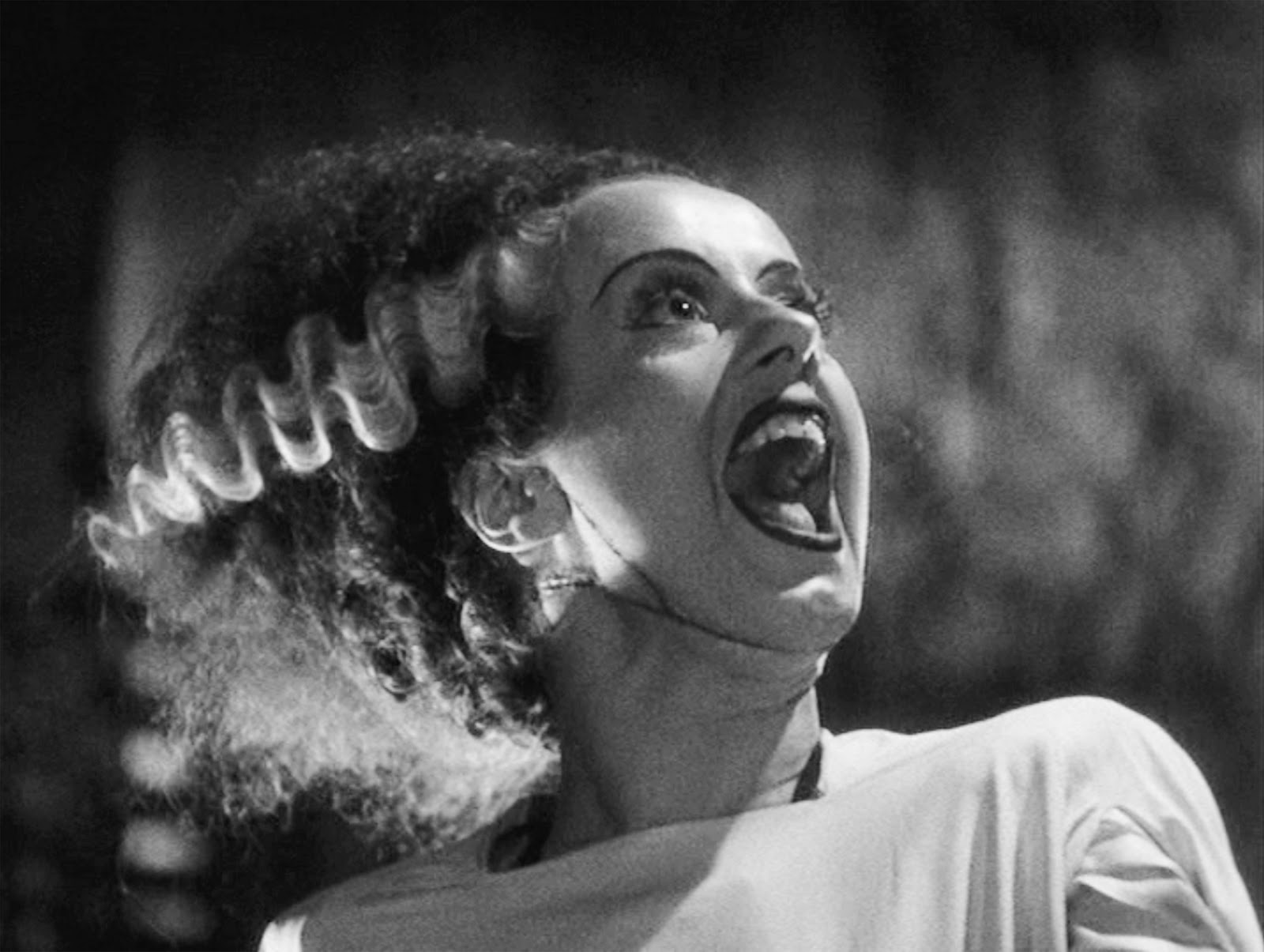
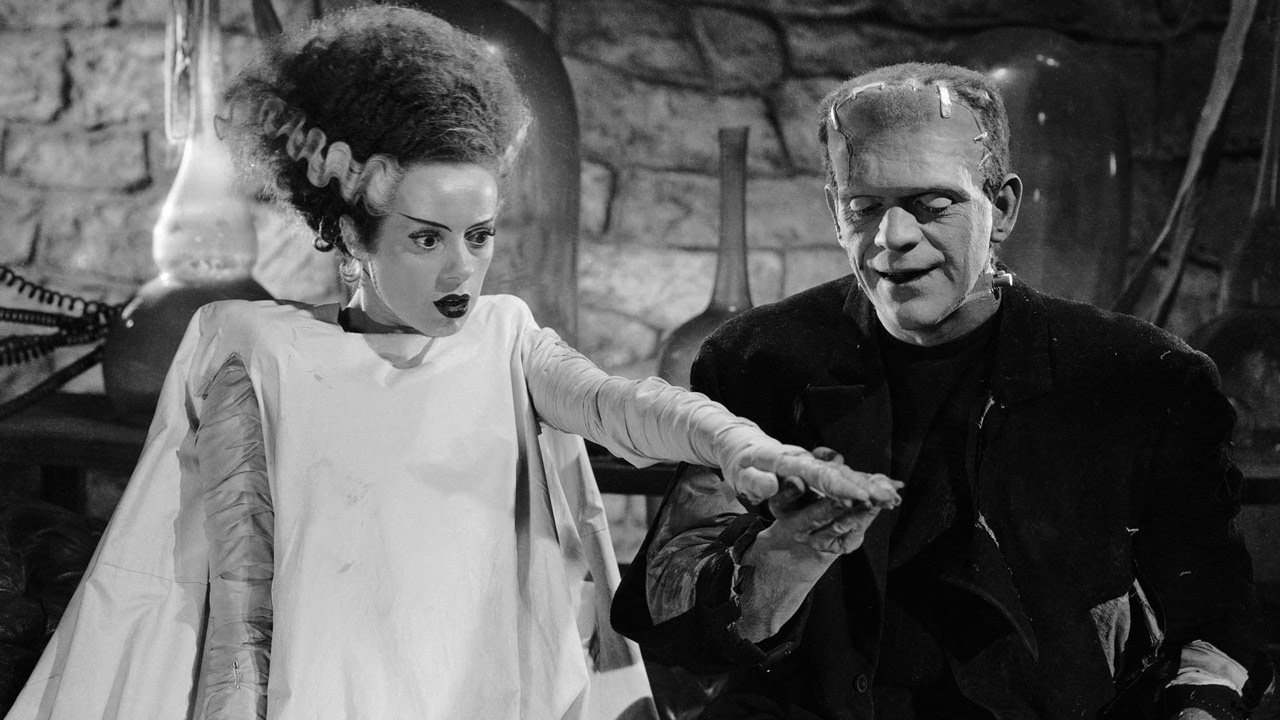
Iconic Elsa Lancaster scream in Bride of FrankensteinIt’s a ridiculous thing, art proselytizing. Who even cares? Bride of Frankenstein doesn’t. In fact, James Whale’s combination of navel-gazing puffery and honest retconned genius actively refuses to play along. That’s one of the reasons that it is one of the greatest films ever made.

4 years after the original made Boris Karloff a semi-star for portraying a walking collection of other people’s bodies, tortured and misunderstood for existing in a world that demanded his presence, Bride of Frankenstein appeared. As its title implies, the frame is shifted. In fact, even the now-constant “Frankenstein vs. Frankenstein’s Monster” goofballery gets lampooned: this is in a bunch of ways the story of a doctor, his wife, and a corrupting influence. (It comes as a surprise every time that Elsa Lancaster is hardly in this movie.) Everything comes in threes, like hetero couple and the intruder and their doppelgangers in the form of the Monster, His Bride, and the twinned men who would create them. Anyone expecting a regular monster film will be disappointed.

We open on another set of three: Lord Byron, Shelley, and Mary, adorably bickering and providing the occasion for a flashback, a sort of highlights reel of its predecessor, underscored with purple prose. It’s a costume comedy, pitched at a level of high camp. From its opening moments, Bride announces that we get something different, something almost hostile to the prevailing norm:

Lord Byron: And we three. We elegant three within. I should like to think that an irate Jehovah was pointing those arrows of lightning directly at my head. The unbowed head of George Gordon, Lord Byron. England’s greatest sinner. But I cannot flatter myself to that extent. Possibly those thunders are for our dear Shelley. Heavens applause for England’s greatest poet.

Percy Bysshe Shelley: What of my Mary?

Lord Byron: She’s an angel.

Mary Wollstonecraft Shelley: You think so?
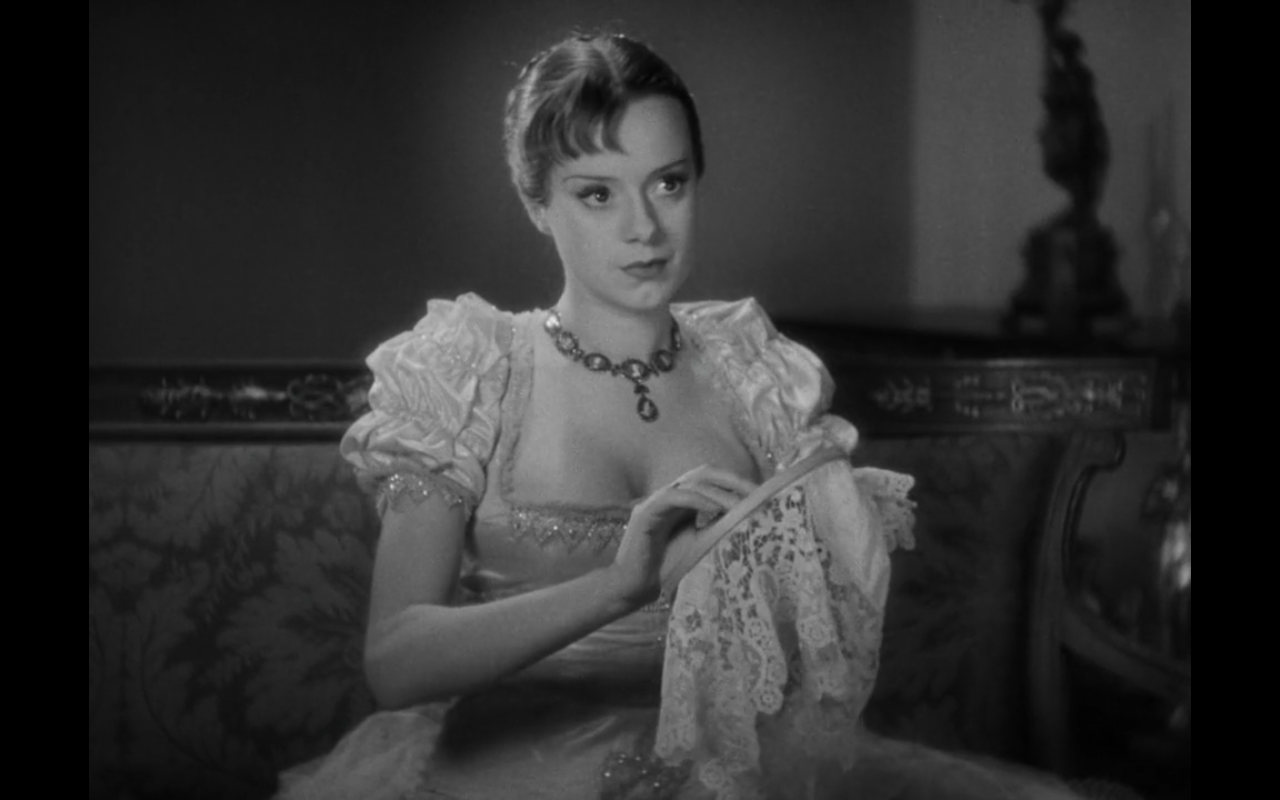
Elsa Lancaster as Mary Shelley in Bride of FrankensteinThe rest of the film echoes this sentiment. From an entirely incongruous opening we segue into a story about solidarity and difference, run through with as much skepticism about heteronormative coupling as God-like creation. If the first film, and Mary Shelley’s novel for that matter, are about the horrors of reproduction and responsibility, Bride is about the ways in which presumptions about our connection to others fail us, especially connections based in patriarchy. If Frankenstein will present a drowned child, Bride will feature a rescue from drowning. It is an inverse, a mirror-image reflected in broken glass.

Gary Morris, who Roger Ebert kind of sneers at in his review before allowing a few of the points, thinks it’s a queer parable. Many others have joined him over the years, and it’s not hard to see why. Bride showcases not just a monster who doesn’t fit in, but a whole range of them, up to and including the corpse-bride fashioned for him by madmen. Yet the happiest moment in the film is when he smokes cigars and drinks whiskey with a blind man.

The monster (Boris Karloff) can be seen as the terrifying “child” of the unholy “marriage” of Pretorius and Henry — Henry the father in giving it life, Pretorius a mother-figure who nurtures it. The monster is society’s paranoid vision of the logical outcome of a homosexual tryst. It is a child in many ways: inchoate, demanding affection and attention, unreasonable and violent when crossed. Like a child, too, his sexuality is unsettled, bisexual, his attentions captured equally by the male hermit and his possible female bride. Henry exhibits an overall revulsion toward his “child,” alternately excited and repulsed by what he has produced; Pretorius is the monster’s more involved, but manipulative, even abusive parent figure — the embodiment of society’s fears of the vast damage the homosexual, nefariously moving into the role of domestic caretaker, teacher of social values and sex-role attributes, is capable of doing.

All of which raises the question: who is this baffling weirdness even for? Fans of monster movies? Sure, and the extended Elsa Lancaster in Bride of Frankensteinshortlist: queers, freaks, people who don’t fit in, outliers, people skeptical of modern science’s ability to explain our pain, existentialists, revolutionaries, those who find white people in positions of power inherently suspicious, anyone who’s wanted to burn it down, anyone who’s wanted to know more than they do right now, anyone who’s known too much, cinephiles, James Whale enthusiasts, Karina Longworth,  Mel Brooks, rooftop architects, fans of Byron or either of the Shelleys, German Expressionism enthusiasts, violin players, suckers.

In short, weirdos.

Among the Universal monster cycle, Bride of Frankenstein stands alone, because it is guided by an authorial sense that’s bothDr. Pretorius and a homunculus in Bride of Frankenstein bemused by the material and in thrall to it. It’s a not-so-secret attack on conventional values, masquerading as a horror movie about a big dead guy and his big dead wife. It’s perfect. It is art.
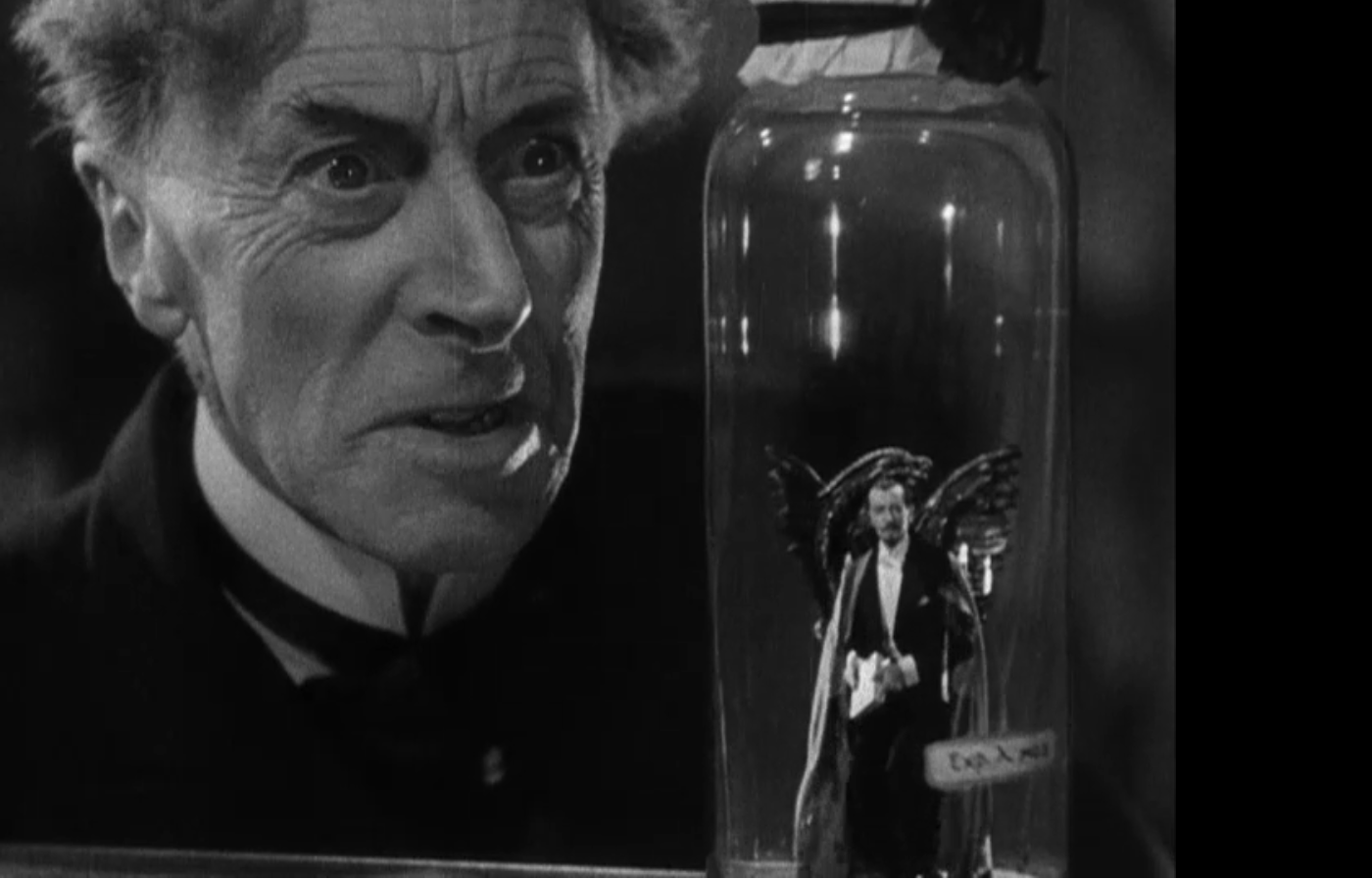
Also, Dr. Pretorius created a tiny royal family who he apparently just keeps in jars for some reason.

Why? I have no idea. Anyways, do y’all want to go watch Bride of Frankenstein?

Favorite Ebert quote:

The genre also encourages visual experimentation. From “The Cabinet of Dr. Caligari” (1919) onward, horror has been a cue for unexpected camera angles, hallucinatory architecture and frankly artificial sets. As mainstream movies have grown steadily more unimaginative and realistic in their visuals, horror has provided a lifeline back to the greater design freedom of the silent era. To see sensational “real” things is not the same as seeing the bizarre, the grotesque, the distorted and the fanciful. There is more sheer shock in a clawed hand unexpectedly emerging from the shadows than in all the effects of “Armageddon,” because “Armageddon” looks realistic and horror taunts us that reality is an illusion.



January 25, 2018 0 comments
0 FacebookTwitterPinterestEmail
Punisher still
CommentaryFilm

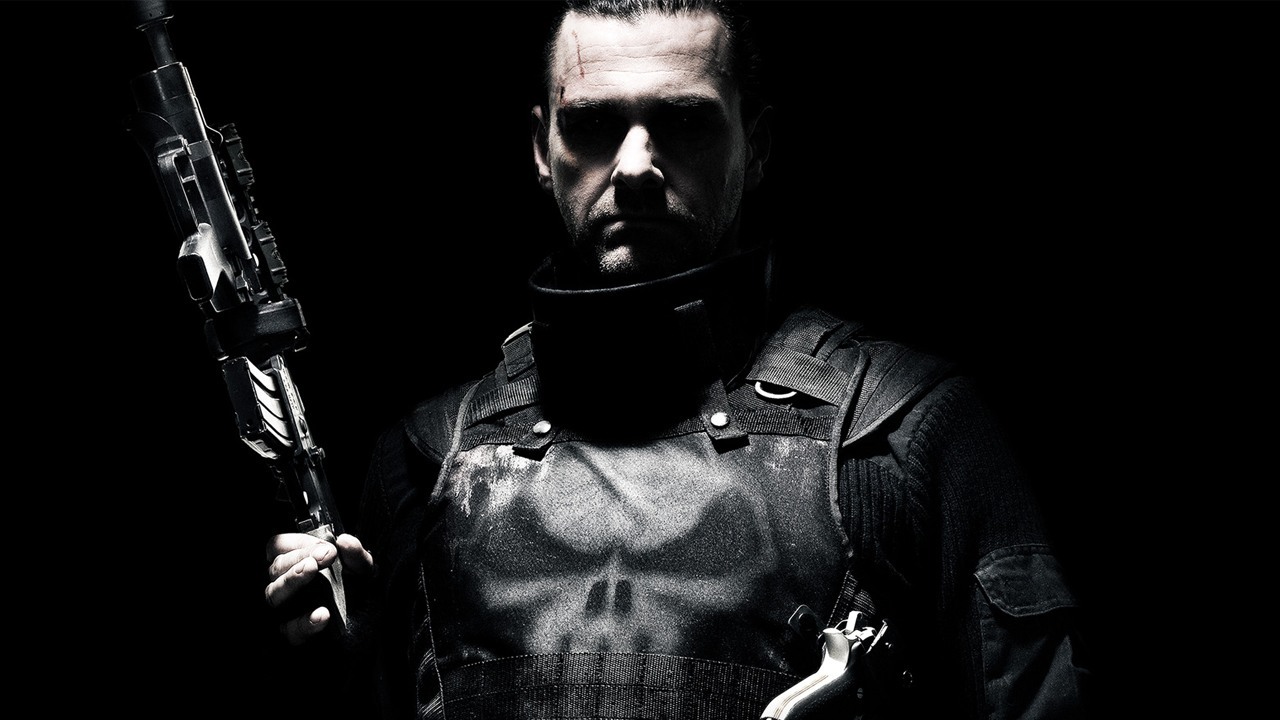
The Punisher reveals that images don’t define your politics

by Lark January 24, 2018
written by Lark

It’s difficult to base a piece on a Twitter conversation, particularly one you half-remember and which you refuse to look up. I don’t want to look it up because there was nothing particularly unique about this back-and-forth; it’s more useful as an example of a type than as something particularly awful.

In a thread about a major X-Men writer’s astonishingly stupid comments about the series, one fan responded (something to the effect of): “I hope he gets fired. Comic books aren’t for right wingers.” “Well, except for The Punisher,” someone else responded. “The Punisher isn’t for right-wingers. Frank Castle never makes anything better. If you think Castle’s the hero, you’re not paying attention.”

I’m not sure why this claim stuck in my mind. I suppose it might have been this: that while Frank Castle, a.k.a. The Punisher, has sometimes been depicted as the villain in the stories in which he appears — he certainly was when he first showed up in The Amazing Spider-Man in 1974 — he has undeniably been the star of a number of stories in which he is presented more or less favorably.

Punisher logoBut the artificial brevity Twitter forced on this reader made me wonder about their argument. Of course things never “get better” in The Punisher’s comics — he’s a superhero. Nothing ever “gets better” in Gotham or Metropolis, or in Peter Parker’s New York City. There’s no end-game for most superhero comics, and if there is one, it will get unwritten pretty soon.
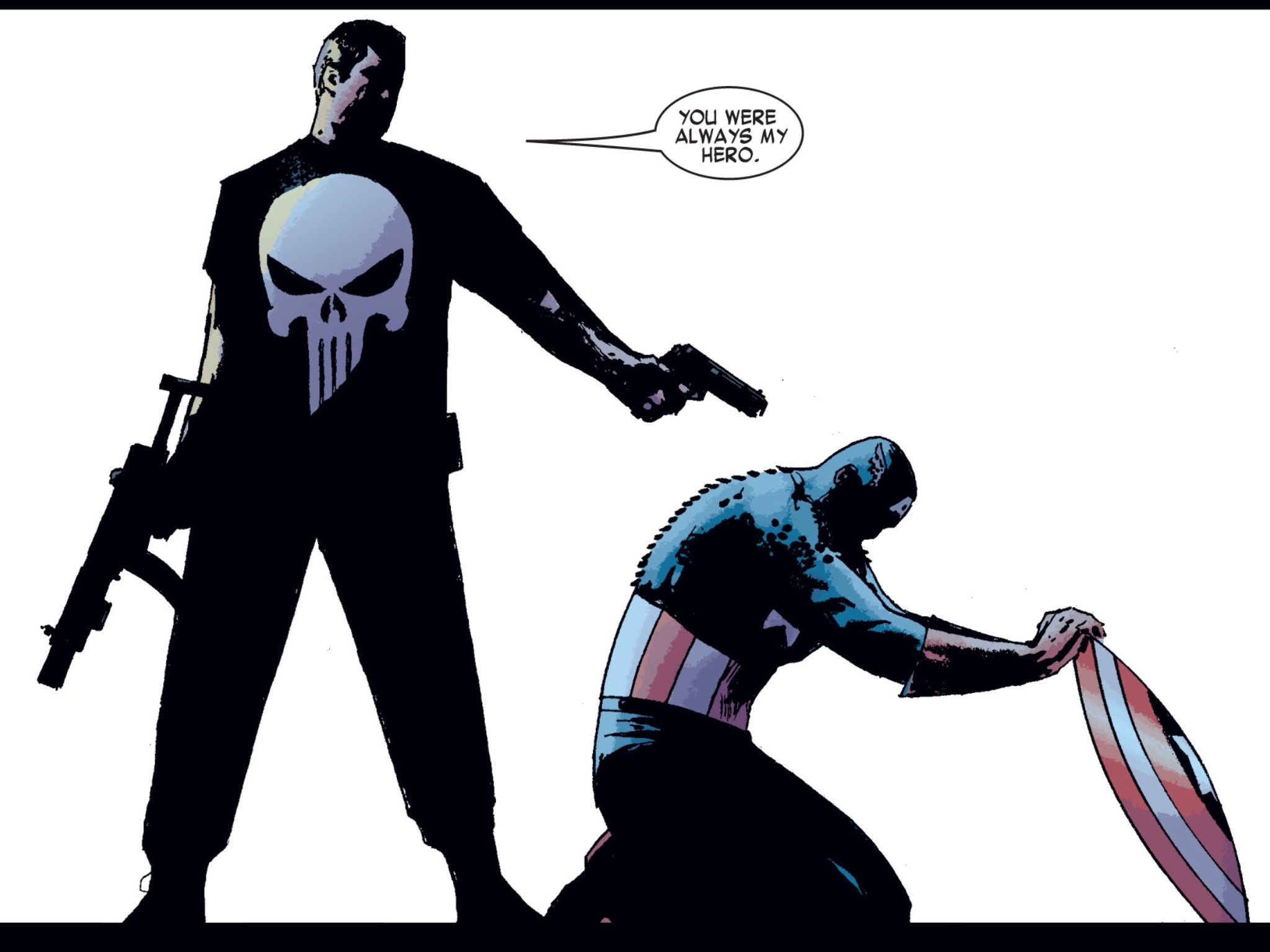
To use that to read The Punisher (and whatever comics have starred him over the years) as a liberal or leftist series is quite the bold move, and it made me realize that we, as the broader community of people who prattle about media on the Internet, seem to have a problem when it comes to talking about politics and media.

It seems to me that the current style of talking about this is an awkward hodgepodge of academic ideas that have been assembled together into a makeshift set of assumptions. Some of them aren’t too surprising — like the assumption that all forms of art, both high and low, are worth discussing. But when it comes to authorial presence and the meanings of a work, things get a little more complicated.

There’s an overwhelming desire, it seems, to draft pieces of media to one’s side, as all of superhero comics were to the left in this Twitter thread. (What about Steve Ditko’s explicitly Objectivist superhero Mr. A?) I’ve often seen this kind of drafting married to admonishment of those who don’t agree with it — that, in short, the liberal/leftist politics are there, and anyone who misses it is a “bad reader”. (This seems to come up a lot around YA fiction; I distinctly remember being called an incompetent reader for not appreciating the subtle anti-Maoist political nuances of The Hunger Games.)

But to position these works in this way, I often see artists making use of any and all forms of interpretation. To return to Punisher and Captain AmericaThe Punisher example: if the Twitterer was making the point that the way in which superheroes never seem to solve any real problems in the city and that every fantasy that things are OK falls apart at the start of the next issue ultimately means the work in question is left-leaning (by suggesting that something more fundamental needs to change than just another group of bank robbers being rounded up), then that is an interesting position worth exploring.
But how much can we say that’s the work being left-leaning? Wouldn’t it be truer to say that the form of serial superhero storytelling is left-leaning? And even that seems a shaky thing to say. After all, every issue (or arc or whatever) does end with everything fine, with families safe in their homes from muggers, with maybe a couple of homeless people helped out but nothing really different. Someone left-leaning may read that and recognize in it a phony, moribund stasis, and may then turn from it to see it in real life, but it’s hard to say the work itself passes along that meaning.

It’s this looseness of interpretation that seems to me to counterbalance the placing of art on teams, left- and right-leaning. This looseness is also borrowed from academia, mostly from a hazy recollection of the day in class Barthes’ “Death of the Author” (PDF) was assigned as required reading.

We end up with conflicting forces, then. On the one hand, we want to categorize art as conservative or liberal; on the other, we want to open up art to the free flow of interpretation, in which every reading is equally valid. We want to make all art worthy of serious discussion and analysis, but we want to rank them in terms of political alliance. And those political positions often end up replicating what we instinctively like and instinctively find boring.

I want to quote here a long but terrific section from a book by Christian Metz, The Imaginary Signifier (PDF). That Metz is so rarely read these days, even by those who consider themselves Lacanians, is rather tragic; even if his claims to scientificity are completely overblown, his articles are so filled with wonderful passages that manage to pin movie-lovers to their place like a lepidopterist pins butterflies. From page 11 of Imaginary Signifier:

Consider cinematic historians: they very often act—and this is not to be regretted, for without this cast of mind we should have no cinematic documentation—as real cinema archivists, the keepers of an imaginary archive, in the sense in which Malraux’s Museum was imaginary. Their wish is to save as many films as possible; not qua copies, qua celluloid, but the social memory of those films and hence a by no means unfavorable image of them. The history of cinema often presents the appearance of an easy-going theodicy, a vast Last Judgment where indulgence will be the rule. Its real aim is to annex to the category of ‘interesting’ (a suitably valorizing variant of that ‘notable’ as defined by Roland Barthes) the maximum number of tracks. To this end various and sometimes contradictory criteria are called on, in a disparate and gossipy gathering: one film is ‘retained’ for its aesthetic value, another as a sociological document, a third as a typical example of the bad films of a period, a fourth as a minor work of a major filmmaker, a fifth as a major work of a minor filmmaker, a further one owes its inscription in the catalogue to its place in a particular chronology (it is the first film shot with a certain type of lens, or else the last made in Tsarist Russia)… The true function of this accumulation of criteria practiced by many historians of the cinema is to mention as many films as possible… and then to multiply as often as can be the number of points of view from which a film may be felt to be ‘good’ in one respect or another.

It’s a long passage, but one I think about often. I don’t think anyone has ever described my tendencies better, or those of my movie-loving friends. (Malraux’s museum without walls he invokes here — a place like a museum where disparate objects can be compared by being placed next to each other (an African mask next to a Renaissance painting, for example), but one that encompasses everything (in other words, the world itself) — is what I often think of looking at Letterboxd, a place in which all film viewings are mathematically equivalent.

Other than being a great passage, it reminds me of those who want to “draft” movies politically. Again, we have a kind of lenient aesthetic Last Judgment, in which almost everything will be brought to the right side — one through explicit political leanings, one through implicit political leanings, one through the structure itself leaning left, or being able to be read leaning left, one by being so right-wing that it reveals the holes in right-wing ideology. Why are we assembling this mass? The reasons are multiple, and too complex to get into here.

The only point, I suppose, that I want to make is this: we all need to think much harder about what it means for a film to be “on our side”.

January 24, 2018 0 comments
1 FacebookTwitterPinterestEmail
Kiefer Sutherland in Dark City
CommentaryFilm

Fake Worlds, Dark City

by Lark January 23, 2018
written by Lark

In 1998, two movies were released: The Truman Show and Dark City. Although they both revolved around a protagonist who realizes the city in which he lives is “fake” — an elaborate form of reality television in the former, an alien sociology experiment in the latter — they don’t seem too similar on their own.

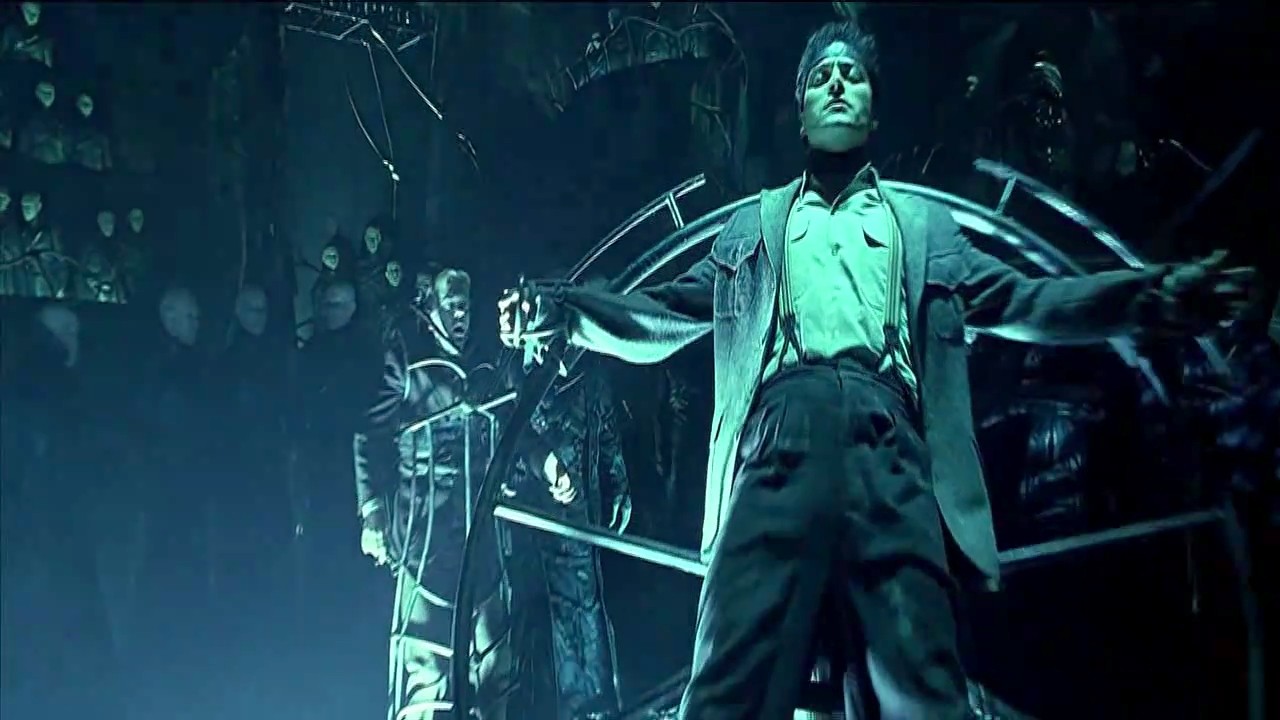
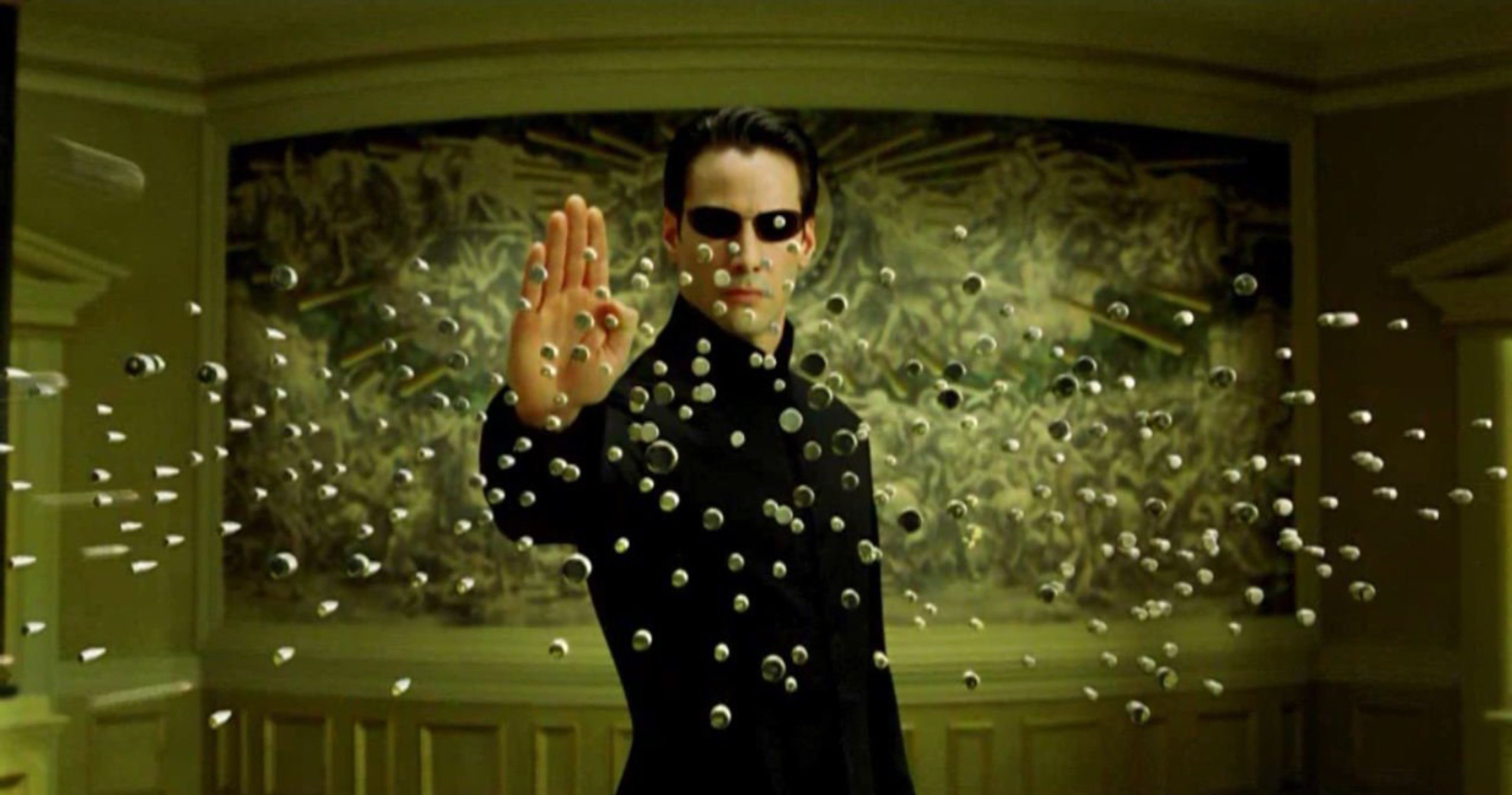
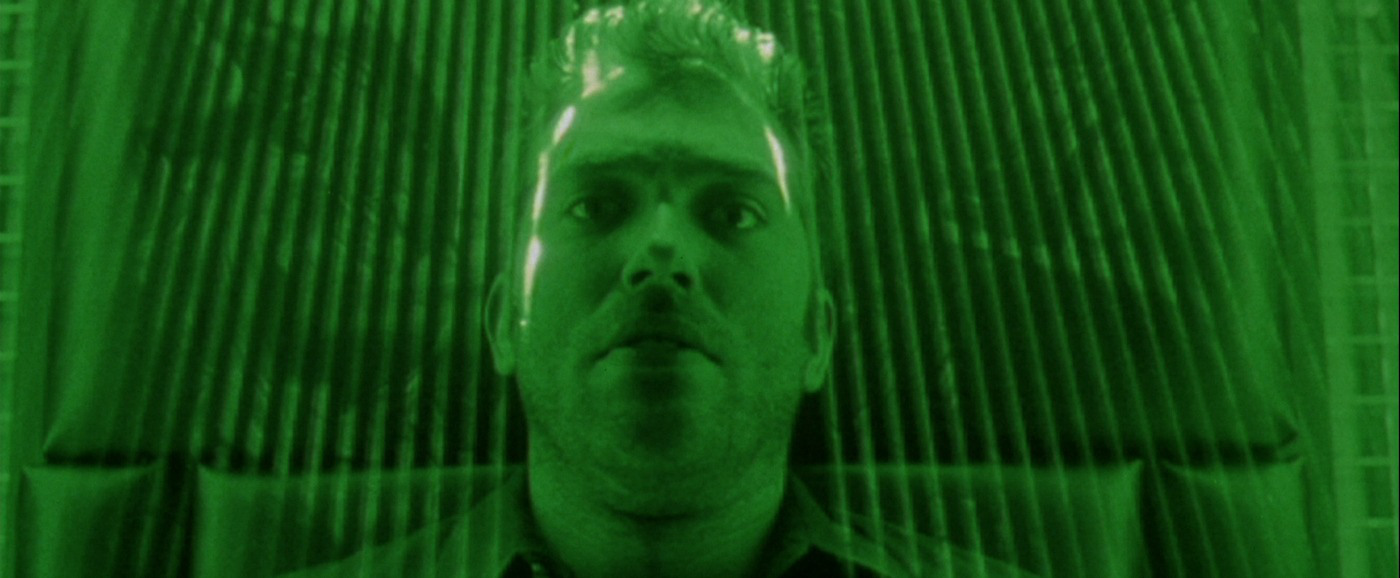
Keanu Reeves in The Matrix13th FloorBut in 1999, three more movies were released: eXistenZ, The Thirteenth Floor, and The Matrix. All 3 movies had an extremely similar plot, in which the protagonist realizes that the world they live in is “fake”; they all, in fact, took it further to reveal that the world is a computer simulation.
This means that in 15 months, 5 different movies came out with the basic premise of the world being fake. (Dark City was released on February 27, 1998; The Matrix was released on May 28, 1999.)

Why? There is certainly an element of chance operating in the intense concentration — as much of a materialist as I am, I’m not suggesting that something was special about those 2 particular years that made this happen — but it certainly is something worth examining.

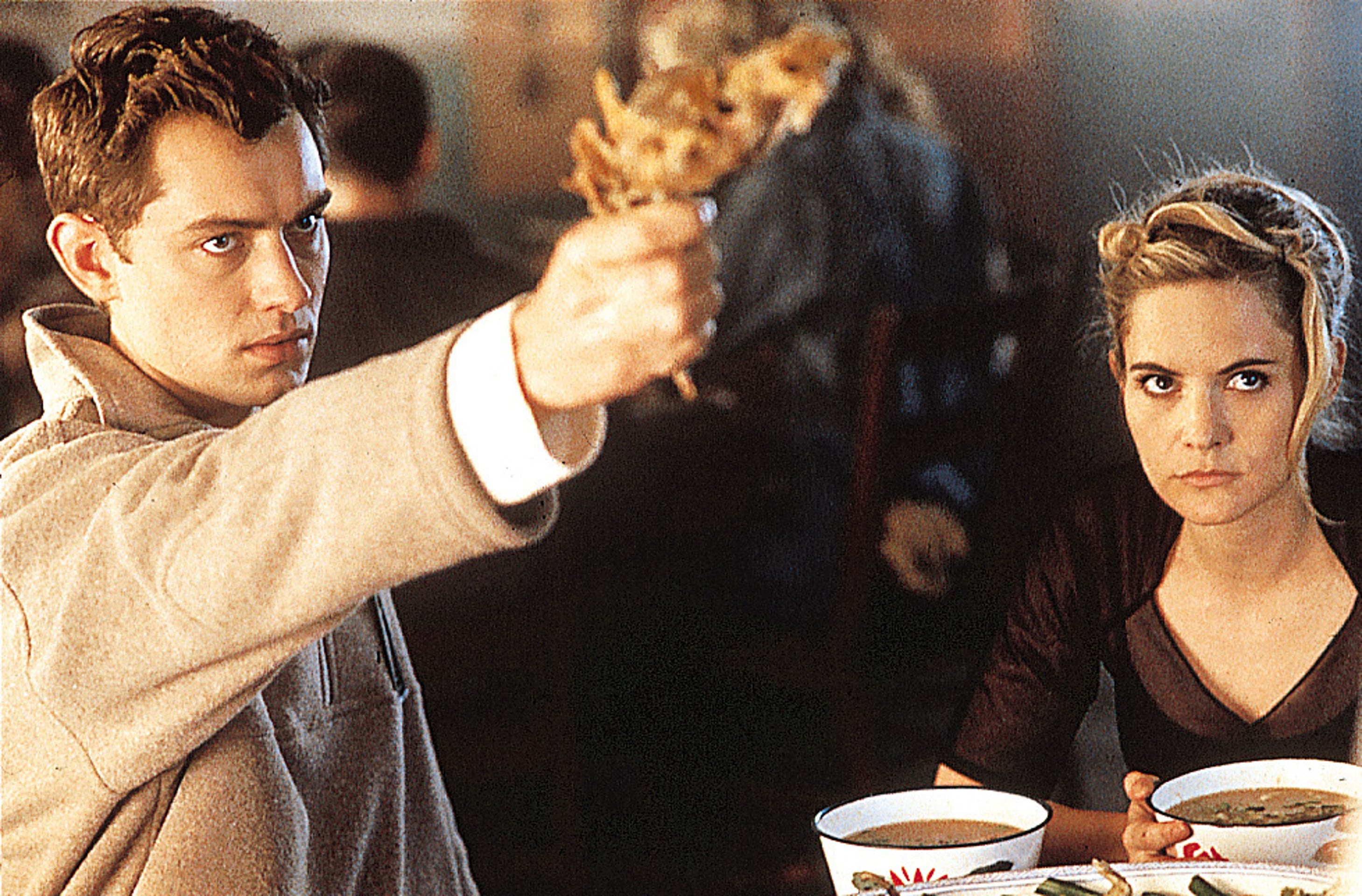
Jude Law and Jennifer Jason Leigh in eXistenZFassbinder's World on a WireThe 3 computer-reality films could be explained by the development of computers, but I don’t think it’s so simple. First, that doesn’t explain The Truman Show or Dark City, which are unrelated to computers. Second, the source material for The Thirteenth Floor (the novel Simulacron-3) was released all the way back in 1964 (Rainer Werner Fassbinder, of all people, adapted it for German TV as World on a Wire in 1973), and that was hardly the first story of its kind. And third, 1990s computers were not much closer to computer-simulated consciousnesses than we are now.
I’ll be upfront about this: I have no idea why these films came out at this point in time. These pieces are more of a sketchbook towards a theory about them than anything final. With no further ado, let’s talk about Dark City.

—

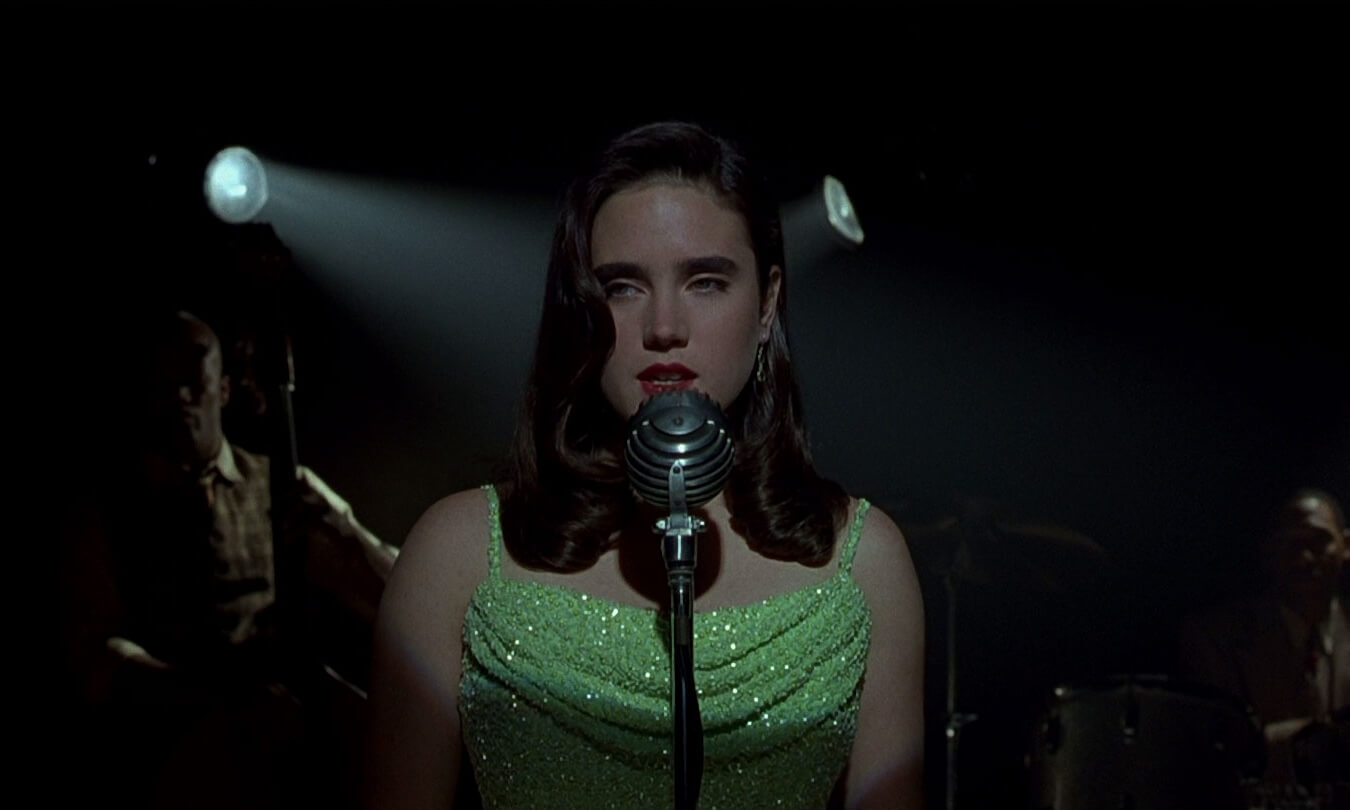
Nothing dates Dark City like its attempts to be timeless. In an attempt to confuse the viewer, the titular city freely mixes a number of temporal markers, but the backbone is noir time, that ambiguous superimposition of the 1930s onto the 1950s. That aesthetic, however, is reflected through a distinctly 1990s lens, a distortion nowhere more visible than the scenes set in the bar in which Jennifer Connelly, a jazz club singer, works.

Jennifer Connelly singing in Dark CityEven by the standards of neo-noir jazz, which is itself a more recent invention — the number of original noirs that have prominently jazz soundtracks can be counted on both hands — this sounds nothing like the period it is trying to evoke.

This isn’t to knock the movie for being of its time — everything is, if we’re honest — but to try to situate its gestures. Kiefer Sutherland’s bizarre performance more than any other can help us decipher what is happening with the free temporal borrowing. He plays his character (named Daniel Schreber, an unsubtle reference to the 19th century German judge who wrote Memoirs of My Nervous Illness from a mental institution suffering from paranoid schizophrenia) as a slightly more goyish version of Peter Lorre’s Ugarte, pausing every few words to suck air in.

It’s a next-level insane performance, almost entirely tick. It begins to make more sense once it is revealed that he is a Quisling for the pale, bald creatures who run the city and who are falsifying everyone’s memories. As a former psychiatrist he is apparently particularly gifted at synthesizing fake memories in a lab.

Green goo memories in Dark CitySynthesizing is very literal here. In one incredibly silly scene, Sutherland looks through a microscope at science-y looking blobs and literally mixes memories together. “A touch of unhappy childhood,” he says,  “good. Ah, a dash of teenage rebellion… and last, but not least, a tragic death in the family.”  A death in the family is represented, of course, by green goo.
I wish to briefly be unfair to this movie. As a teenager, I wasn’t really aware of the time period from which the movie was drawing; honestly, it just looked cool. But rewatching it now, it is hard not to think about the repercussions of relying so heavily on a 1930s German expressionist aesthetic. We don’t have to directly compare the appearance of anti-Semitic caricatures to the evil aliens who run the city to notice some similarities in their function.

The parasitic aliens are both parasites on the city and the city’s creators. They are both invincible and impotent — our hero ends up vanquishing them all without much effort. They’re the definition of the fascist’s target, as Eco describes it: so invincible they must be destroyed for our own safety, and so pathetic they should be destroyed for their own good. They are responsible for all the corruption present in human — meaning European white — culture, trying to turn the hero subconsciously into a serial killer of prostitutes as a sociological experiment. They are, in short, the furthest point of the Other-figure.

I’m not saying that this is a fascist movie, whatever that might mean, but in making use of the 1930s German milieu Dark City has replicated the basic ideas that make it such a fascinating moment in film history. By putting this in the context of the “fake world” idea, it reveals something about the fantasy of the 1930s — and the 1990s.

January 23, 2018 0 comments
2 FacebookTwitterPinterestEmail
Liam Neeson at far end of train in The Commuter
FilmReviews

High Stakes on a Train in The Commuter

by rick January 22, 2018
written by rick

The latest offering from genre auteur Jaume Collet-Serra and his hangdog, improbably athletic muse Liam Neeson may not be a great work of art, but, like its predecessors Non-Stop and Unknown, it’s compulsively watchable, even fascinating, and guided by a directorial sense that seems excessive for the material. (To say nothing of the Neeson-less The Shallows, which found a way to make a 200-yard swim a marvel of compact storytelling.) Plus, however absurd its narrative resolution, The Commuter also has the added benefit of not turning out to hinge on GMO corn politics, always a good thing.

Like those earlier Collet-Serra/Neeson collaborations, The Commuter focuses on a blank slate of a working man, beset on all sides by a conspiracy that’s singled him out for specific reasons. (Yes, we are asked to believe that our commuter is a paragon of the beleaguered American working man, despite possessing cat-like reflexes, a certain set of skills, and rising 10 feet tall even when stooping, but bear with me.)

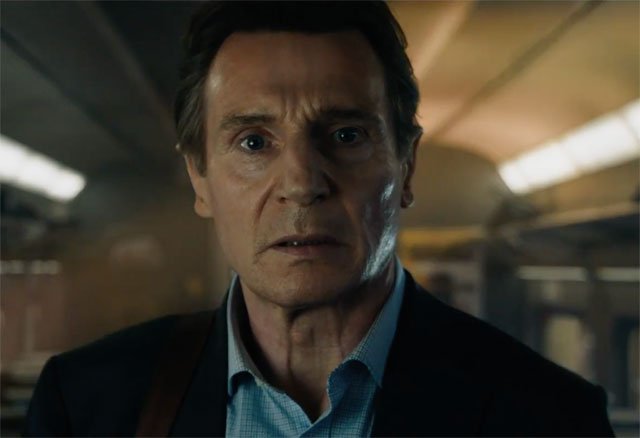
Liam Neeson close-up in The CommuterHere, Neeson is a former cop who’s given up that dangerous line of work (police work in the movies is, by definition, dangerous) for the almost too on-the-nose banal safety of selling life insurance. Interestingly, we only see Neeson try to sell life insurance once, and he doesn’t seem great at it, and then he gets fired, so perhaps that career move wasn’t so wise after all.
In The Commuter‘s opening moments, Collet-Serra gives us a cross-faded montage of Neeson’s mornings: a radio alarm clock tuned to news that no life insurance salesman needs, coffee, friendly chats with his college-bound son, a ride to the train from his wife. Shades open up in the narrative: we witness something like contentment bleeding into frustrated boredom, with financial problems on the horizon and quiet apologies contrasted with years-earlier marital bliss. His life seems a ghostly routine, with hints dropped that a break is due.

That break comes first in the mundane form of his lay-off, and then in more pointed fashion on his ride home after a few drinks at the bar. The lay-off itself signals that The Commuter is up to something different than, say, the invulnerable, queasy patriarchy of the Taken series: Neeson is outmoded the demands of the contemporary American workplace, vulnerable precisely because he’s played by the rules. (His much younger boss calls him “a good soldier” and laments that capitalism has no place anymore for his version of nobility.)

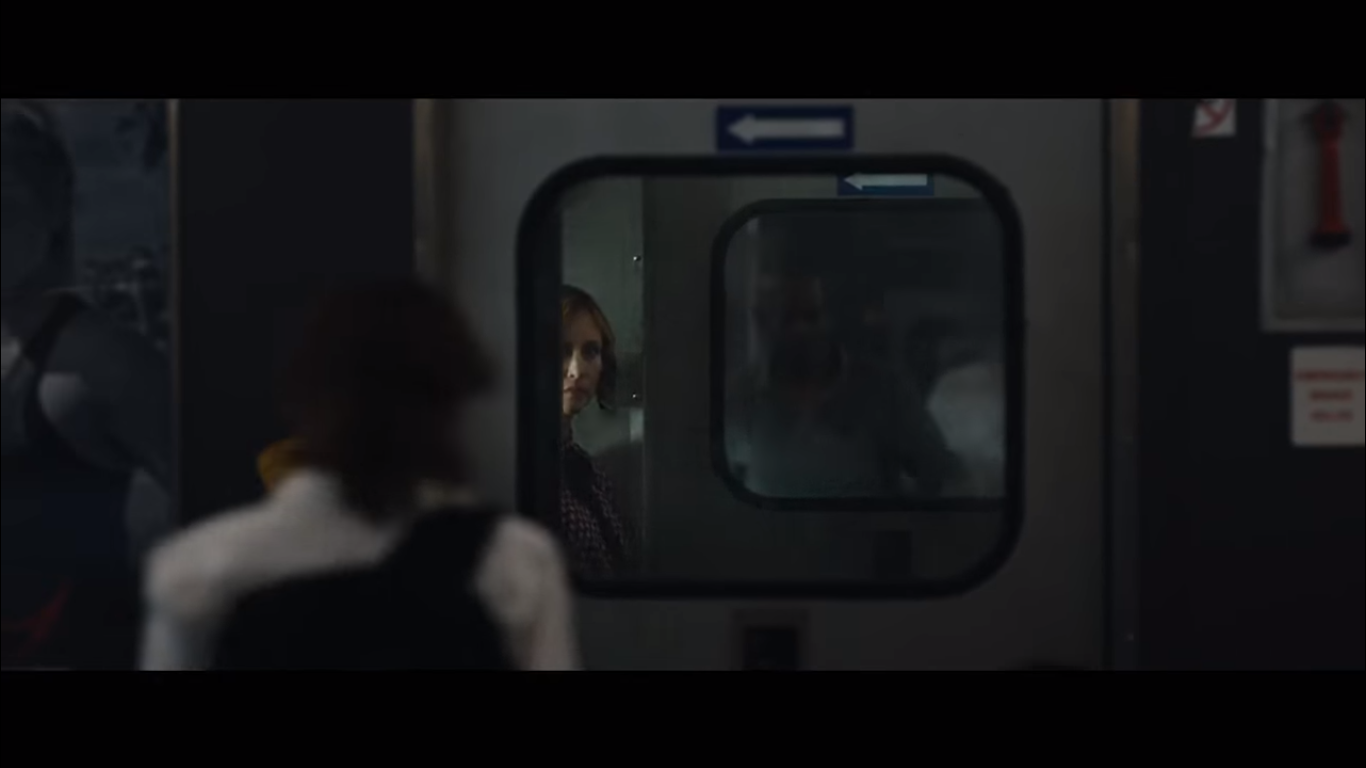
When he meets the mysterious, God-like “Joanna” (Vera Farmiga) on the ride back and she offers him a cool $100K,Half-obscured Vera Farmiga in The Commuter “hypothetically,” to find the person on the train who “does not belong,” it seems both a dubious answer to his financial woes and the kind of plot device that compels us to look closer. In an overt retread of The Box, all he has to do is choose whether to play or not; something will befall a stranger, and then it will be over. When he discovers that this is not a hypothetical, that his family is in jeopardy if he doesn’t comply with these imperatives mysteriously issued from on high, we remember we are in a Liam Neeson movie. He may be a swatted-down victim of the times, but he’s also both cop and actuary, skills he will need to deploy to save any number of lives on the train and at home.

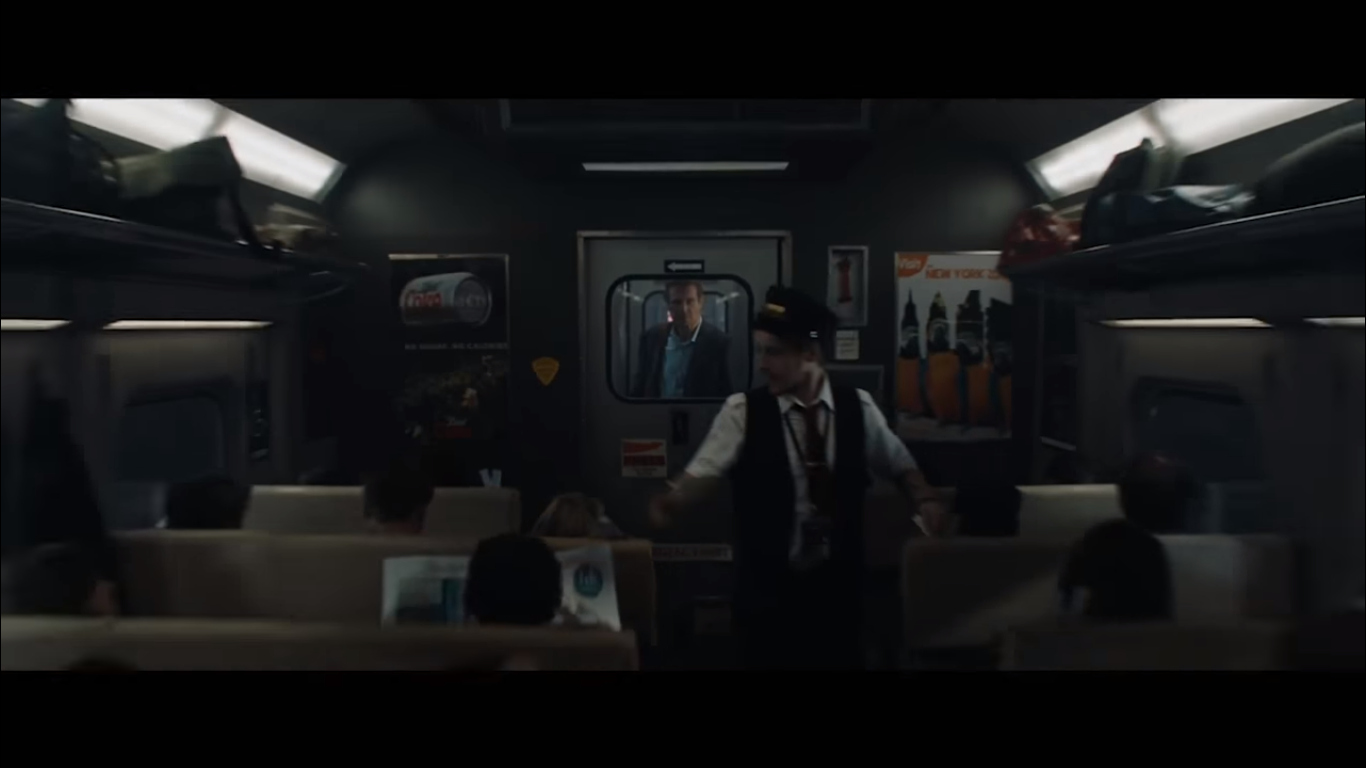
Screeching train in The CommuterThe train, of course, is the ideal setting for this sort of affair. I’m a sucker for a good train movie — hell, I am a sucker for a bad train movie — and The Commuter leans into it. Neeson has a set of clues to go by as he determines who this person is, and also why he’s been targeted in the first place to play this opaque role. The train allows for both close confines inside and wide spaces seen from above, stillness amid velocity, and the introduction of characters both relevant and superfluous. It’s a classical trick deployed for genre reasons, and The Commuter is at its best when the contrasts are at their fullest: a douchebag investment banker for Neeson to bristle at on behalf of the middle class, the crouched figures hiding behind stationary chairs as the train speeds on, the barely-visible, half-reflected faces of ominous antagonists amid the crowd. As in Non-Stop, Collet-Serra relishes the visual and narrative possibilities. 
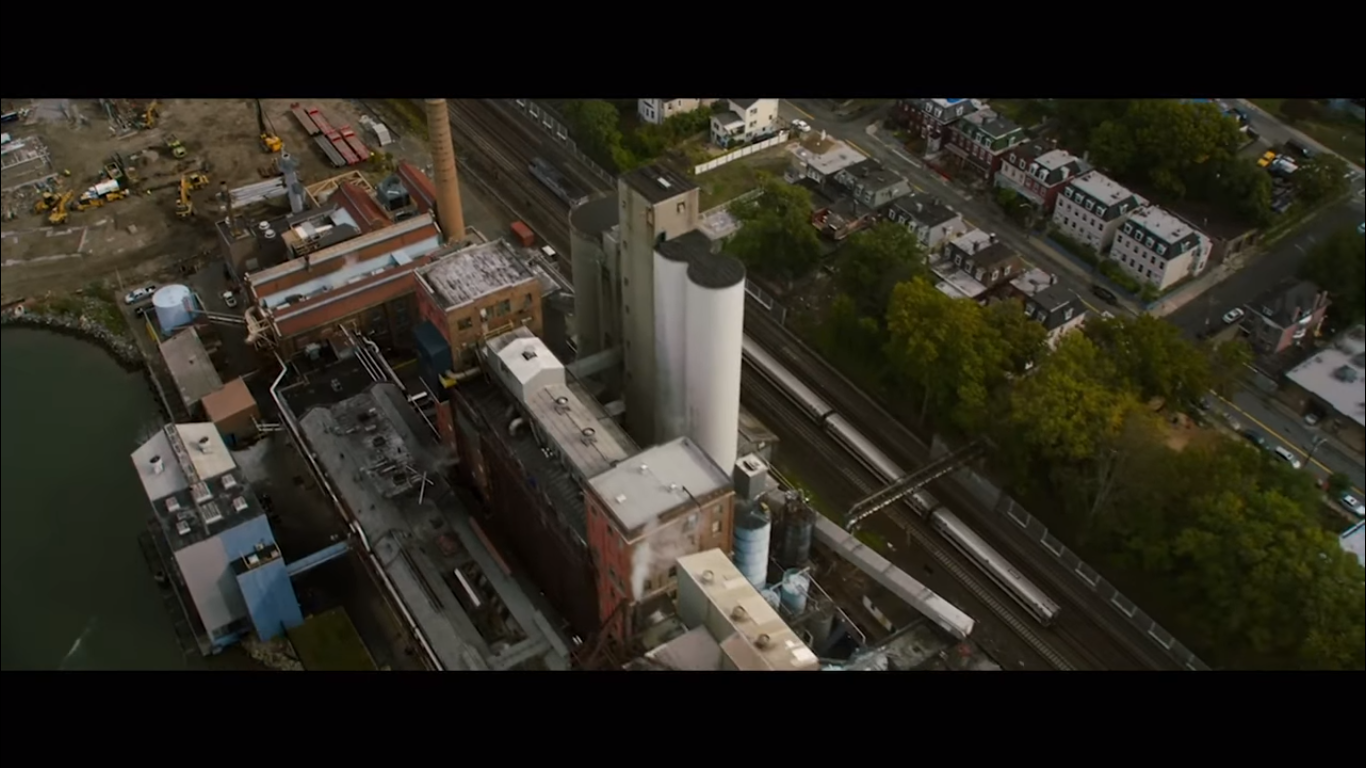
Aerial view of train in The CommuterBy the time the ride is through, The Commuter will have run through any number of possible resolutions, like an insurance salesman crunching numbers. The appearances of a bearded Sam Neill and fellow cop Patrick Wilson (who, along with Farmiga, distractingly implies this might turn out to be a secret Conjuring sequel) complicate matters for our commuter. A guy gets smashed in the face with an electric guitar. So forth.

In its closing moments, The Commuter resolves so neatly that the effect is comic. Collet-Serra seems to smirk before the credits roll, it’s so over the top. Which does raise the question, here, of how seriously we should take material the film itself finds farcical, and also, retroactively, how much I should fault the corn stuff in his previous outing. Popcorn entertainment, indeed.

Despite that, or maybe because of it, The Commuter works on several levels — as a deconstruction of the hero, a tweak on the genre, a train movie, a jerky-cam action thingababobber, and a comedy. There is a “Spartacus moment” that led to actual applause from my fellow moviegoers, and knowing applause at that — “oh my god,” followed immediately by laughter and appreciation. The ludicrousness isn’t an accident, and it’s not nearly as stupid as it first appears. (Ok, it’s still pretty stupid, but a particular kind of stupid.)

Collet-Serra’s high-velocity, high-stakes room escape narratives are rooted in almost existential treatments of individual choice, which ground them in something unusually gripping for movies that also include a Jason Bourne-like 60 year old almost being crushed by the falling debris of his own dilemma. The Commuter is much smarter than it needs to be for something so dumb.

January 22, 2018 0 comments
1 FacebookTwitterPinterestEmail
Walls closing in on Richard Widmark in Night and the City
CommentaryFilmStreaming Selections

Streaming Selections: Night and the City

by Sam and Rick January 20, 2018
written by Sam and Rick

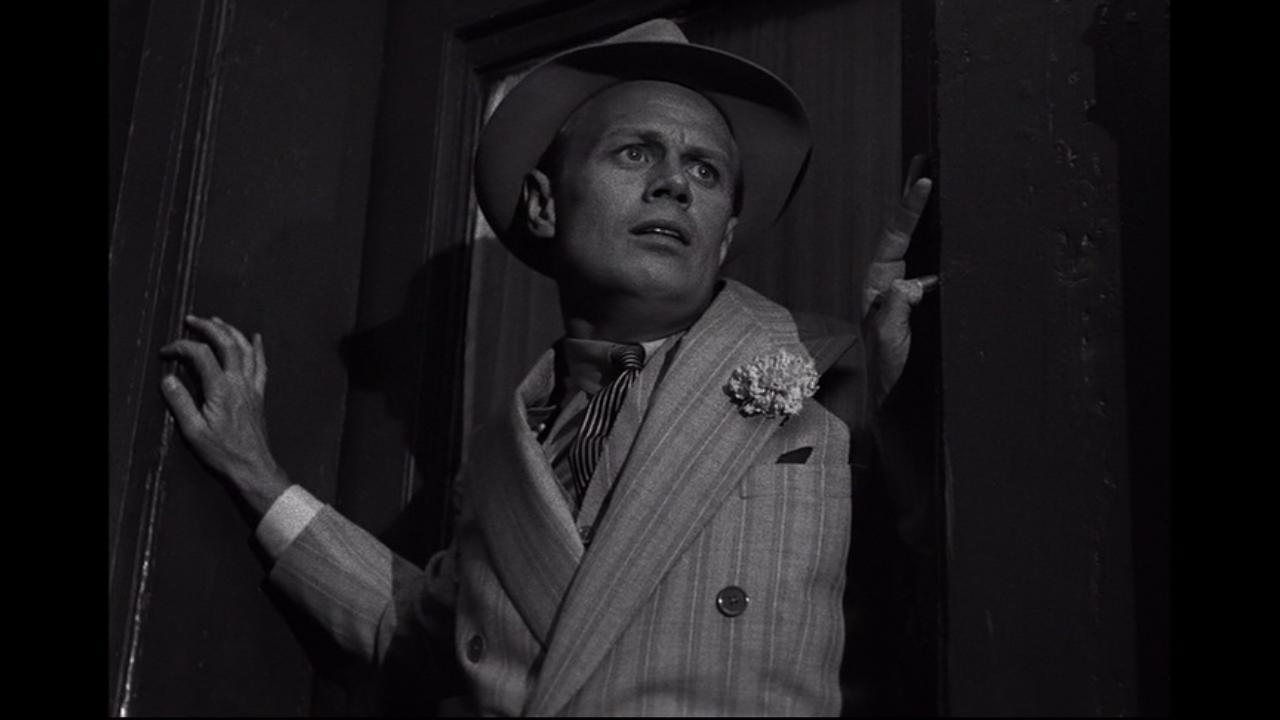
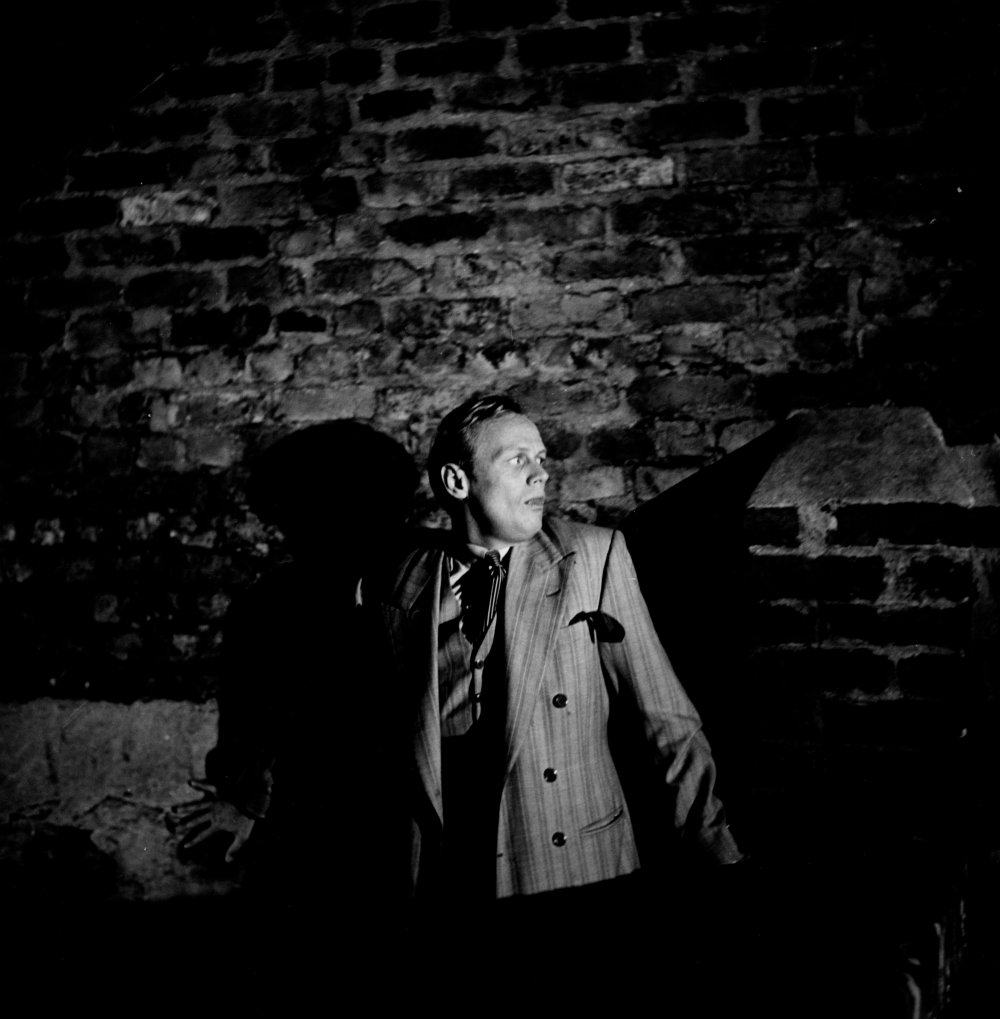
In some ways, Jules Dassin’s Night and the City (1950) is an unlikely noir, which (along with an icy reception at the time from critics) might help explain why it’s not the first example of the genre that springs to mind — no femme fatale, no particular mystery, no play-by-play heist gone wrong, a curious fixation on wrestling, of all things. (The latter seems something of a Dassin trademark.)Richard Widmark in Night and the City

In others, though, Night and the City is paradigmatic, as Nick Schrager notes, in its “fundamental gloominess and urbanity … the inevitably cataclysmic end for its enterprising protagonist” who “commits noir’s cardinal sin by striving to better his lot in life.” Dassin, blacklisted and exiled from Hollywood at the time, presents a grimy, half-lit London full of born losers, fixed fights, and schemes that seem obviously destined to fail before they start. It’s as dark a vision as noir could present, even without the typical noir trappings.

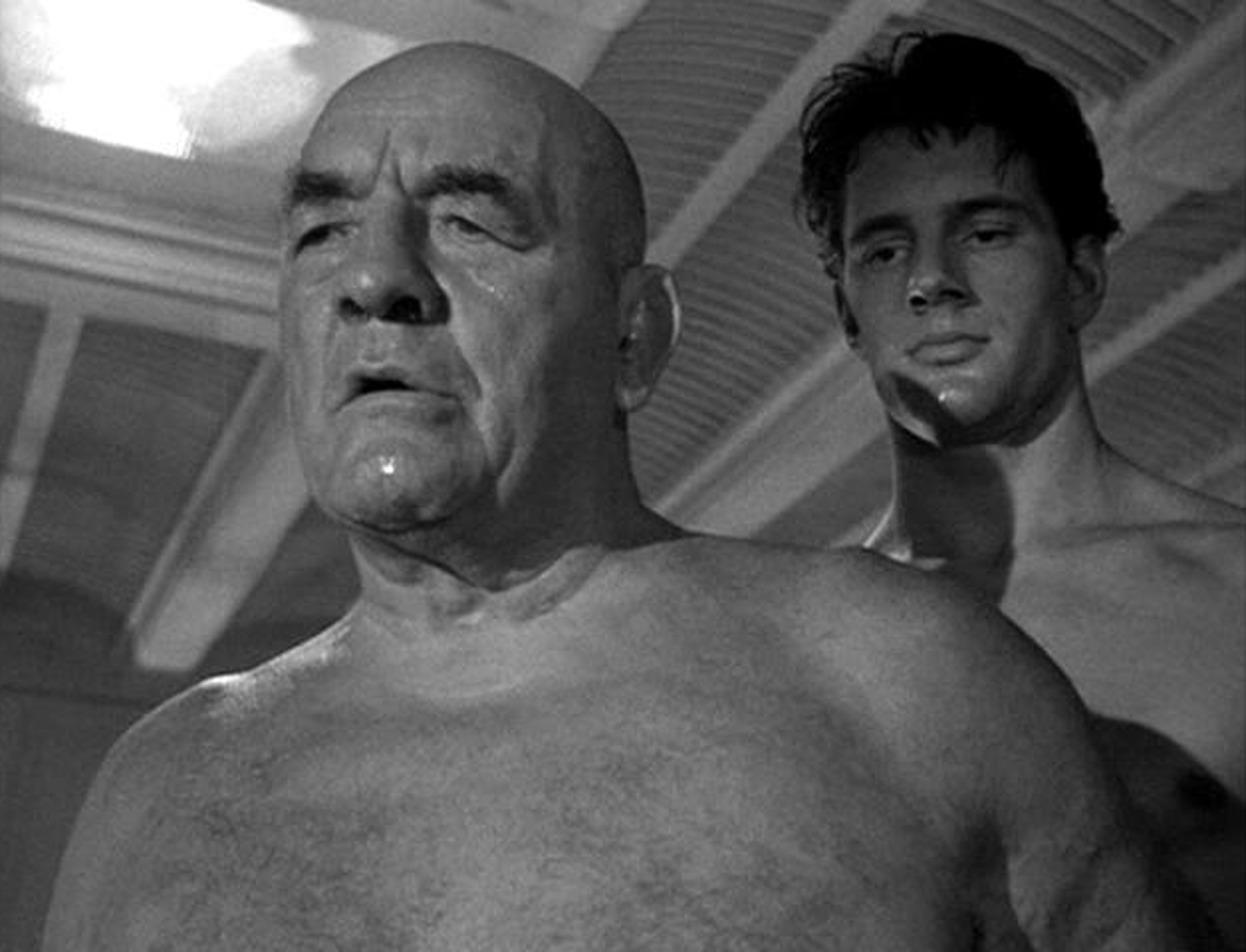
As with so many of these narratives, the plot hardly matters. Low-level con-man Fabian (Richard Widmark) wants to corner the apparently lucrative wrestling promotion market, and makes bad decision after bad decision to this end. He lies, cheats and steals his way to a watery death in the Thames, but not before betraying pretty much everyone he meets. The end. That perpetual curmudgeon Bosley Crowther dismisssed Night and the City as a “pointless, trashy yarn,” a “turgid pictorial Wrestlers in Night and the Citygrotesque” with “only one character in it for whom a decent, respectable person can give a hoot,” comes as no surprise. Night and the City is angry through and through, not least at the pointlessness of its characters efforts to ever come out on top.
Wrestling seems to be an apt metaphor for that pointlessness, it turns out, and the title neatly captures all that’s left after the clock runs out. Night and the City is pessimistic stuff, enamored with Wellesian angles and deployed with scorn. It should be remembered as one of the genre’s best.

(Rick – Streaming on Filmstruck, along with Dassin’s Thieves Highway from the prior year)

Quick Links

The Box

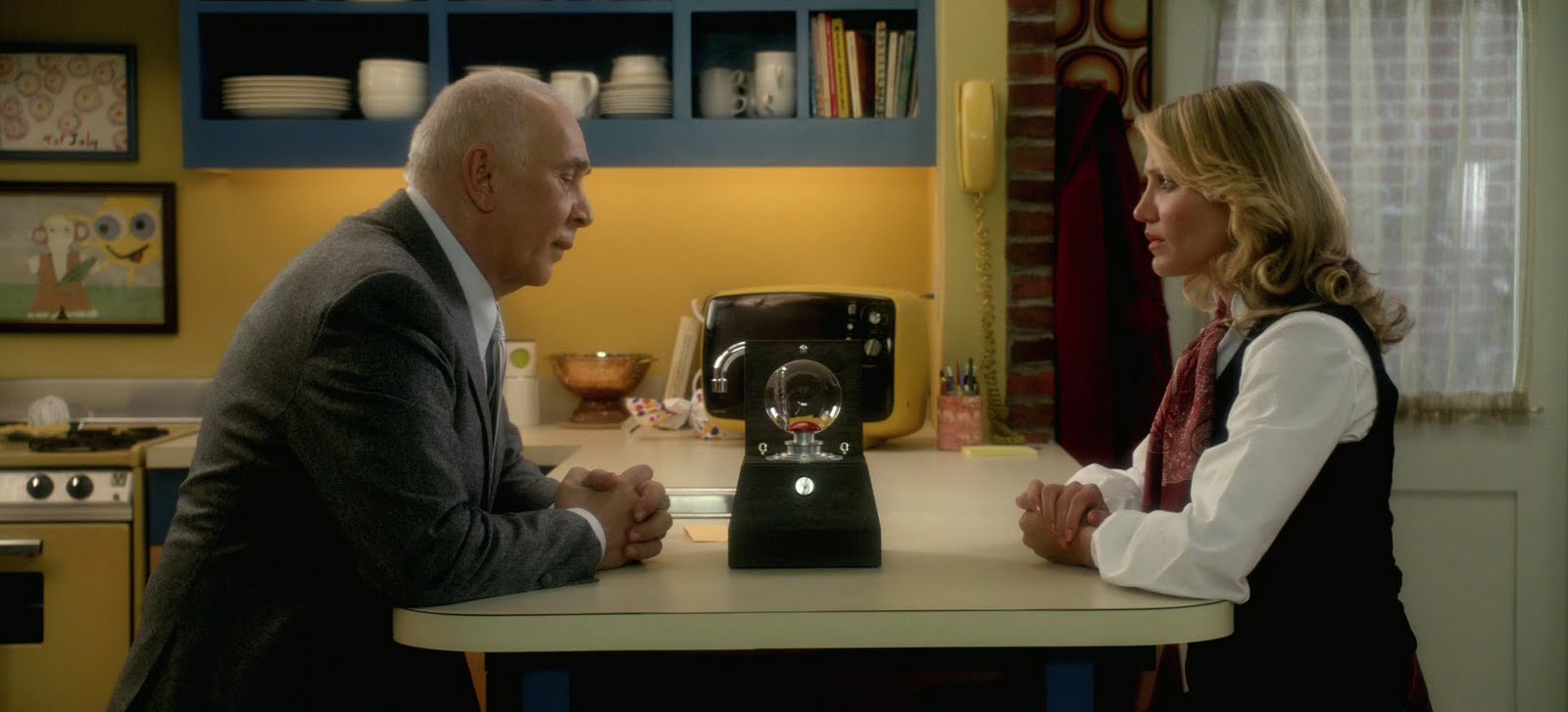
Frank Langella and Cameron Diaz in The Box

Neither as adolescently navel-gazing as fan favorite Donnie Darko or as out-and-out bananas as not-quite-cult-classic Southland Tales, Richard Kelly’s riff on No Exit by way of the Stanford Prison Experiment was his bid for respectability.

It didn’t quite work out that way, and The Box doesn’t entirely work on its own terms, but it’s still a fascinating failure, and probably the best deployment of magic lightning people I can think of offhand.

(Rick – Streaming on HBO)

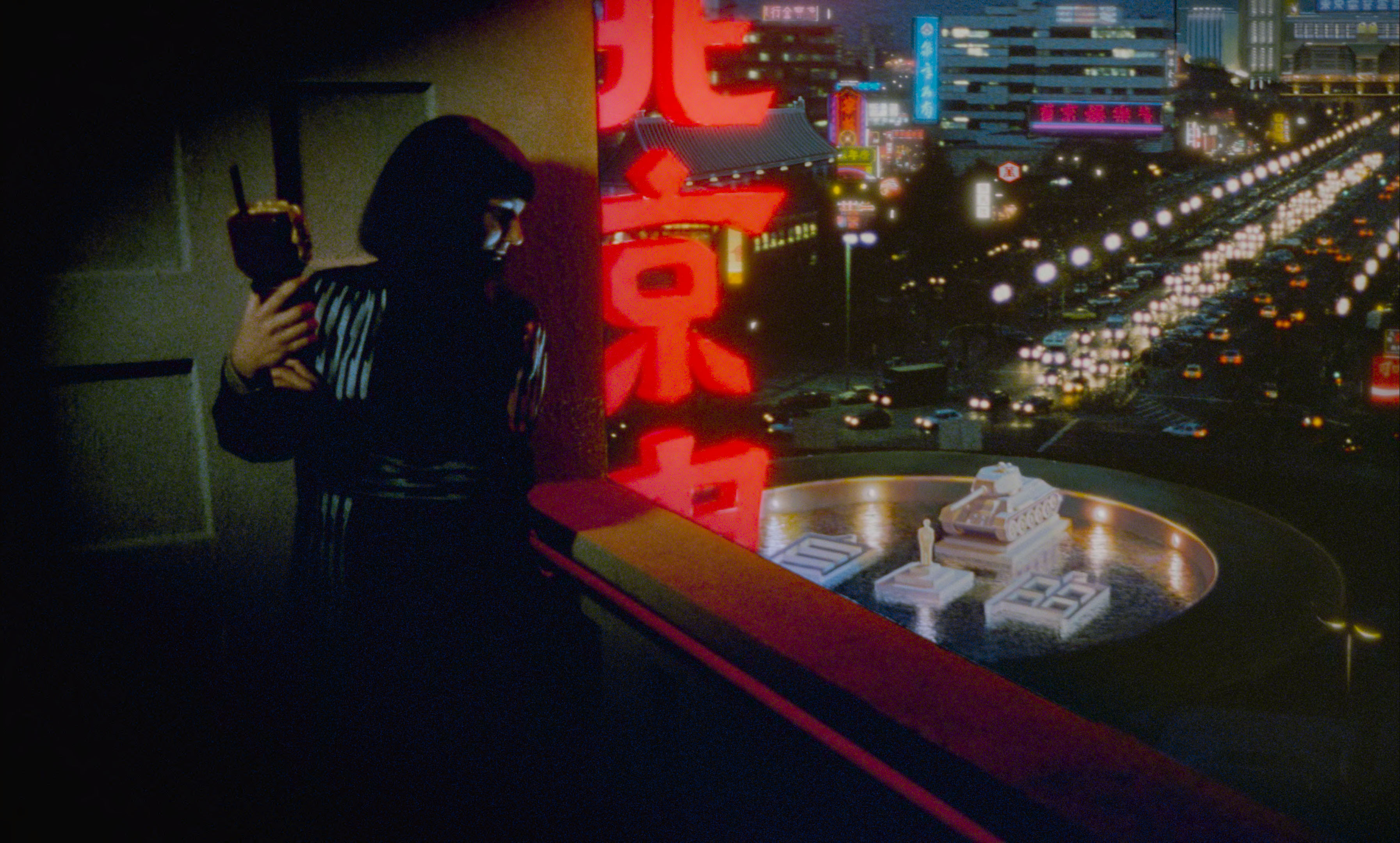
Ghost in the Shell

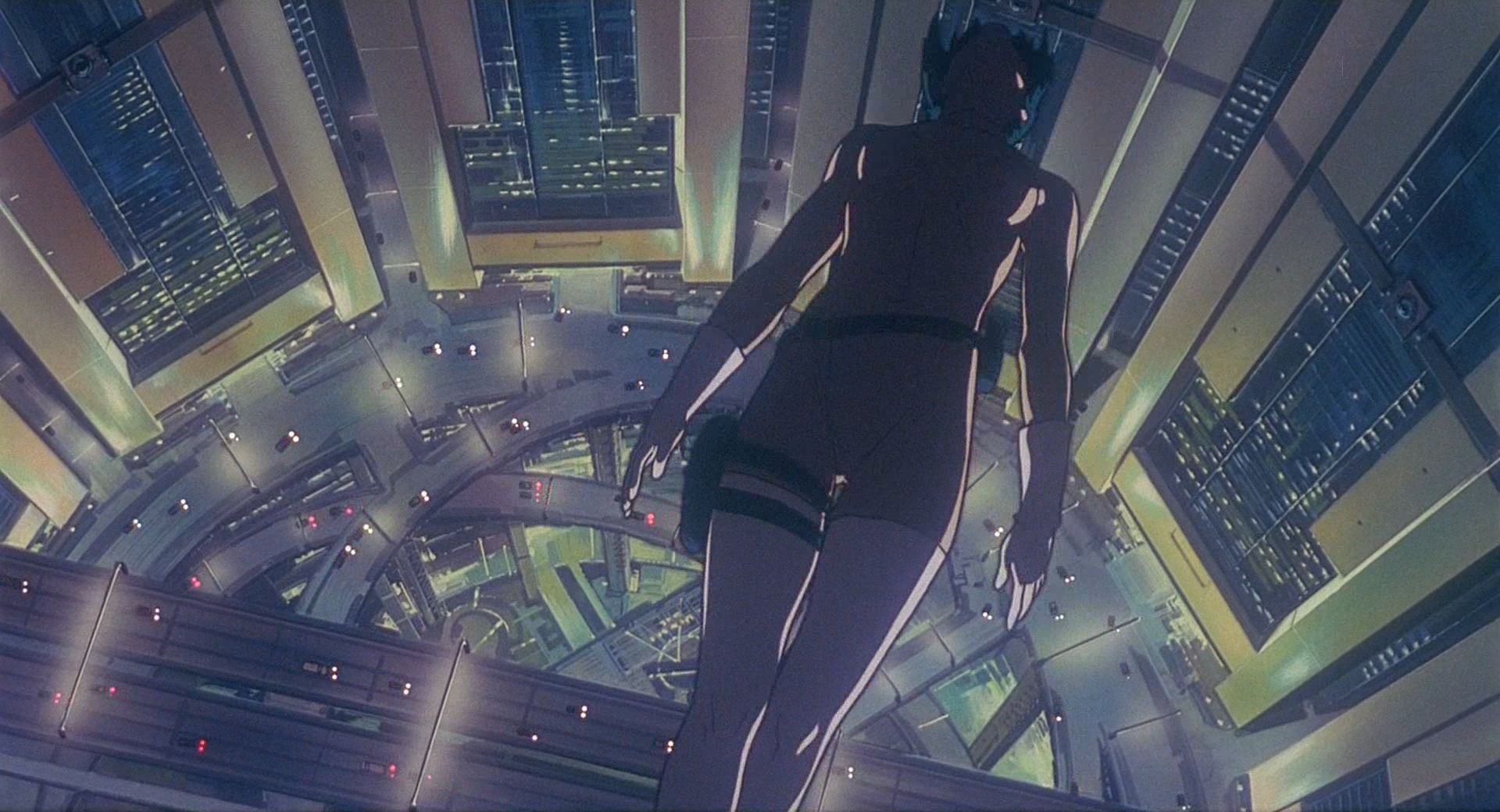
Ghost In The Shell cityscape

It is easy to go into the 1995 anime Ghost in the Shell thinking you know what you will get. You can know that it massively influenced serious science fiction films and inspired people like the Wachowskis to mix philosophical ideas and action freely, but you still may end up expecting an action movie (an expectation the first 20 minutes encourages).

But it’s possible to go too far in the other direction. While Ghost is a movie about ideas, a lot of them are much less profound now than they seemed 20 years ago. Why go back to the original film, then (and not to the 2-season TV show Stand Alone Complex, which offers a much more satisfying and conventional story)?

Maybe I go back because there is a sense of wonder at technology and the ideas it engenders. Plenty of movies, shows, and novels since (and, let’s be honest, before) have explored the questions of identity in a world of technology more complexly, but the sense of wonder in Ghost is hard to match.

(Liz – Streaming on Starz, via Amazon Channels)

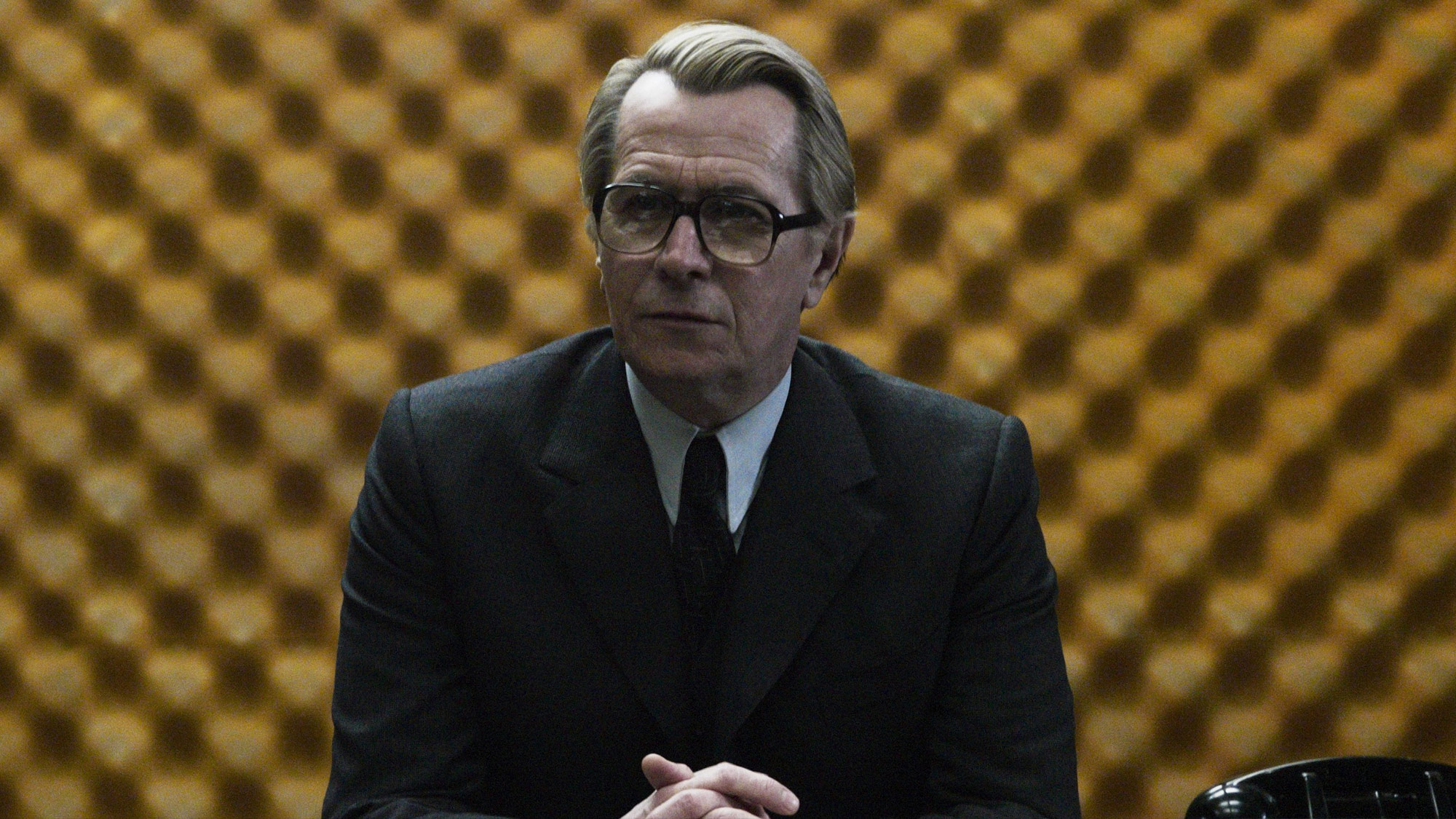
Tinker Tailor Soldier Spy

Gary Oldman in Tinker Tailor Soldier Spy

I’ve been fiddling around with a series on le Carre adaptations (he’s a lifelong obsession of mine), and in that I’ll find plenty of room to dump about what I do and don’t like about his most notable recent adaptation, 2011’s Tinker Tailor Soldier Spy.

But my fanboyish nitpicking should dissuade no one from watching the film. Will it make any sense without having read the original novel? Almost certainly not — even the Alec Guinness miniseries had trouble fitting everything in. But like The Big Sleep and other great mysteries, it is not a question of what is happening, but how the characters respond to it, and the film’s sense of style (which picks up as it goes on, building to a terrific finale) will keep you moving to the end.

(Liz – Streaming on Netflix)

Wild Hogs

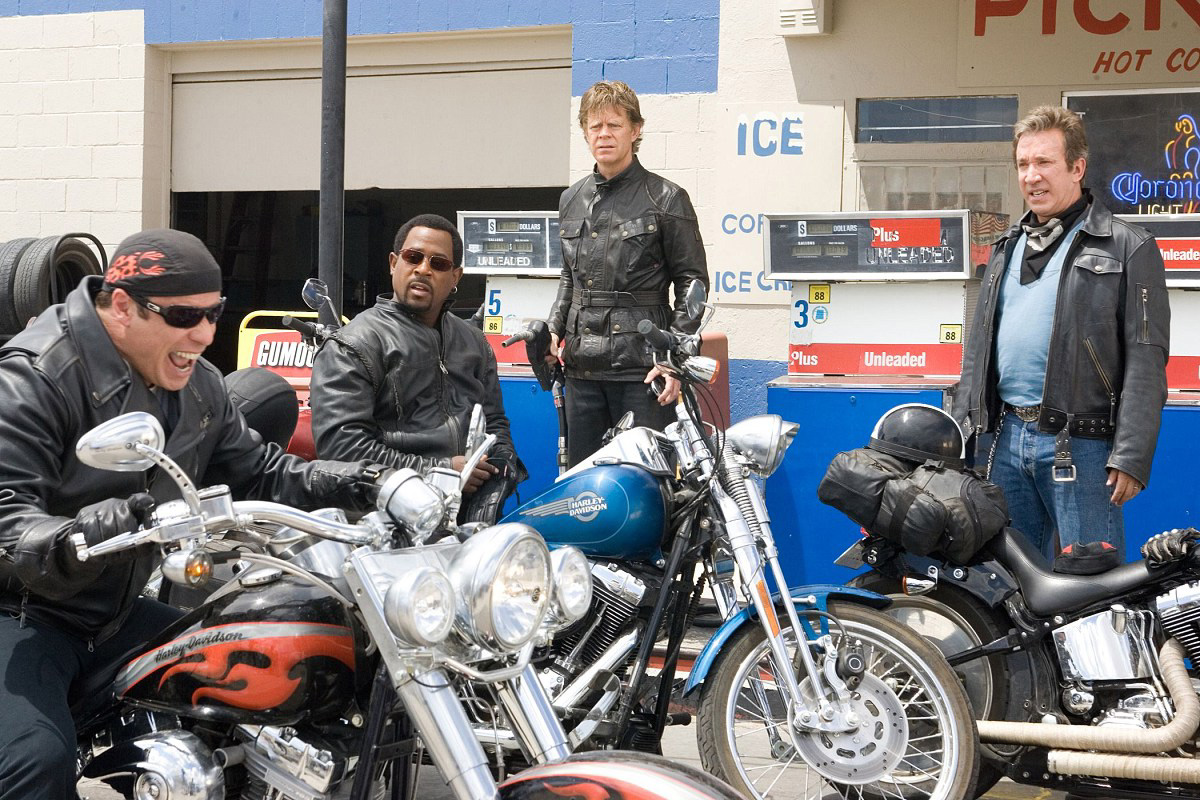
A bunch of dudes trying desperately to assert their masculinity in Wild Hogs

I’m not including Wild Hogs on this list because it is a good movie — it is not a good movie — but because it is a very weird glimpse of what studios presumed we would find entertaining in 2007. (Given that it grossed more than $250 million on an $85 million budget, making it the 13th top-grossing film of the year, they weren’t wrong, either.)

Simultaneously a “fun” road trip flick starring some of the most recognizable guys in Hollywood and also a morose tale of henpecked middle-aged men clumsily asserting their quieted masculinity, with enough gay panic jokes to power a small, stupid nation, Wild Hogs now seems like it landed here from outer space. What limited pleasures there are come entirely from William H. Macy, incongruously sweet as a thankless fourth fiddle to once-beloved fixtures John Travolta, Tim Allen, and Martin Lawrence.

The whole enterprise is pretty gross and revealing, but, say what you will, Wild Hogs did introduce this fact into the world: the diner that plays a central role in the plot was built for the movie, and it still exists as a shop selling Wild Hogs merchandise. Wild Hogs will outlive us all, and as Nathan Rabin noted, it’s a must if you’re on a “quest to visit the most depressing tourist traps in the world.”

(Rick – Streaming on Netflix)


January 20, 2018 0 comments
1 FacebookTwitterPinterestEmail
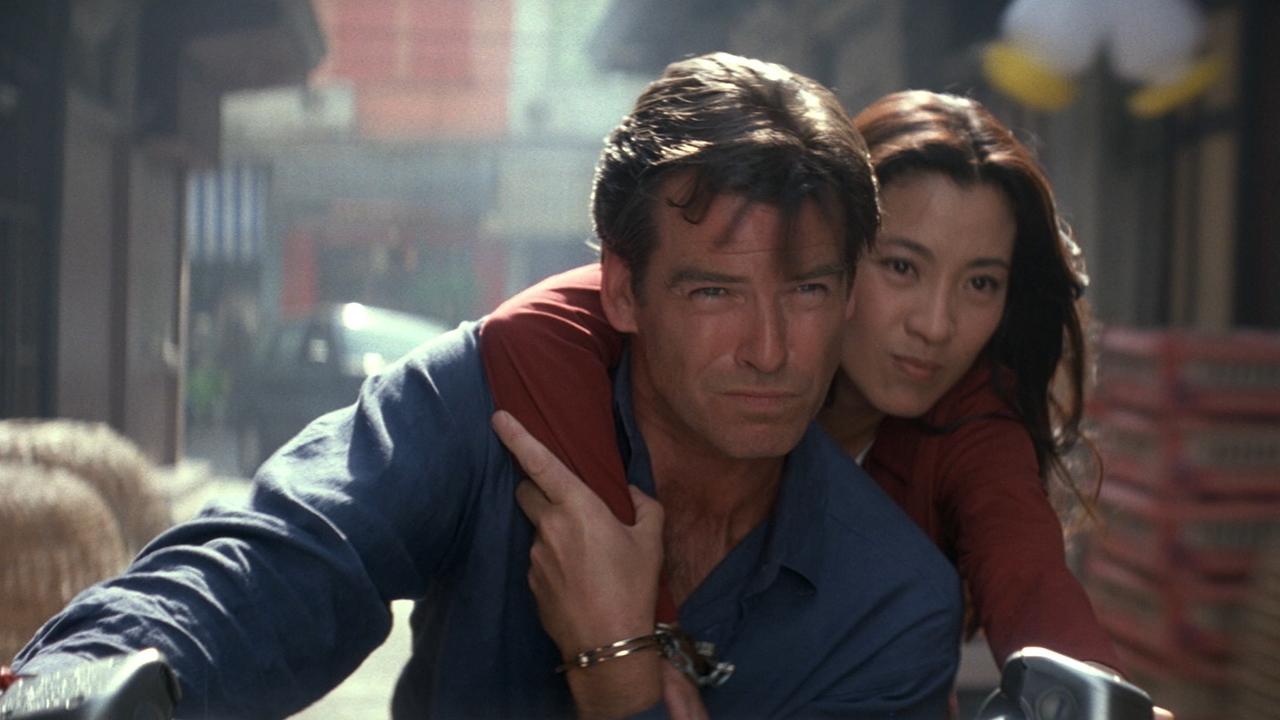
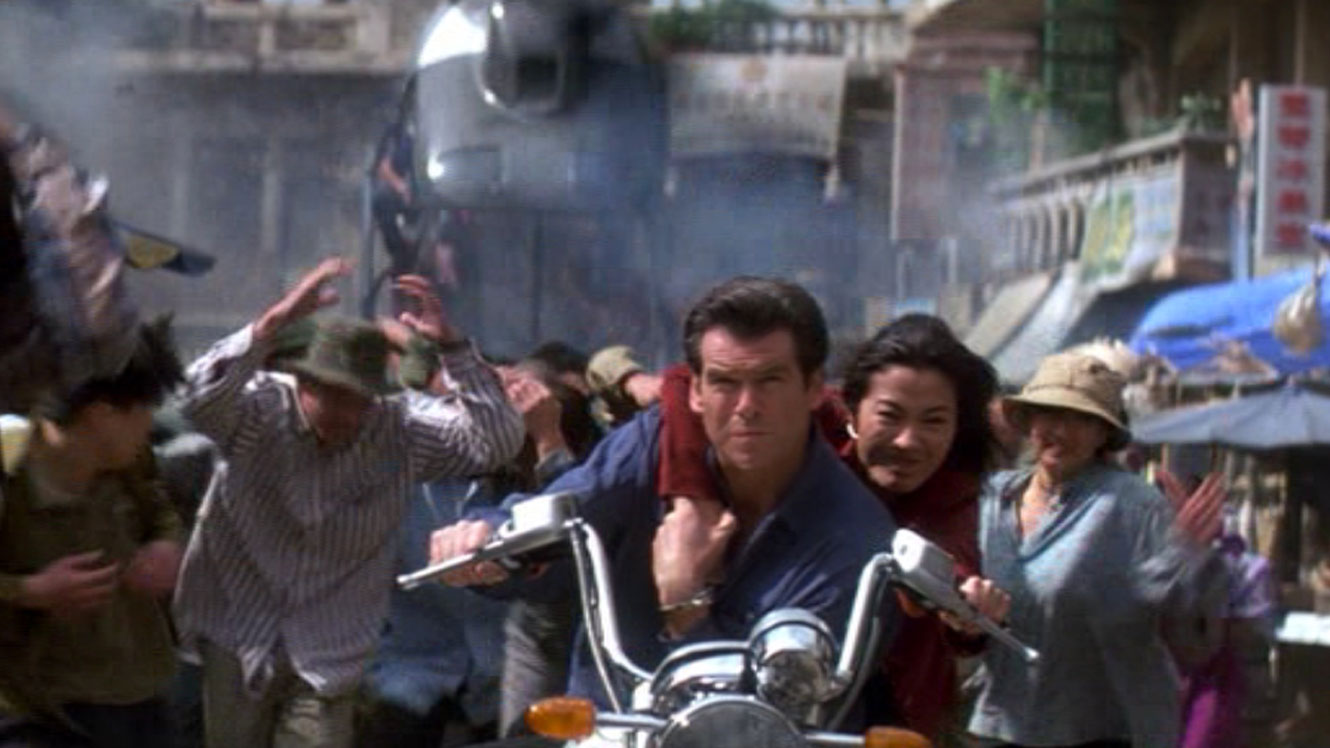
Pierce Brosnan as James Bond with Michelle Yeoh on motorcycle in Tomorrow Never Dies
CommentaryConversationFilm

Tomorrow Never Dies, With Apologies to Donald Barthelme

by Lark January 17, 2018
written by Lark

Q: On what movie viewing experience are you reporting?
A: The experience on the night of January 14th, 2018.

Q: What was the movie viewed?
A: The 18th James Bond movie, Tomorrow Never Dies (1997).

Q: Why?
A: Death felt about 2 hours too far away.

Q: Why this film?Pierce Brosnan as James Bond with woman in Tomorrow Never Dies
A: A lingering fascination with the James Bond franchise, I suppose; a general appreciation of it as a bellwether of something or other.

Q: What is the plot of the film?
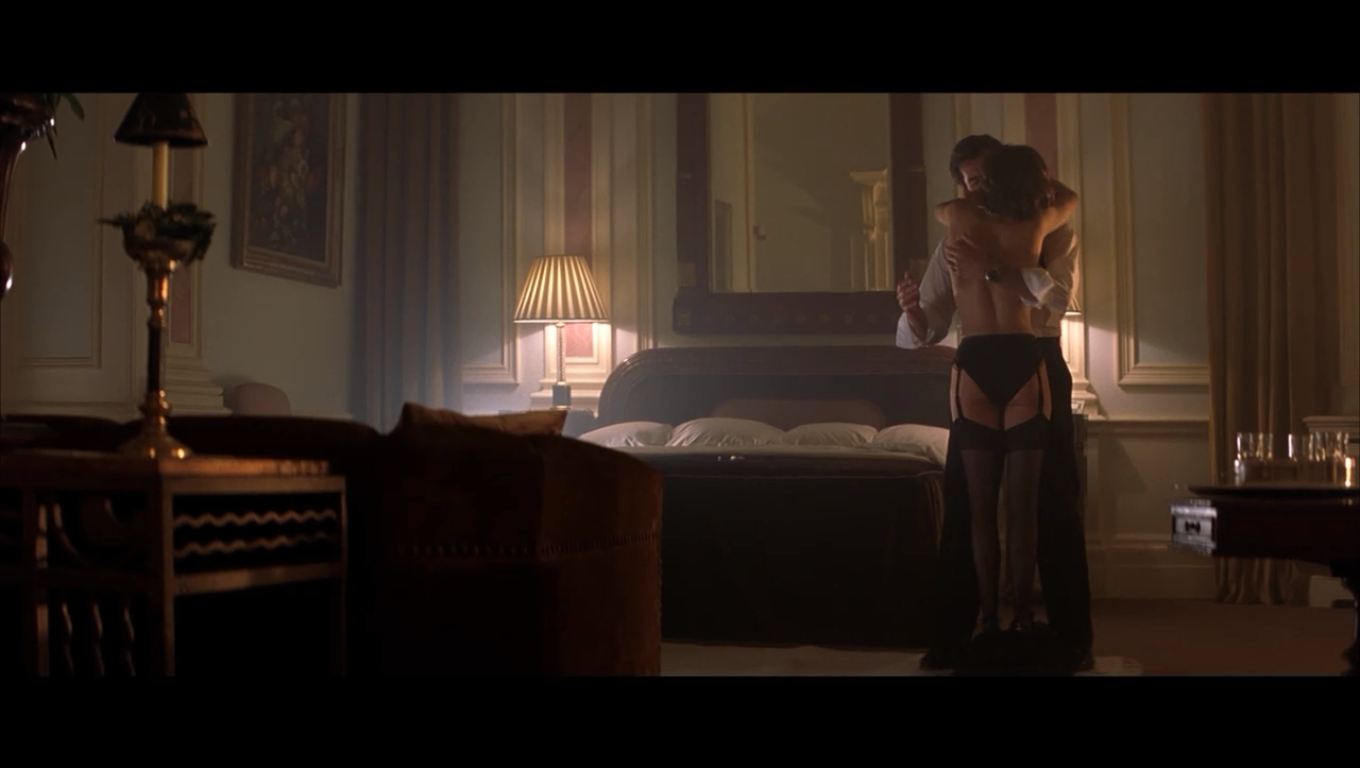
A: James Bond (Pierce Brosnan) is called away from a morning of casual sex—

Q: Nature of sex act?
A: Judging by the quips, some form of -lingus, whether cunni- or ani-.

Q: Continue.
A: James Bond is called away from a morning of casual sex to stop a villain-

Q: Nature of villain?
A: Evil media mogul; clearly based on Rupert Murdoch.

Q: Nature of plan?
A: To cause massive wars so that he can cover it.

Q: Nature of henchmen?
A: European in a vaguely German way.

Q: Continue.
A: James Bond is called away from a morning of casual sex to stop a villain from causing a nuclear war. In the process, he manages to kill one girlfriend—a former fling, who is now married to the villain—and acquire another, Hong Kong action star Michelle Yeoh.

Q: Nature of Yeoh’s presence?
A: Amused by her own presence in the film.

Q: Nature of Yeoh and Brosnan’s relationship?Pierce Brosnan as James Bond with Michelle Yeoh in Tomorrow Never Dies
A: Textually sexual, but subtextually paternal. Bond seems far more interested in protecting her than sleeping with her, and they manage to make being handcuffed to each other wholly un-sexy. In the field of un-sexiness, it is a towering achievement.

Q: Nature of Brosnan’s reference to Yeoh?
A: Consistently, he refers to her as “the girl,” as in “Let the girl go, it’s me you want.”

Q: Age difference between Yeoh and Brosnan?
A: Brosnan was 44 and Yeoh was 35, making her nine years his junior.

Q: Why, then, is Brosnan’s relationship with her so curiously paternal?
A: I was getting to that. It seems to be relevant to point out here that the movie makes several references to Bond’s fingers and tongue in a sexual manner, but no references to his penis.

Q: Nature of references?
A: A partial summary: the aforementioned sex scene, in which Brosnan quips about mastering a foreign tongue; his conversation with Moneypenny in the same scene, in which she calls him a “cunning linguist”; his later conversation with Q, in which he claims a trackpad (which has a female voice) will “respond to his touch better,” followed by him dragging his finger across it in what seems to me to be a sexually suggestive manner.

Q: Continue.
A: And yet, despite the focus on non-phallic forms of sex, the film is filled with phallic and yonic imagery.

Q (whispered): Yonic?
A (whispered): A somewhat outdated term for “vagina-like”; “vulvic” is slightly more popular these days.

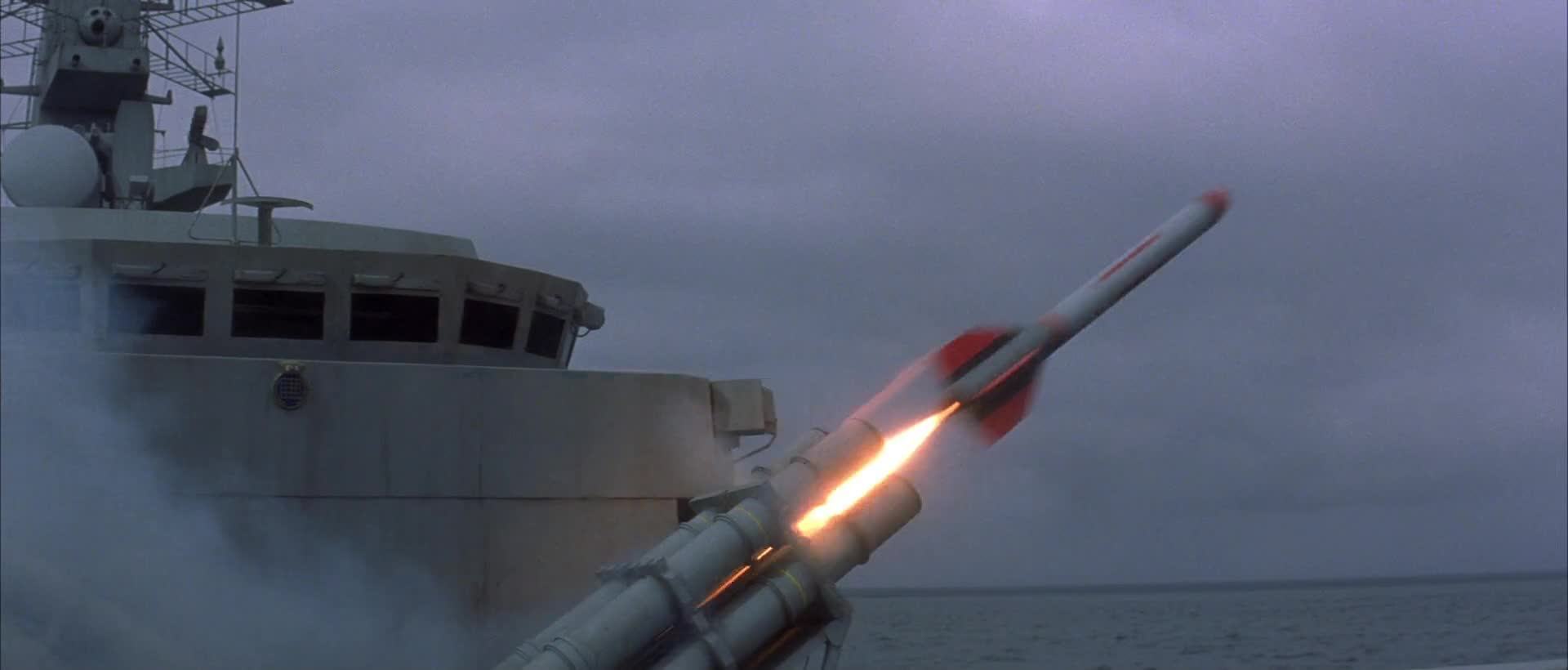
Q: Continue.Phallic rockets firing in James Bond Tomorrow Never Dies
A: When it comes to weapons, Bond is armed with an infinite variety of phalluses in the form of missiles. He fires many missiles in the opening scene, which is centered around him stealing missiles from the enemy, and in almost every other major firefight he manages to find missiles of some variety lying around.

Q: Nature of missile imagery?
A: The classic 1990s image of missiles: sharp red tips just pointing out of a large square launcher.

Q: Nature of yonic imagery?
A: The villains have a peculiar weapon on which a great deal of time is spent: a missile-drill, which with 3 large rotating blades pointing towards a center void reminds one (or at least this one) immediately and strongly of a vagina, particularly in the form of the “vagina dentata”.

Q: Relevance of this diversion?
A: It seems as if the focus on missiles and vagina-drills replaces Bond’s actual sex, and his sex is repurposed as a form of service to women. His sex becomes a gift focused around her needs — a very progressive movement from Sean Connery, one supposes.

Q: In short, what does one wonder?
A: One wonders if the replacement of Bond’s single phallus for a number of sexual objects — tongue, fingers — creates a new singularity within the woman, a need for a man’s fulfillment. This is thus perhaps a variety of the women constantly being put in peril: just as in sex they are placed in the position of the absolute receiver of pleasure, in peril they are placed in the position of the absolute receiver of rescue. Brosnan’s peculiarly paternal role in relationship with his lovers comes from this: he is the one who can give the gift of pleasure and salvation from pain, through a multitude of skills and techniques. The singularity of his phallus is replaced by the singularity of her need.

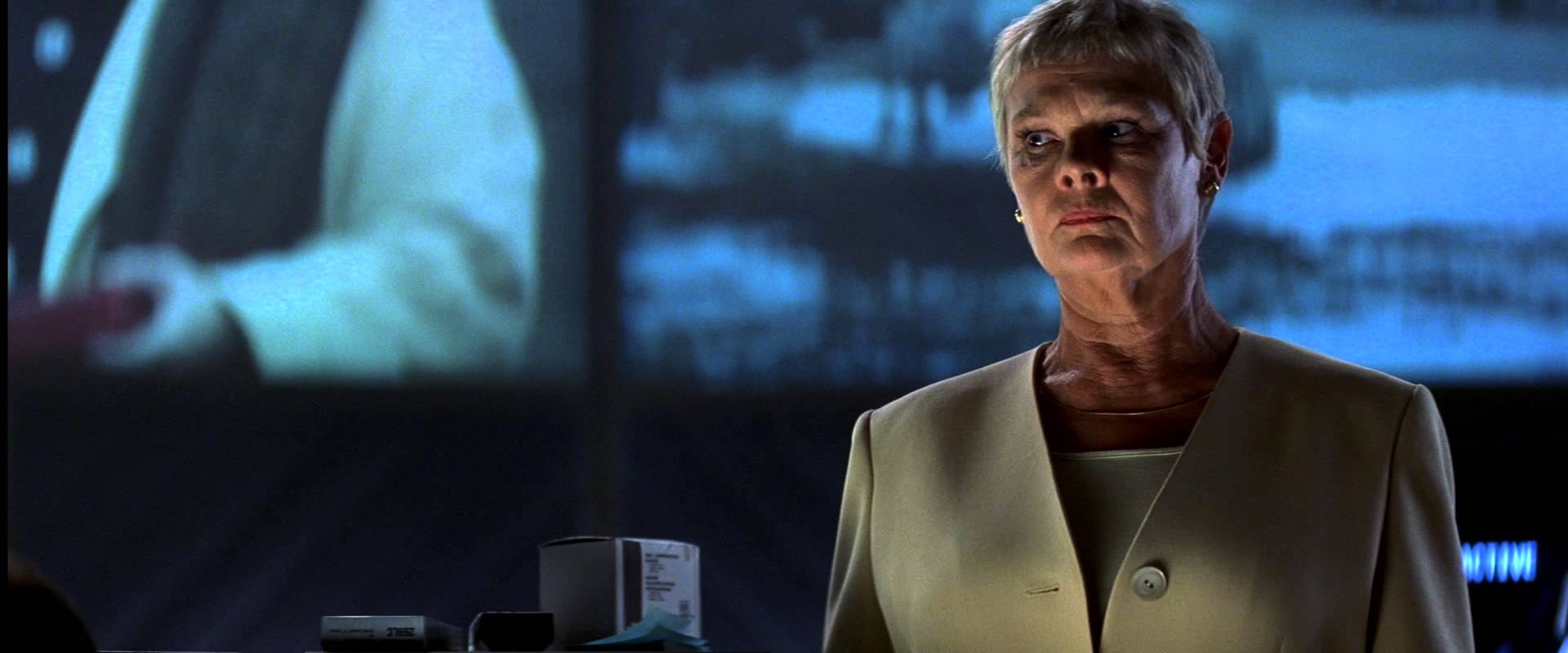
Q: What else does one wonder?Judi Dench in James Bond Tomorrow Never Dies
A: One wonders if this is not a transformation of a larger problem, the loss of the USSR, which could serve as a clear enemy. In the place of the enemy who must be destroyed (and, of course, SPECTRE was always a thin layer of camouflage placed over the books’ explicitly Russian SMERSH), there is the public who must be protected. It is this protection which is the most important thing, even if it requires lying — note the contrast between the villain, who actually does report the news, even if he causes it himself, and the final moments of the film, in which M writes a fake news story of the villain’s suicide for public consumption.

Q: What, finally, does one wonder?
A: One wonders if the Brosnan Bonds do not, in their awkwardness, represent the crisis of a culture that has lost an enemy and is trying to establish a new way of thinking of itself as morally superior, as a superior paternalistic figure—but now a figure who is explicitly equal to everyone else, while implicitly believing itself to be superior. One wonders if, in short, these films do not merit further study as being highly revealing of the Western power fantasy into which we may fall back at any moment.

Q: This is, of course, all bullshit.
A: Mostly.

January 17, 2018 0 comments
0 FacebookTwitterPinterestEmail
Ultimate road trip movie
CommentaryFilm

Until the End of the Road Movie

by Lark January 15, 2018
written by Lark

The road trip belongs to an incredibly particular technological moment.

There must be an element of protraction; it must take long enough to get from point A to point B to generate enough plot to keep the opening and closing credits 90-plus minutes apart.

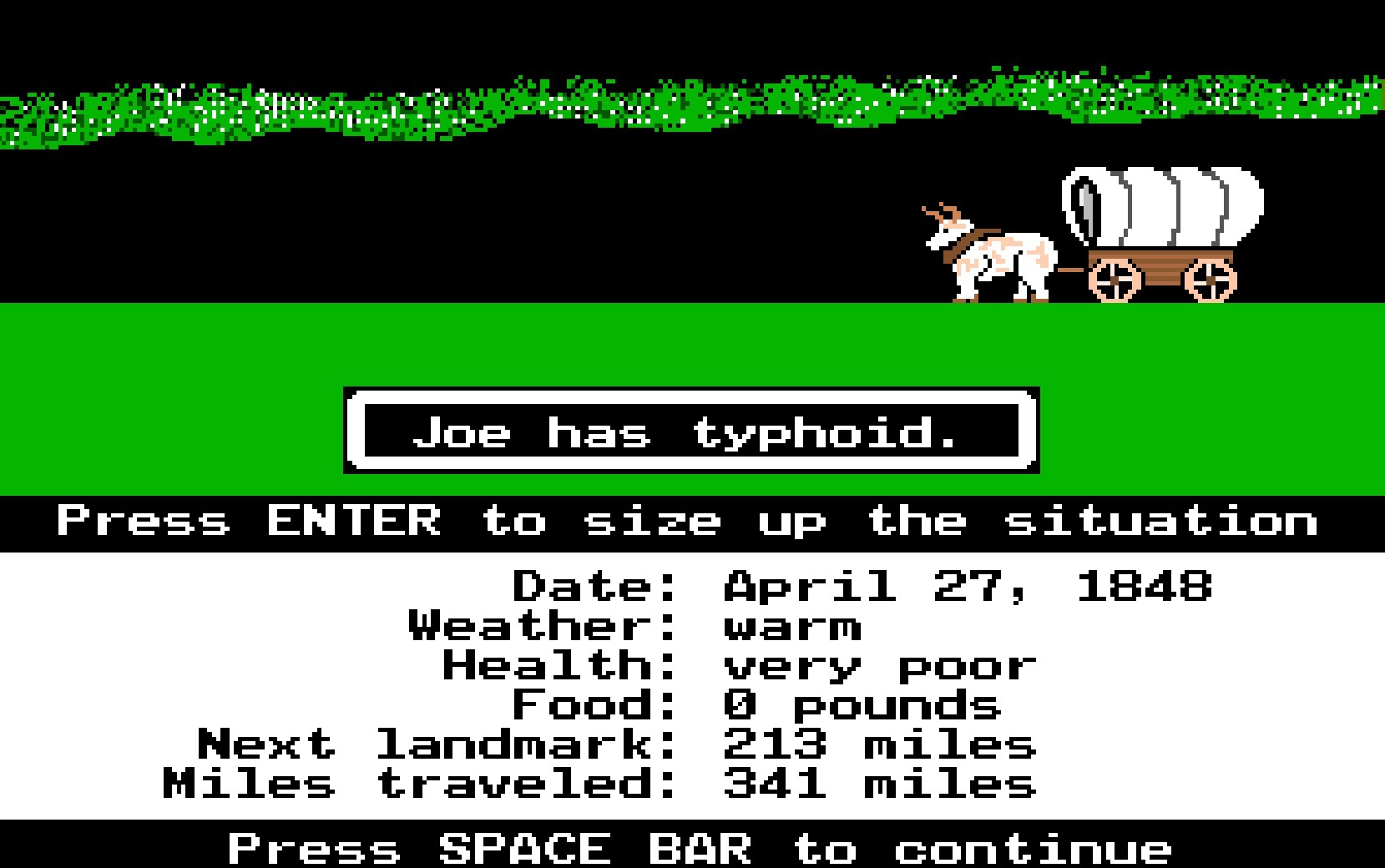
But there also must be an element of ease which makes the trip an escape from the travelers’ everyday lives, not a permanent and irreversible shift. The Joads were not quite going on a “road trip,” nor were the thousands of families who schoolchildren killed off playing Oregon Trail.

Oregon Trail as road tripBefore the post-war automobile production boom in the United States, the road trip movie couldn’t exist. What is—or was—its endpoint? Genres usually are born more suddenly than they die, but if Wim Wenders’ Until the End of the World doesn’t mark the end of the genre as a real form of life (as opposed to a self-referencing, self-replicating fantasy machine), it can mark one of the logical endpoints of it.
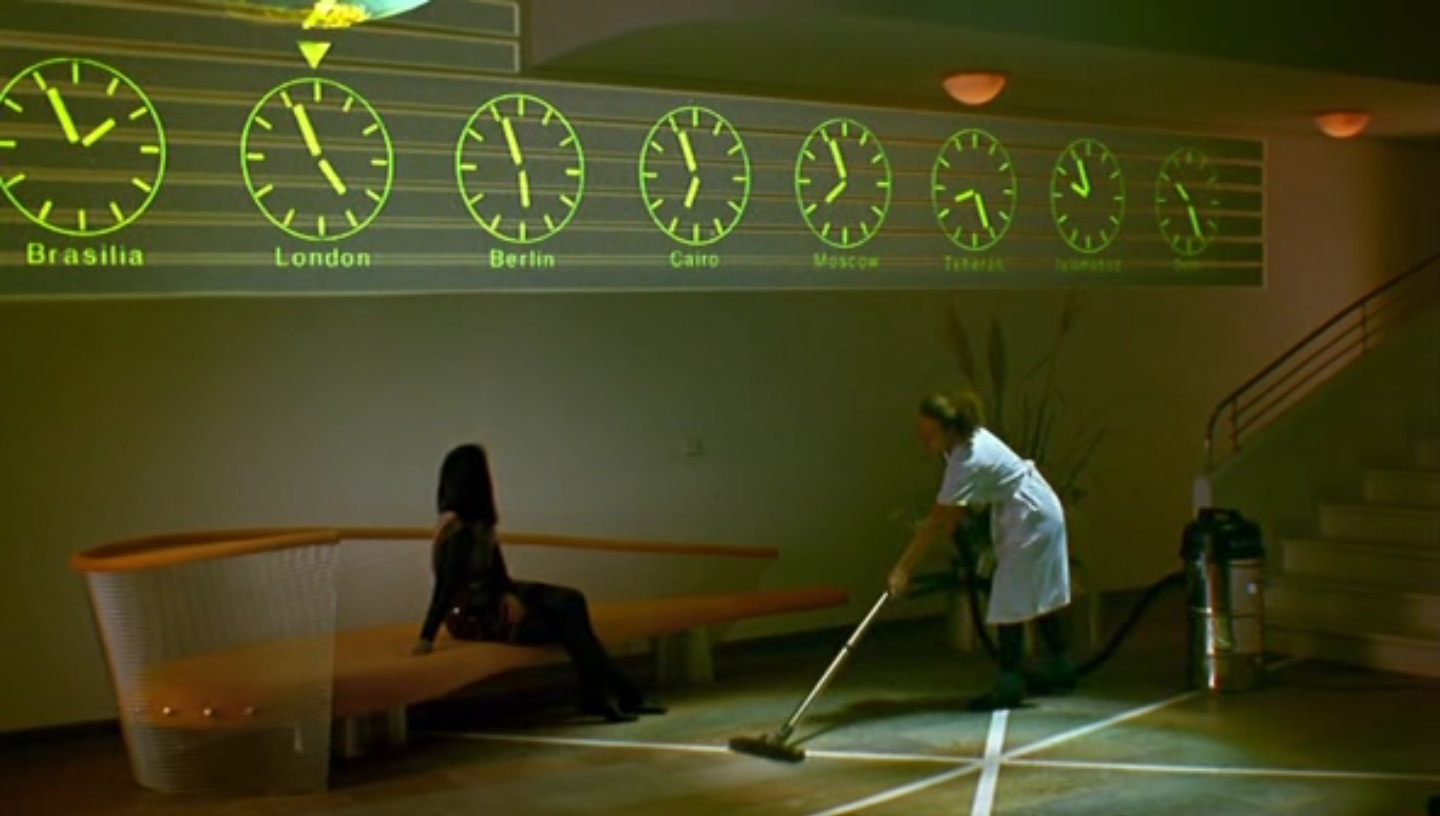
In its extended form (the 270-minute The Trilogy version, which splits the movie into three feature-length films; a 300-minute, 2-part version recently toured as part of a Wenders’ retrospective and is rumored to have a Criterion release in its future), Wenders’ film is the road trip at the end of its life.

Released in 1991 and set in 1999, it feels like the last gasp of a world where points on a map are close enough to make travel possible, but far enough away to make them distinct, to make it still possible to tell a story about the getting there.

In fact, remarkably little attention is paid to the travel. Most of the “road trip” elements take place in the first 2-and-a-halfAirport clocks in Until The End Of The World hours, as Solveig Dommartin (who co-wrote the script with Wenders) tracks down William Hurt, a fugitive with whom she falls in love. But outside of their ‘meet cute’, a segment in which Dommartin gives Hurt a ride to help him escape from mysterious bounty hunters, all the travel of her chase takes place in brief shots of boats, of cars, or of planes as her former lover (Sam Neill) narrates.

As all points on the map become neighbors to all the others — and I’m using the term as much in its mathematical sense as its commonsense one — each individual place they visit becomes essentialized. Removed from its place in Japan as a whole, the traditional inn Dommartin and Hurt visit becomes merely a magical place where the mystical owner uses vague ancient Road trip detour in Tokyo in Until The End of the Worldrituals to heal Hurt’s failing eyes. The trip to Japan serves as an essential turning point in the movie, occurring roughly 2 hours in and marking a transition from European ports of call like Germany and America, which still manage to retain some uniqueness, to Eastern locations which increasingly stand in for the magical other-place.
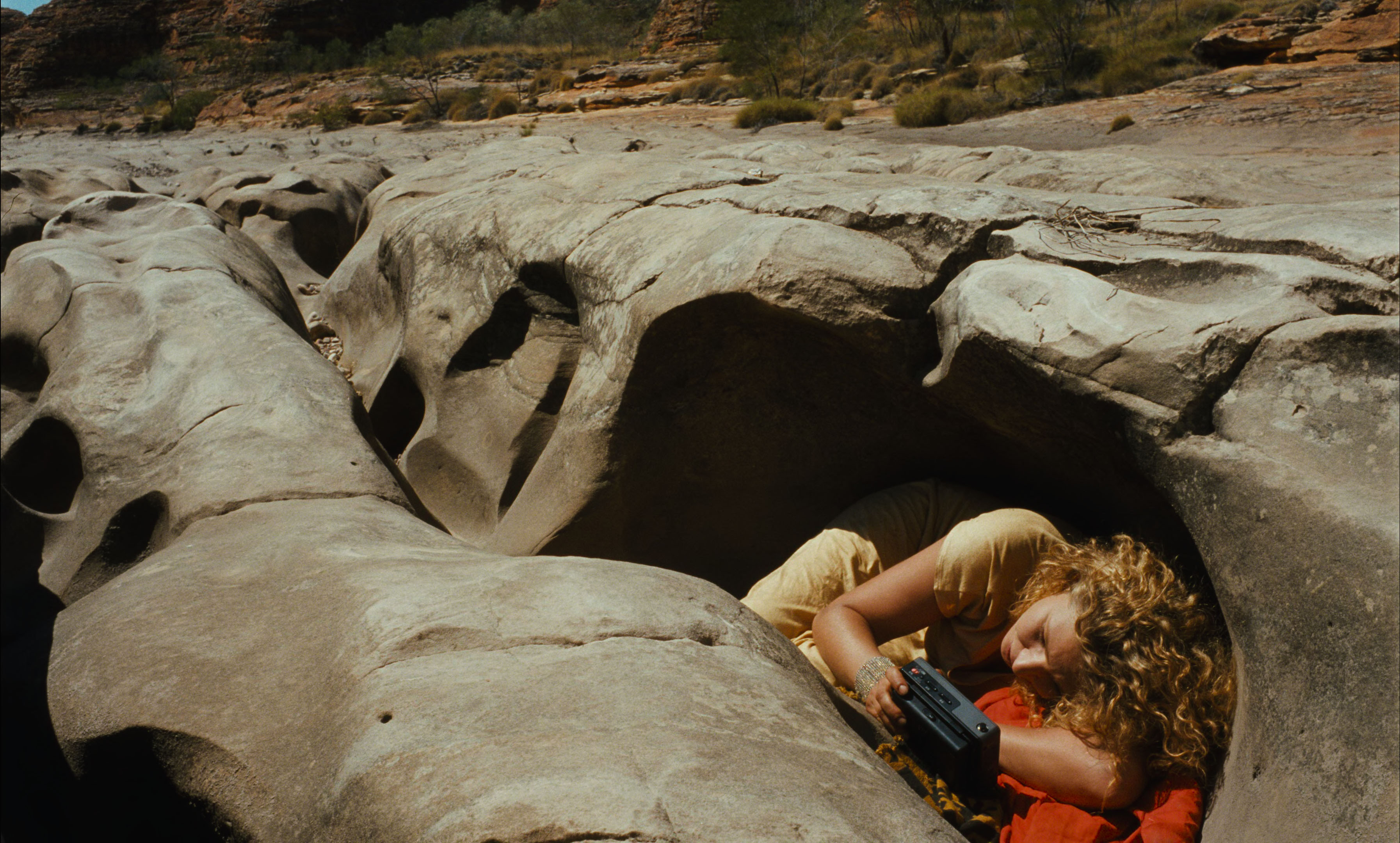
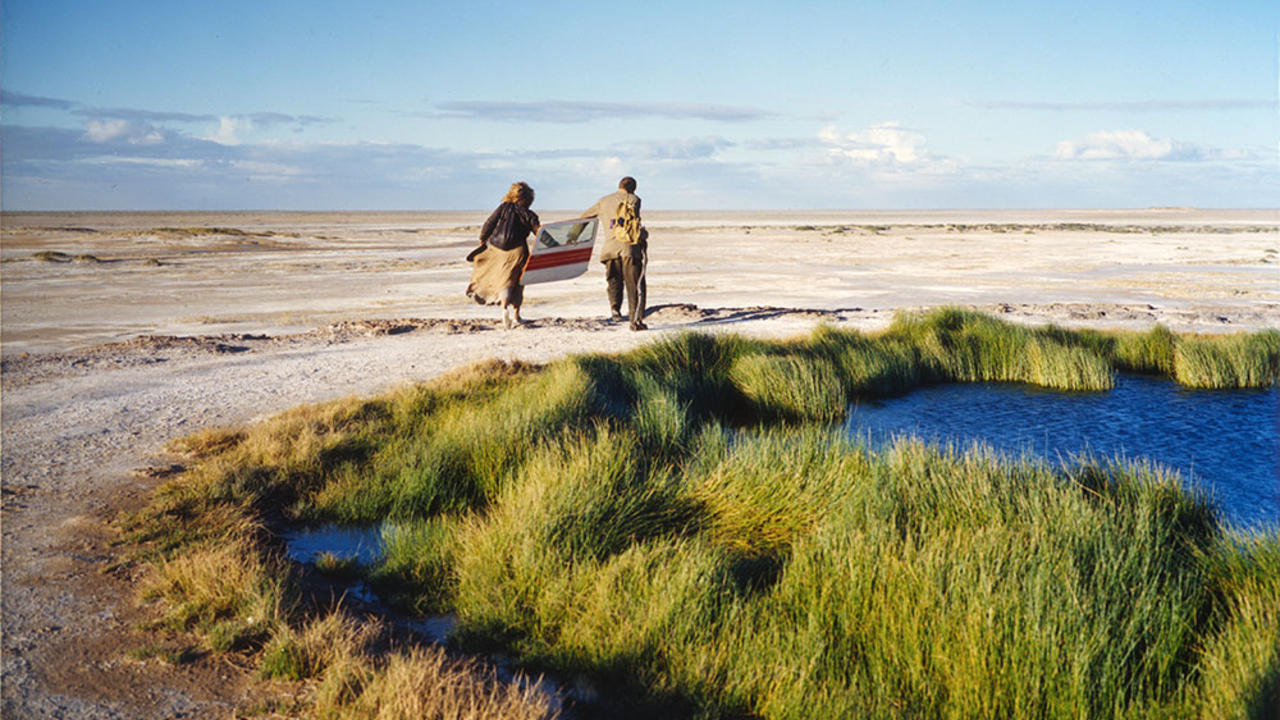
As the film moves into its final third (The Trilogy is so clearly divided into thirds that the credits run in their entirety before each section), it reaches the final stage of a terminal acceleration. It settles into the Australian outback as an EMP blast wipes out all technology, and aboriginal Australians begin to stand in for all sincere life. Whether or not Wenders’ depiction of indigenous Australians is essentialist or Orientalist (I’m not nearly informed enough to say for sure), they are really stand-ins for something else. They are the ultimate end of the “road trip” as such. Absolutely situated, unable to move from their place (several scenes center around them marking sacred spaces in the land so they are not destroyed by radiation), they are every point on the road the road trip travels down brought to a point.

After all, that is always the essential relationship of the stops on the road to the travelers on the road. For the travelers to travel down the road, everything along the side must stay still. And for those things to stay still, they must have their own frames of reference. As travel changes and those points become closer, the uniqueness of the places at which one can stop must shrink inwards. The magic secret that was located in a place now has to be located somewhere inside. What does that do to the road trip as a narrative idea?

The exhaustion of the movie, the sense that this is the “ultimate road trip movie” (to quote the tagline) — ultimate in Until The End Of The World, ultimate road trip moviethe sense of final — is what drives the colossal running time. One wonders if it is the increasing closeness of everything that has led to the stagnation of the second half of Wenders’ career; other than the documentary Buena Vista Social Club in 1999, he hasn’t made an acclaimed movie since Wings of Desire (1987).

Maybe it’s time to reorganize how we think about Wenders’ films. It is easy to celebrate the brilliance of his early movies like Alice in the Cities, Kings of the Road, Paris, Texas, and a half-dozen others and ignore everything post-Wings of Desire as the result of a brilliant artist losing their touch. But maybe it is closer to an artist whose world shriveled up in the face of technological progress, and has spent half his career trying to recreate and recover it. Maybe it’s in that failure that we can understand the world better and more beautifully than in a nostalgic desire for his golden period.

January 15, 2018 0 comments
2 FacebookTwitterPinterestEmail
Flying through Triangle Land in World of Tomorrow 2
FilmReviewsStreaming Selections

World of Tomorrow Episode 2: The Burden of Other People’s Thoughts

by Sam and Rick January 13, 2018
written by Sam and Rick

We don’t usually recommend streaming titles you have to rent as standalones, but when Don Hertzfeldt suddenly drops a sequel to World of Tomorrow, I’ll make an exception.

Judging by the reactions of friends, Hertzfeldt seems to fall pretty squarely in the love-it-or-hate-it column. His stick figure drawings paired with swirling computer animation, the existential wallowing and drier-than-dry humor, the cosmic sensibility undercut by child-like whimsy … some people seem to find it altogether too much.

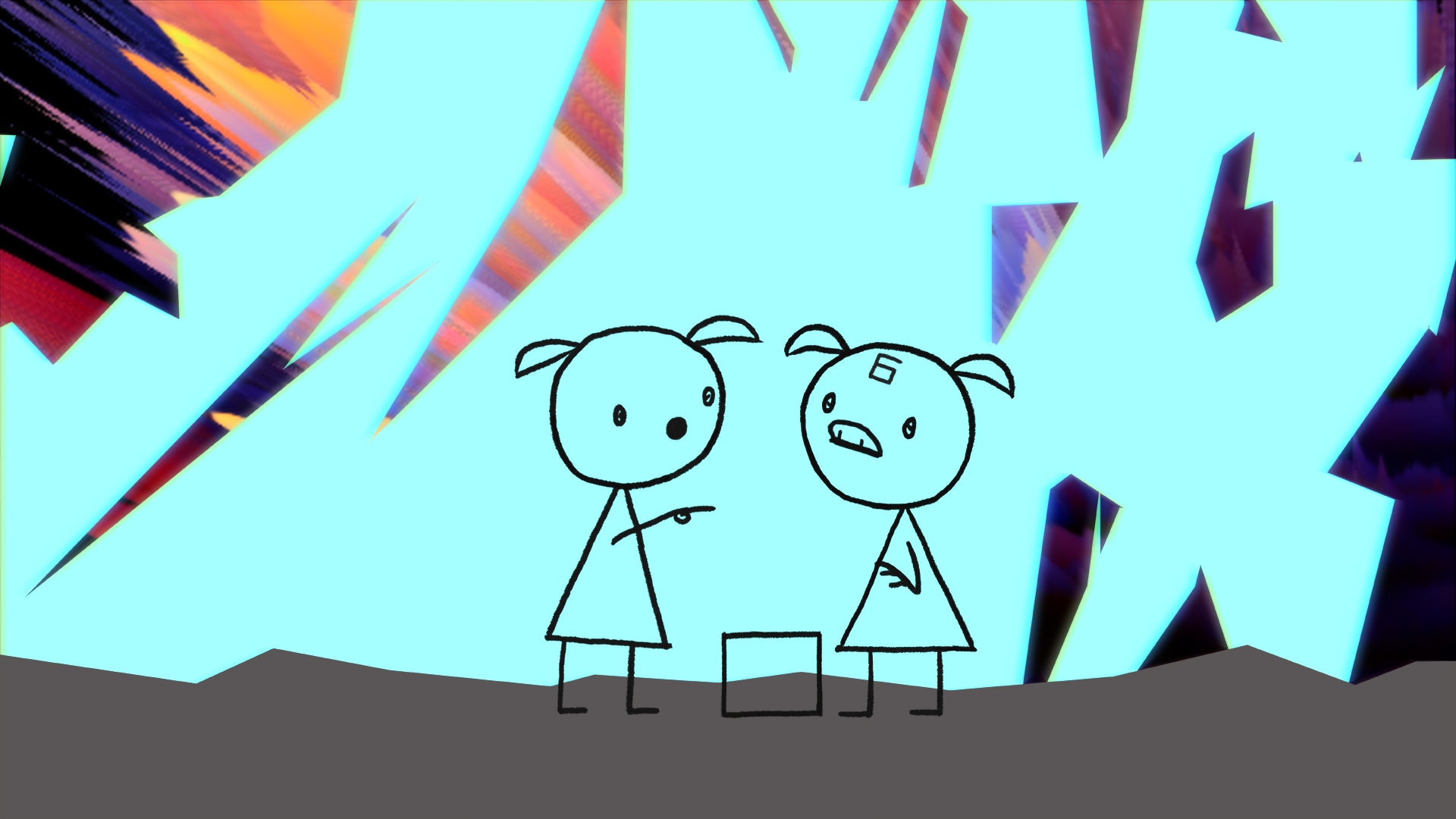
Emily Prime and Emily 6 in World of Tomorrow 2With all due respect, those people are lunatics. World of Tomorrow Episode 2 picks up where its short predecessor left off (and you should really, really watch that one first, if you haven’t: it’s 16 minutes long and streaming on Netflix, so hop to it).
Emily Prime, our tiny World of Tomorrow protagonist, continues to find herself on elaborate adventures, though this time into the unconscious. Questions of identity and copies of copies echo throughout the sequel’s comparatively epic 22 minutes, with all the off-kilter sci-fi and unexpectedly devastating turns you’d expect from Hertzfeldt.

It’s somehow both sadder and funnier than what’s preceded it, which was already extremely sad and hilarious.

(Rick – Streaming for rent on Vimeo)

Quick Links

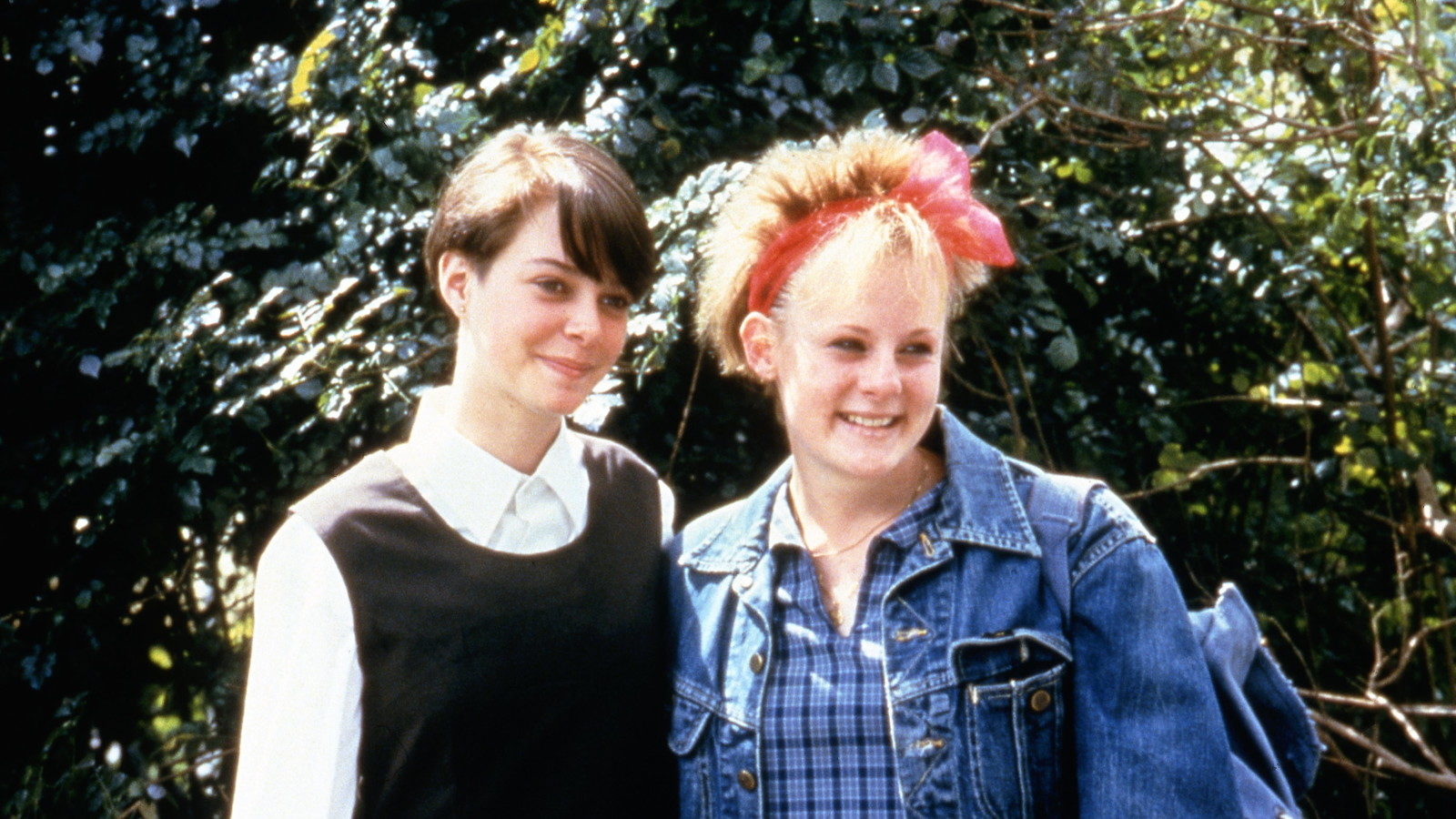
2 Friends

Jane Campion's 2 Friends

Jane Campion suffers from a peculiar kind of neglect. A few of her most famous works have become well known (I recently heard references to The Piano on the podcast Comedy Bang Bang, of all places), but many of her smaller films have completely passed under the radar.

Her first film, 2 Friends, recalls a number of more recent films in its incredibly frank depiction of the breakdown of the friendship of two teenage girls, presented backwards from the final moments back to its incipience. Pair it with some of her beautiful impressionistic short films, also available. (Liz – Streaming on Filmstruck)

13th

Ava Duvernay's 13th

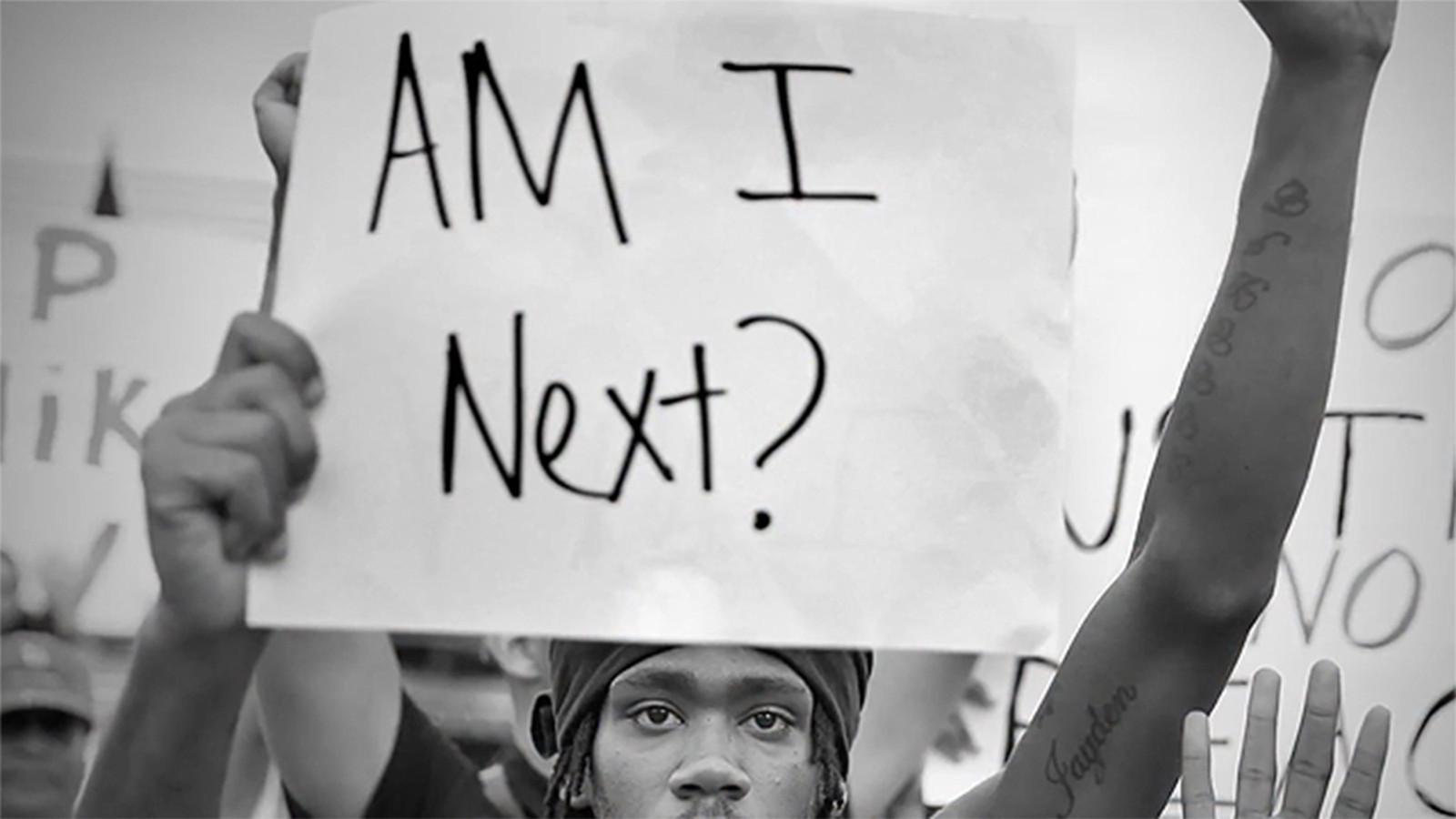
Given that it is MLK Day weekend and our “first white president” has decided to celebrate the occasion by stridently issuing at least 3 racist provocations by Saturday, now might be a good time to cue up Ava DuVernay’s 13th. (It might also be a good time to riot, but that’s a story for a different sort of website.)

Meticulously constructed, DuVernay’s doc traces the development of white supremacist American conceptions from slavery to Jim Crow to the prison industrial complex, underlining the ways our cultural imaginary has made them possible and hinting at paths forward to justice. It’s a bracing, furious piece of polemicism that aims to leave us outraged. Good.

(Rick – Streaming on Netflix)

A Ghost Story

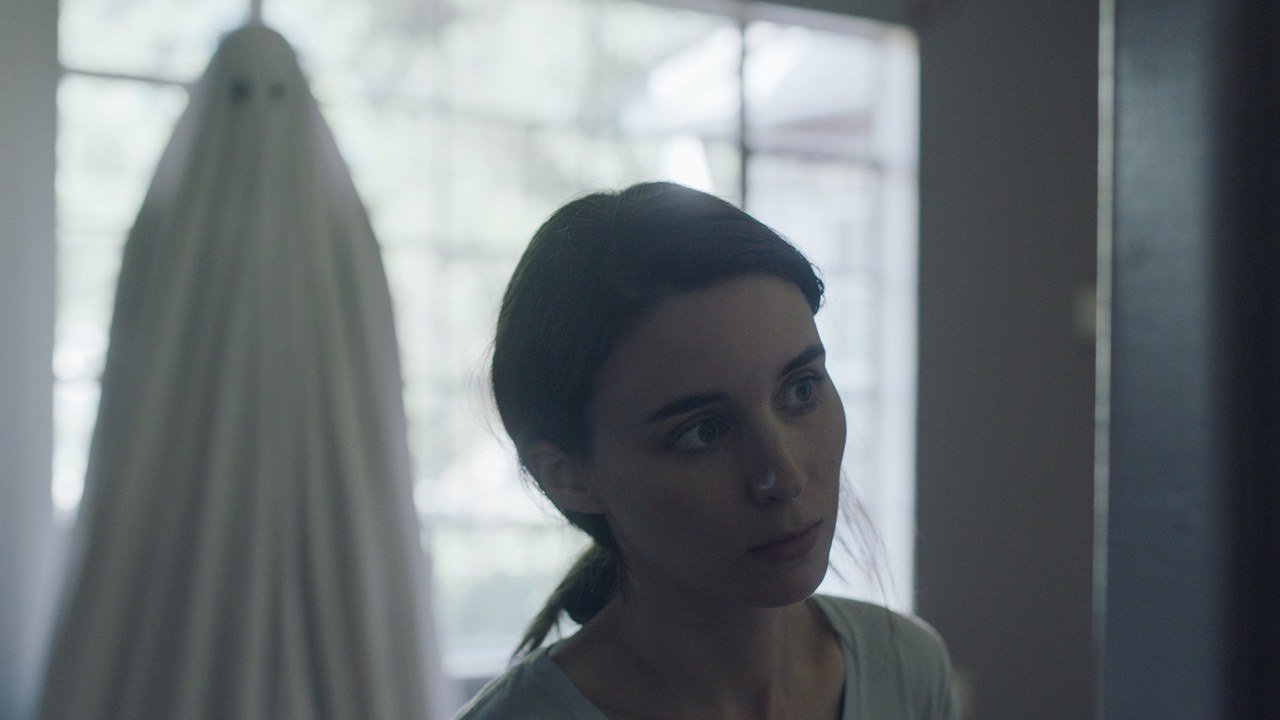
Rooney Mara and Casey Affleck in David Lowery's A Ghost Story

I’ve been singing the praises of David Lowery’s deeply melancholy, half-ridiculous, entirely effective examination of grief and place since I first saw it — it’s one of the best of 2017 (the 3rd best exactly, as a matter of fact). There are moments in A Ghost Story that rank among the most quietly devastating in recent memory, and you should bump it up the list if you haven’t already.

Speaking of best-of’s, Nocturama is also still streaming on Netflix, and Hulu just added, um, XxX: The Return of Xander Cage, which Liz assures us is like “Vin Diesel’s throbbing cock became sentient and made a movie. Two stars.”

(Rick – Streaming on Amazon Prime)

Why Don’t You Play In Hell?

Sion Sono's Why Don't You Go Play In Hell

How on Earth did Sion Sono’s high-energy yakuza movie Why Don’t You Play in Hell?, about amateur filmmakers trying to make a movie in the midst of a real yakuza war, end up on Shudder, a streaming service ostensibly for horror movies? Who the hell knows. (Maybe they just read the title and assumed it was a slasher.)

But anywhere Western audiences can get a dose of this film’s completely lunatic energy, maybe akin only to Seijun Suzuki in its madcap wave, should be celebrated. If you’re left wanting more after it ends, good news—Sono probably wrote, shot, and edited 2 more features in the time it took you to watch it. (Liz – Streaming on Shudder)


January 13, 2018 0 comments
3 FacebookTwitterPinterestEmail
Haley Lu Richardson and John Cho in Columbus
FilmReviews

The sublime Columbus finds beauty all around us

by rick January 11, 2018
written by rick

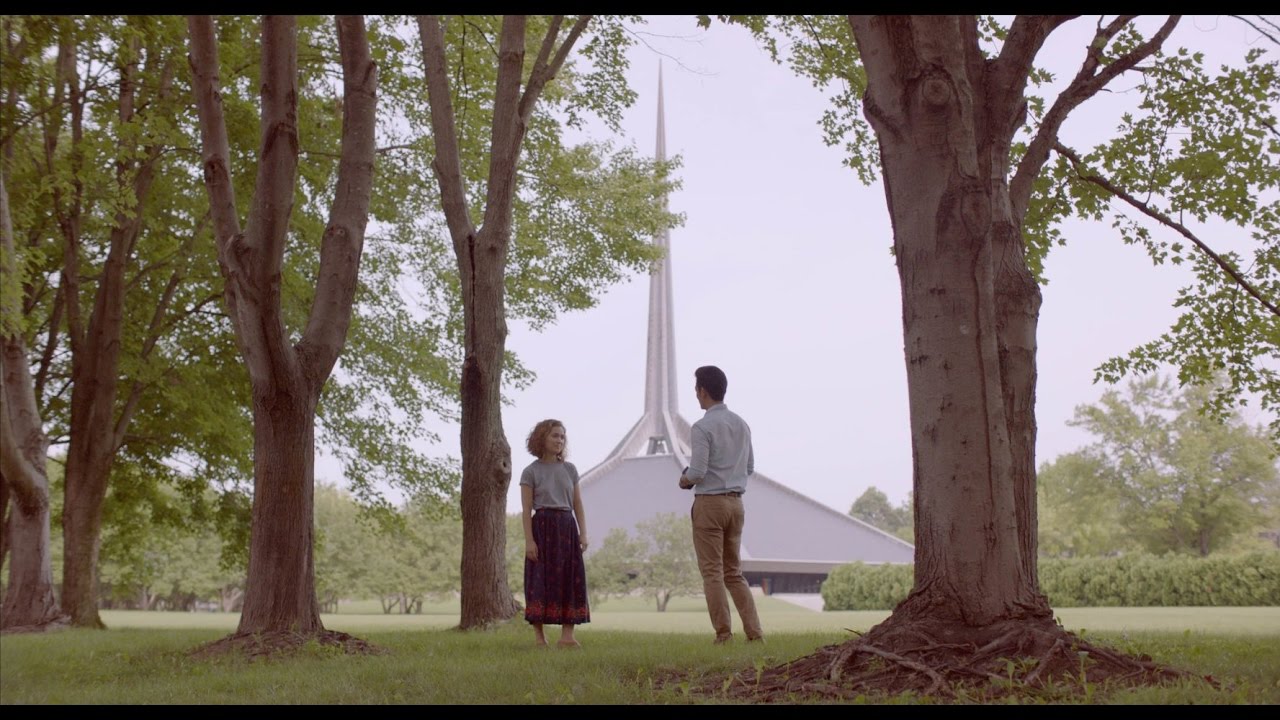
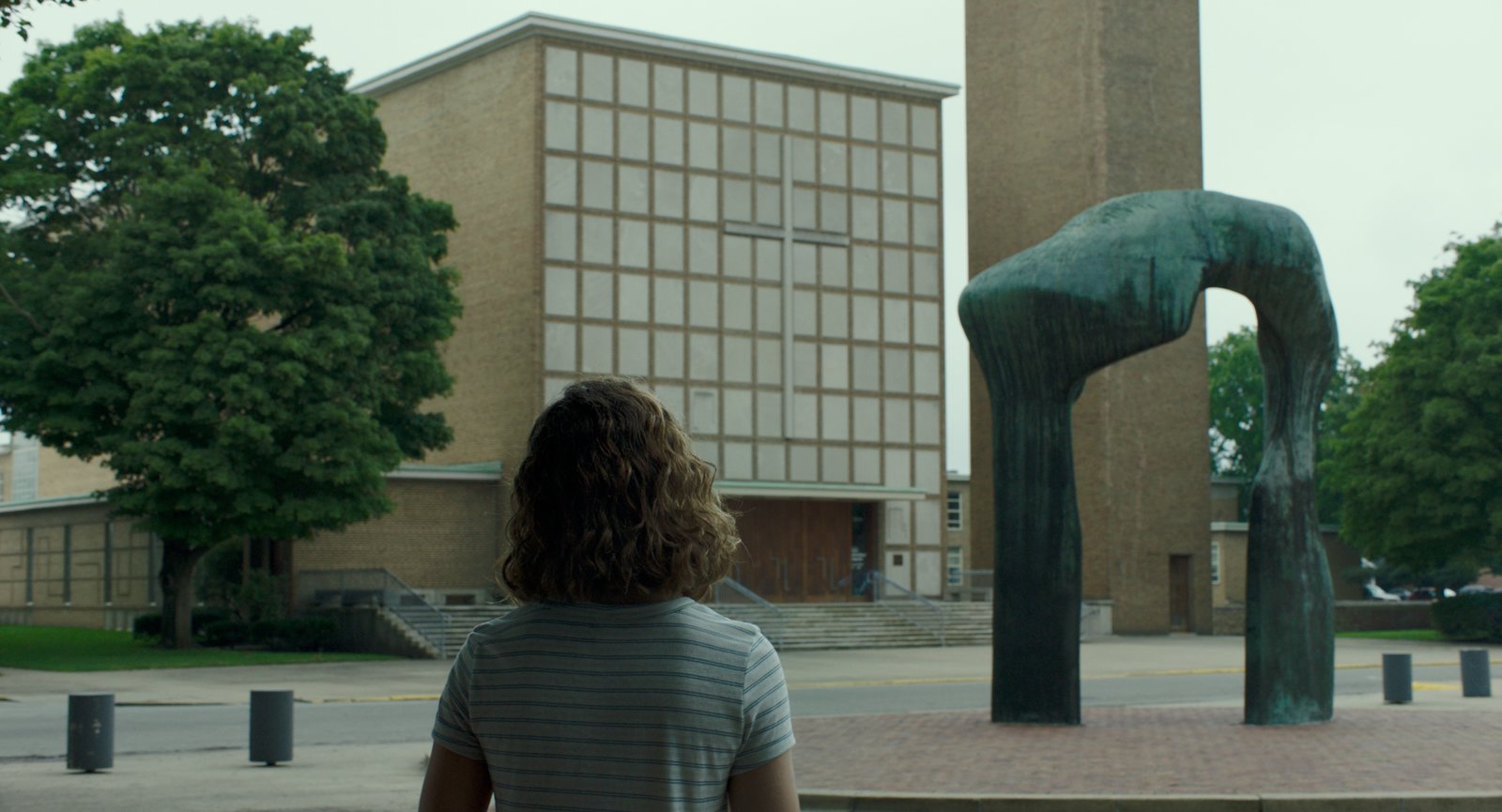
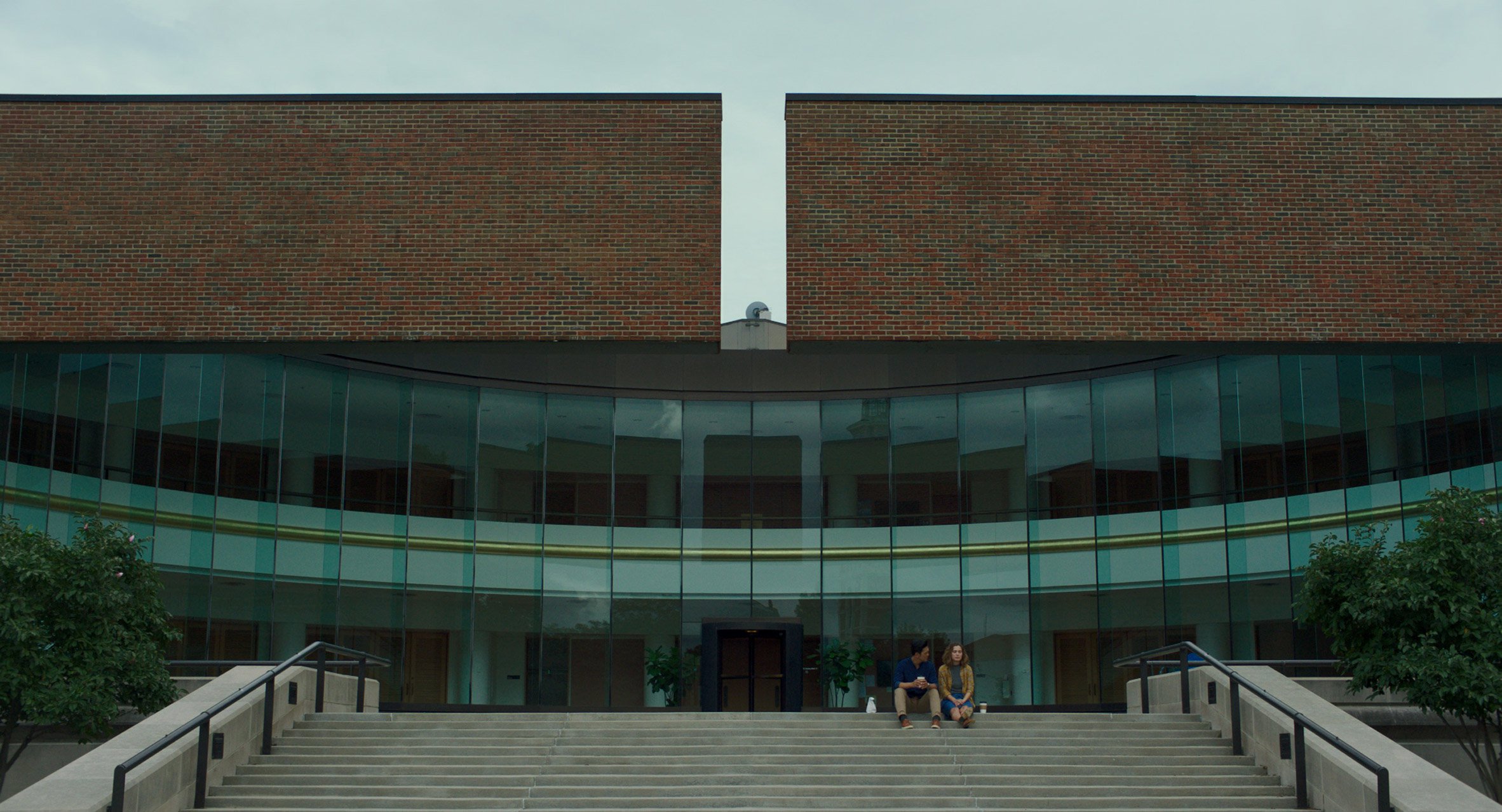
Columbus, Indiana is a town of less than 50,000, located about halfway between Indianapolis and Louisville, that happens to boast enough modernist architecture that its visitor’s guide includes tours of the iconic structures. It’s an improbable fact, a mecca of modernism in the heartland, that long-time video essayist / first-time director / one-name-haver Kogonada relishes in Columbus, one of the absolute best films of 2017 that I didn’t see until 2018.

It’s difficult — I’d argue impossible — to separate this debut feature from the numerous influences Kogonada has visually Haley Lu Richardson and public art in Columbusanalyzed at lengths short and shorter for Sight & Sound. The critic-turned-filmmaker is one of our more cherished notions, at least since the French New Wave exploded off the pages of journals and changed cinema forever, and Kogonada is a worthy heir to the tradition. No one really likes the writer’s crutch of dredging up disparate sources for comparison, magically encapsulating tendencies. (“It’s like Tarkovsky and David Bowie had a baby, in a room that Rimbaud grew up in and also the doctor was John Cage and he had recently been crashing on David Lynch’s couch and Patti Smith hated it.”). But in Columbus, the two presences that most make themselves felt are Ozu and Linklater — the silent, geometric, measured and the restless, grasping, shaggy. This is no accident. (And not just because the director’s name is “a clever heteronymous tribute to Yasujirō Ozu’s screenwriting partner, Kōgo Noda” and he made a terrific short about the Talky Texan, which hopefully is how Linklater enjoys being referenced.)
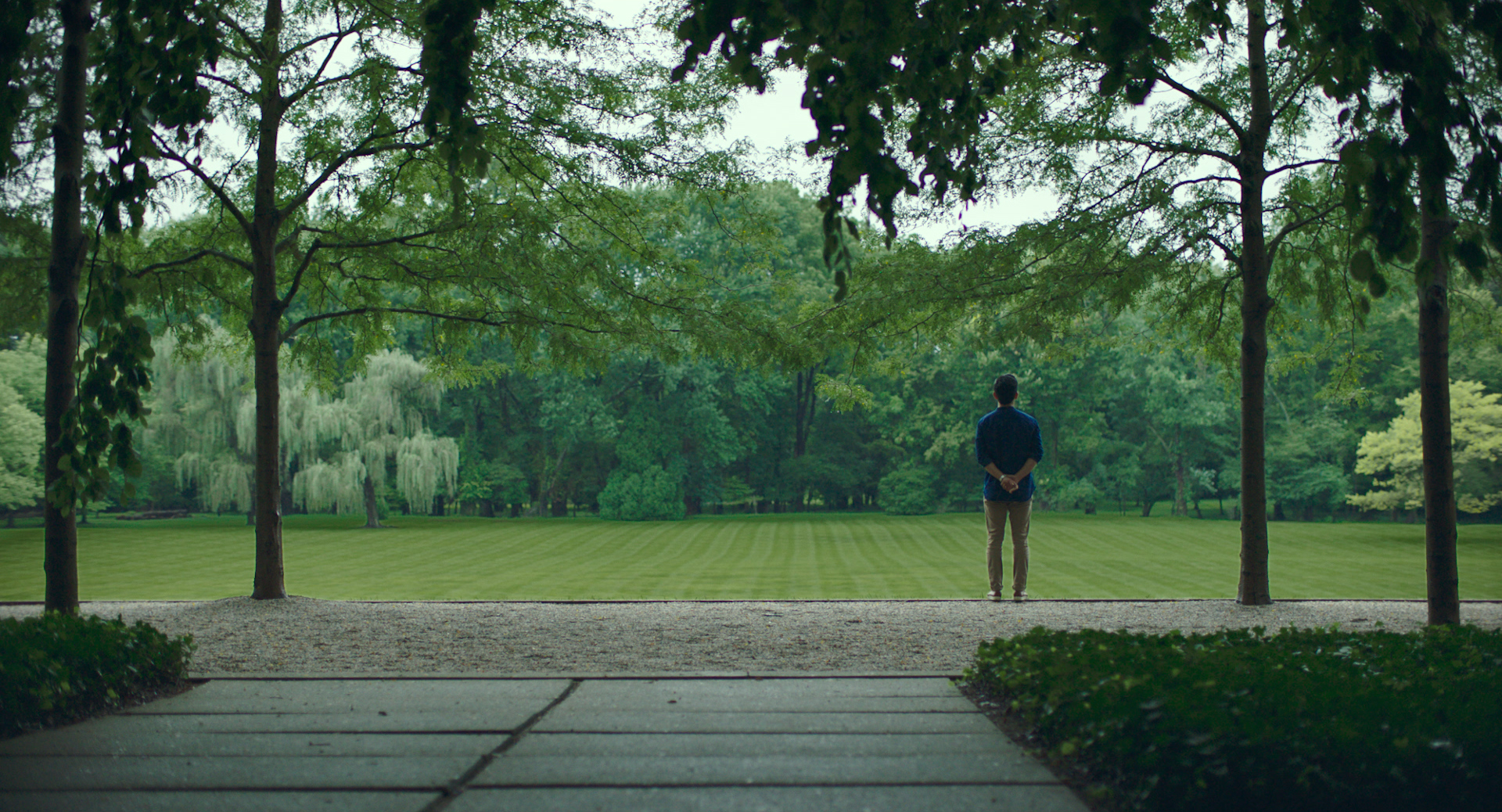
John Cho looking at landscape in ColumbusThe narrative is true to both. Jin (John Cho) comes to Indiana to attend to his ailing dad, an architecture luminary who’s fallen ill while in town to speak at a conference. He doesn’t much want to be there, professing a distaste for his father’s lifelong passion and a need to get back to work. (He’s a translator, between worlds.) He meets Casey (Haley Lu Richardson), who’s lived there all her life, and isn’t certain she wants to go anywhere else. She’d wanted to go to his dad’s talk, it turns out. Studious and funny, she’s also semi-parenting her own mom, who has addiction issues. She works at the library and smokes a lot.

Is this too twee? Will you be reassured to learn that Jin and Casey flee their individual prisons of care to go look at buildings? No?

Well, they do. And it is in these segments that Columbus lays bare its heart – a very good thing, given that these segments effectively constitute the film.

The two not-quite lovebirds toy with rom-com motifs as they travel through the city, with Casey the Tour Guide informing us of Columbus’ oddly prestigious architectural lineage, the beauty hiding in plain sight. Kogonada films this as dreamscape: each and every one of the places we visit serves to accentuate Casey’s history and fraught desires, these hopeful structures that ground her but just as easily indicate the things she’d secretly long to escape in the name of life, and to break down the walls Jin has created. Carefully constructed shots linger.

The two talk love and life and grief, like a Korean Jesse and a well-scrubbed Celine. The narratives that accompany places never eclipse the place itself – we see them experience them new, because they are shared. Some shots seem to cleave them into the darkness of memory and personal rumination; others seem to join them in light. Sometimes we veer away from this story, into others. Eventually, we reconnect.

Kogonada pairs also this shaggy plotting with visual rigor and a particular philosophy, or set of interests, that you don’t Empty architectural space in Columbusoften see in Western film. Empty space — or rather negative space, which is not empty — is foregrounded. Jin’s critic father left behind notes on his latest work, which the son, almost against his will but guided by either filial or cultural or personal compulsion, finds himself translating. One of the keys is a scrawled exclamation — “much ado about nothing!” Nothing is underlined.
It’s heady stuff that leaves us wondering, but in the mean time, it makes us look. More than anything, Columbus is an ode to looking — at the built environment, at the people around you, at the way things that are not there structure the ones that demonstrably are. All throughout last year, ghost buildings have been inescapable. They seem to speak, have something to tell us at this particular moment in history; about where we are grounded, how we are confined, how we are reflected, transported, maybe liberated, maybe murdered. Situated, in any case. The brute there-ness of the built environment marks it — though like in Fredric Jameson’s take on the glass cities we’ve created, they are somehow spectral, too.

Columbus agrees, and then proceeds to zoom in on absences in the visual design. Not as a simple, cute retort, but as an impossible supplement. Our things, and our lives, depend just as much on what is missing. Jin and Casey meet only briefly, but it’s pivotal for both of them. (Cho and Richardson are spectacular at conveying longing, regret, and hope. That is, humanity. They should be in every awards show; maybe their absence from them is a fun bit of meta-commentary.) One imagines that the future selves of these characters will, in some sense, be constructed around these fleeting walks in Indiana, looking at ostentatious masterpieces in the middle of “nowhere” and wondering what the fuck they’re going to do now. And they’ll be okay with that.

Someone please give Kogonada whatever he needs to make another movie.

January 11, 2018 0 comments
2 FacebookTwitterPinterestEmail
Jean-Pierre Leaud in The Death of Louis XIV
FilmReviews

Slow Cinema and Historical Memory: The Death of Louis XIV

by Lark January 10, 2018
written by Lark

We first see Jean-Pierre Leaud as Louis XIV in a wheelchair, being rolled through nature by his assistants. It’s the last time The Death of Louis XIV brings us outside. The rest of the film takes place in cramped quarters, mostly around the king’s bed, as he slowly recedes from life.

It’s a challenging movie, and one whose plot is wholly summed up in the title. Exemplars of the slow movie form, like Lav Diaz and Corneliu Porumboiu, still make some use of traditional plot turns, moments where the atmosphere in the room seems to change. They make slow films, but slow still implies some amount of motion. Here, Albert Serra just brings us through every moment in the king’s deterioration, until the final moment of his death, a moment that has been so delayed and postponed that even that leaves us without a feeling of change.

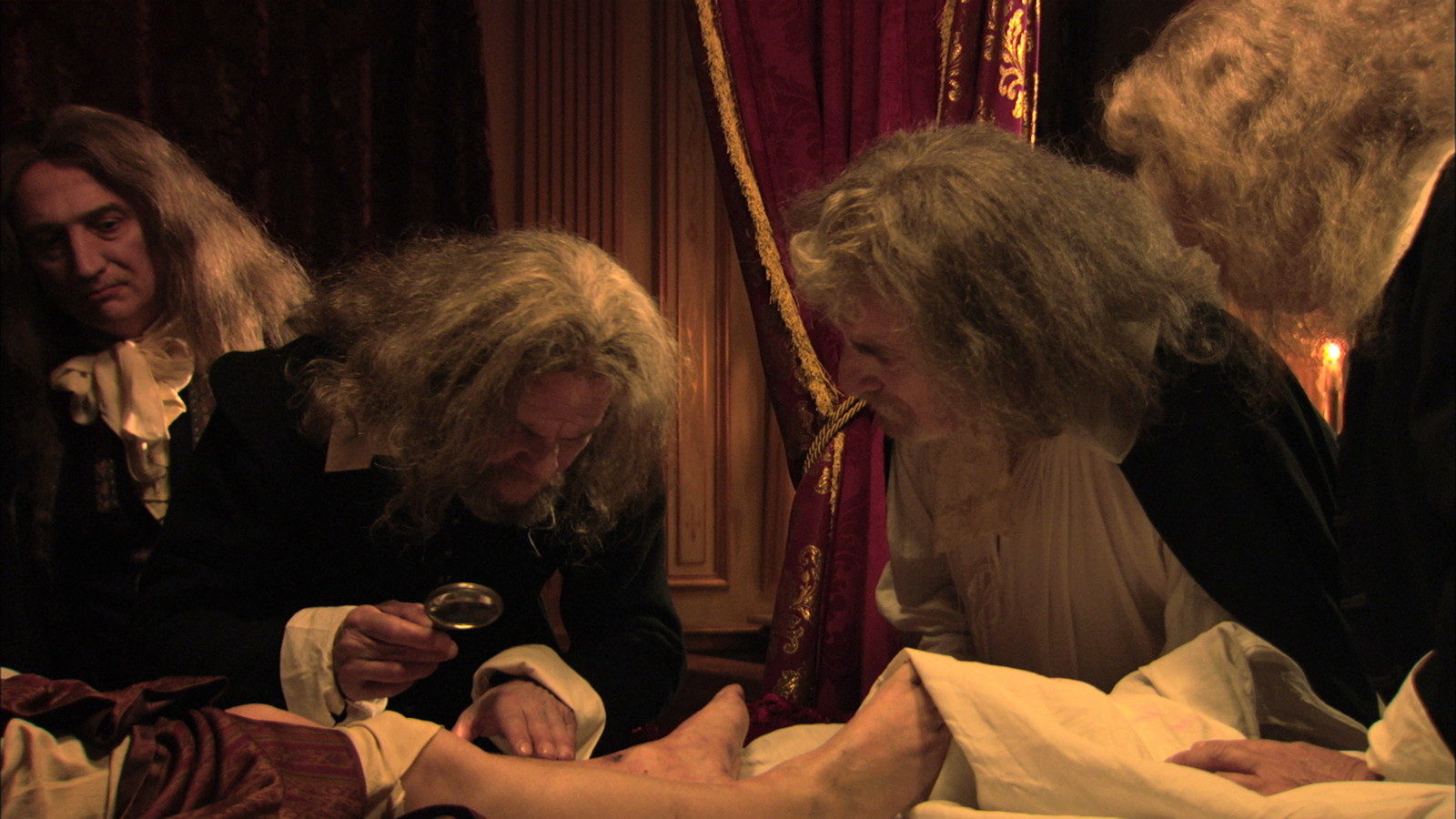
Examining the King's body in The Death of Louis XIVThe intensely cramped spaces shape the brilliant camerawork. Historical movies are defined by how they use masses, great groups of people reduced to form by their relationship with absolute authority. The most important camera relationship to bring about that effect is the bird’s eye view, which allows us to take it all in at once, to understand the scale. The bird’s eye view is a democratic alternative to placing the camera in the place of the monarch (or general or tyrant or…). Spectacle has, for most of human history, been organized specifically in relation to the particular place from which it can be wholly taken in, like the king’s seat at the theater.

Bird’s eye views separate the viewer from the place of power; they allow us to see the relationship in front of us (the masses of people organized around the kingly viewer) and a form of the spectacle (masses of people organized, regardless of shape). It’s a democratic move, but one that Albert Serra avoids.

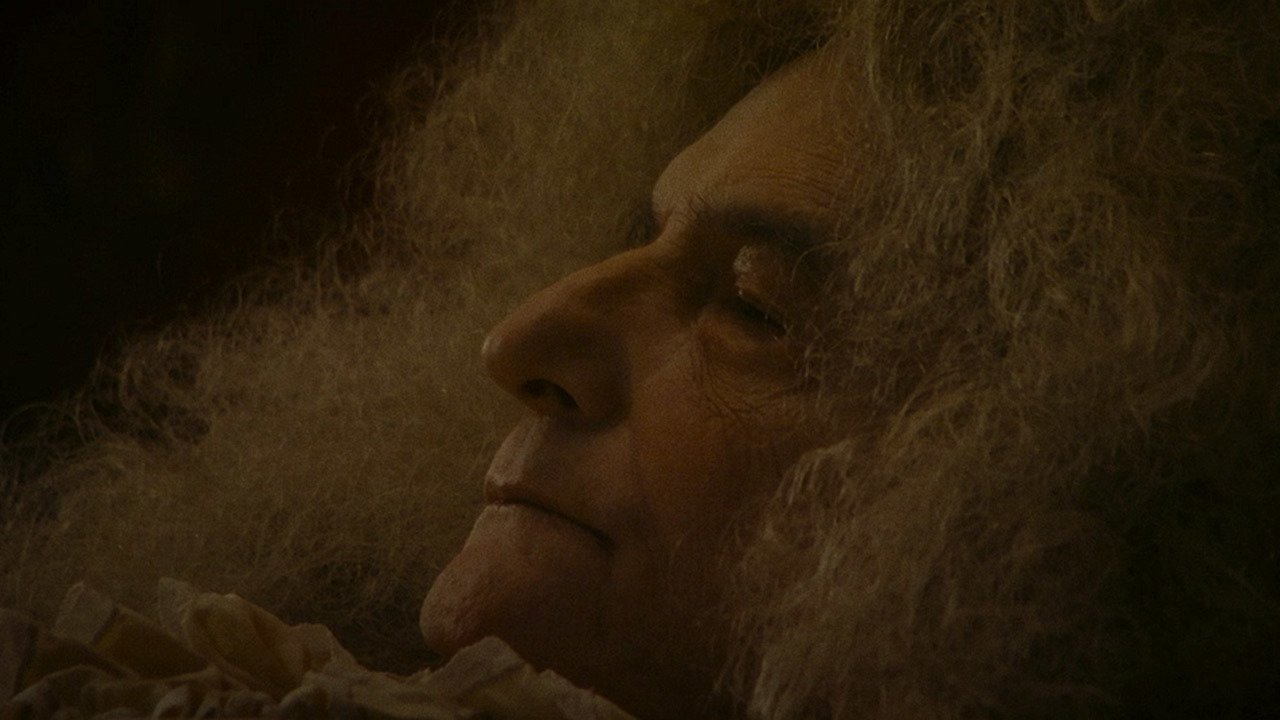
We spend most of Louis XIV roughly at neck level, near the king but off to one side, seeing almost upsettingly close shots ofJean-Pierre Leaud in The Death of Louis XIV his absurd wigs and desiccating body. Scenes operate in relationship to him—people talk to him, listen to him, give him food or water, examine his body—and we are both too close and too far to observe it either wholly subjectively or objectively. We are instead simply one more observer in a room full of them.

As Louis shrinks into himself (Leaud’s performance is incredible), there is a hole in the narrative space. There is no clear relationship of power, and the doctors have trouble deciding among themselves what to do. It’s an incredible narrative way of showing what the end of the longest reign in early modern history meant.

It’s an incredible example of how slow cinema can work; it’s a wonderfully unique historical film; it’s, honestly, barely a movie. Give it a look.

January 10, 2018 0 comments
2 FacebookTwitterPinterestEmail
Newer Posts
Older Posts

About

About

Towards a provisional theory of the cinema, or, failing that, just some shit about movies

Authors
Rick Kelley
Lark Lundberg

Keep in touch

Facebook Twitter

Categories

  • Conversation
  • Film
  • Film By Film
  • Great Movie Project
  • Great Movies: The Counter Programming
  • Guest
  • News
  • Other
    • Commentary
    • Film
    • Interview
    • Reviews
    • Song for a Sunday
  • Streaming Selections
  • TV
  • Uncategorized
  • Vegan Horror

Archives

  • April 2019
  • March 2019
  • January 2019
  • December 2018
  • November 2018
  • October 2018
  • September 2018
  • August 2018
  • July 2018
  • June 2018
  • May 2018
  • April 2018
  • March 2018
  • February 2018
  • January 2018
  • December 2017
  • November 2017
  • October 2017
  • September 2017
  • August 2017
  • July 2017
  • June 2017
  • May 2017
  • April 2017
  • March 2017
  • February 2017
  • January 2017
  • December 2016
  • November 2016
  • October 2016
  • September 2016
  • August 2016
  • July 2016
  • June 2016
  • May 2016
  • April 2016
  • March 2016
  • February 2016
  • January 2016
  • December 2015
  • October 2015
  • September 2015
  • August 2015
  • July 2015
  • June 2015
  • May 2015
  • April 2015
  • March 2015
  • February 2015
  • January 2015
  • December 2014
  • November 2014
  • October 2014
  • August 2009
  • September 2008

Recent Posts

  • China Girls, Death Proof, and the Hidden Face
  • Old News: Old Noise Edition
  • Old News: April 1, 2019
  • Nicolas Winding Refn, Marginalia, and the Deaths of Cinema
  • And now, let us praise Kanopy

Recent Comments

  • Franklin Kat on Michael Shannon shines again in Frank & Lola
  • Sean Tempesta on Cinema and dream-logic in Meshes of the Afternoon
  • ludditerobot on The Left-Wing Slapstick and Iconic Songs of 1937’s Street Angel
  • Franklin Kat on The Left-Wing Slapstick and Iconic Songs of 1937’s Street Angel
  • Arijit Mukherjee on Great Movies Project: The Counter-Programming
  • Facebook
  • Twitter

@2021 - All Right Reserved. Designed and Developed by PenciDesign


Back To Top
Luddite Robot
  • Reviews
  • Commentary
  • Great Movie Project
    • Great Movie Project
      Bride of Frankenstein is a movie for and…

      January 25, 2018

      Great Movie Project
      The Enduring Appeal of Nick and Nora in…

      November 29, 2017

      Great Movie Project
      The Ahistorical Fever Dream of The Scarlet Empress

      August 2, 2017

      Great Movie Project
      Dreams, Mundanity, and the Anarchist Yearnings of L’Atalante

      July 12, 2017

      Great Movie Project
      Duck Soup Is And Will Always Be A…

      April 19, 2017

  • Counter Programming
    • Great Movies: The Counter Programming
      Walking and Talking in the Shadow of Kanchenjungha

      March 7, 2018

      Great Movies: The Counter Programming
      A Brief Encounter in My Mother and Her…

      February 9, 2018

      Great Movies: The Counter Programming
      Horror’s Refusal in Farrokhzad’s The House Is Black

      October 13, 2017

      Great Movies: The Counter Programming
      The rage and beauty of The Cloud-Capped Star

      October 3, 2017

      Great Movies: The Counter Programming
      The daylight noir and social issue empathy of…

      June 22, 2017

  • Vegan Horror
    • Vegan Horror
      Julia Ducournau doesn’t think her film Raw is…

      June 7, 2017

      Vegan Horror
      Licking our wounds: The vampiric masculinity of Ravenous

      December 13, 2016

      Vegan Horror
      Eggertsson and animals: An approach to horror cinema

      September 15, 2016

      Vegan Horror
      “It’s Not My Nature” – Vegetarianism, Body Horror,…

      August 30, 2016

      Vegan Horror
      Bodies and Carcasses in Predator 2

      August 23, 2016

  • Interview
    • Interview
      Jasmine Leyva’s doc The Invisible Vegan aims to…

      May 3, 2017

      Interview
      Bridging The Abyss: An Interview With The Directors…

      November 28, 2016

      Interview
      7 Days in Ohio: An Interview with Nathan…

      September 12, 2016

      Interview
      Film Critic Phil Dy talks New Filipino Cinema

      June 17, 2016

      Interview
      “I Love Seeing Film Projected.” A Conversation with…

      March 22, 2016