Top Posts
Madeline’s Madeline: An Unclassifiable Panic Attack Maybe-Masterpiece
Shoplifters Steals Moments of Wonder from the Mundane
Burning and Forgetting What’s Not There
Kusama: Infinity Expands Beyond The Canvas
Mandy Risks Little, Wins Little
In We The Animals, The Children Are Away...
The Seagull Isn’t Quite Chekhov, But It’s Still...
5 Million Ways Boots Riley Isn’t Sorry To...
American Animals’ and the Queasiness of the Heist
A Star Is Born In Hearts Beat Loud
  • Reviews
  • Commentary
  • Great Movie Project
    • Great Movie Project
      Bride of Frankenstein is a movie for and…

      January 25, 2018

      Great Movie Project
      The Enduring Appeal of Nick and Nora in…

      November 29, 2017

      Great Movie Project
      The Ahistorical Fever Dream of The Scarlet Empress

      August 2, 2017

      Great Movie Project
      Dreams, Mundanity, and the Anarchist Yearnings of L’Atalante

      July 12, 2017

      Great Movie Project
      Duck Soup Is And Will Always Be A…

      April 19, 2017

  • Counter Programming
    • Great Movies: The Counter Programming
      Walking and Talking in the Shadow of Kanchenjungha

      March 7, 2018

      Great Movies: The Counter Programming
      A Brief Encounter in My Mother and Her…

      February 9, 2018

      Great Movies: The Counter Programming
      Horror’s Refusal in Farrokhzad’s The House Is Black

      October 13, 2017

      Great Movies: The Counter Programming
      The rage and beauty of The Cloud-Capped Star

      October 3, 2017

      Great Movies: The Counter Programming
      The daylight noir and social issue empathy of…

      June 22, 2017

  • Vegan Horror
    • Vegan Horror
      Julia Ducournau doesn’t think her film Raw is…

      June 7, 2017

      Vegan Horror
      Licking our wounds: The vampiric masculinity of Ravenous

      December 13, 2016

      Vegan Horror
      Eggertsson and animals: An approach to horror cinema

      September 15, 2016

      Vegan Horror
      “It’s Not My Nature” – Vegetarianism, Body Horror,…

      August 30, 2016

      Vegan Horror
      Bodies and Carcasses in Predator 2

      August 23, 2016

  • Interview
    • Interview
      Jasmine Leyva’s doc The Invisible Vegan aims to…

      May 3, 2017

      Interview
      Bridging The Abyss: An Interview With The Directors…

      November 28, 2016

      Interview
      7 Days in Ohio: An Interview with Nathan…

      September 12, 2016

      Interview
      Film Critic Phil Dy talks New Filipino Cinema

      June 17, 2016

      Interview
      “I Love Seeing Film Projected.” A Conversation with…

      March 22, 2016

Luddite Robot
Film critique, theory, and assorted nonsense.
CommentaryFilm

China Girls, Death Proof, and the Hidden Face

April 14, 2019

Old News: Old Noise Edition

April 8, 2019

Old News: April 1, 2019

Nicolas Winding Refn, Marginalia, and the Deaths of Cinema

CommentaryFilm

And now, let us praise Kanopy

January 24, 2019

Warren Sonbert and the Relief of Anti-Narrative

January 14, 2019

The World Is Ending and It Doesn’t Matter

The Best Films of 2018

FilmReviews

Madeline’s Madeline: An Unclassifiable Panic Attack Maybe-Masterpiece

December 21, 2018

Shoplifters Steals Moments of Wonder from the Mundane

December 11, 2018

Burning and Forgetting What’s Not There

Alien, Musicology, and Reading Soundtracks

CommentaryFilm

Shocktober III: Halloween 2018 Edition

October 24, 2018

Shirley Jackson’s The Lottery Traumatized Schoolkids in 16 mm

October 18, 2018

Shocktober 2018 II: Another Reshockening (of Horror)

Häxan is a movie made by a movie character

CommentaryFilm

Shocktober 2018

October 7, 2018

Unprofessional! Spring Night, Summer Night

October 3, 2018

The Wild Boys: A Luddite Robot Conversation

Kusama: Infinity Expands Beyond The Canvas

FilmReviews

The Babadook (Jennifer Kent, 2014)

by rick April 19, 2015
written by rick

Many horror movies are about external dangers coming to get you – monsters, demons, Dex Dogtective. But many are about the latent terror that was already there. Jennifer Kent’s brilliant, unsettling The Babadook is a recent example of the second sort.

Essie Davis plays Amelia, a widowed single mom raising her very odd, very exhausting son Samuel (Noah Wiseman). In a delicate roll-out, the film makes clear that Amelia’s husband was killed driving her to the hospital to give birth, so Samuel is a living reminder of this tragedy – his birthday and the anniversary of his father’s death are one and the same, which weighs heavily on Amelia.

Samuel, in general, weighs heavily on Amelia. He is in trouble at school, fixated on monsters and building weapons to fend them off, lashing out at his peers and scorned by them. In many ways, she is all he has, and the amount of time and emotional energy needed to deal with him makes the reverse true for her, as well. Family doesn’t even want to be around weird, potentially violent Samuel, and so Amelia is even further isolated.

Out of all this grating co-dependency and social isolation, an actual monster emerges. One night, Samuel pulls a bedtime story off the shelf called “The Babadook.” It’s a pop-up book and its titular character is a frightening vision, an ominous shadowy creature with long nails, sharp teeth, and a telltale knock (ba ba-ba DOOK DOOK DOOK). The book itself, written in rhyme, promises that once he’s released, you can’t get rid of him. And like in many a horror movie before it, opening the book was the first mistake. It’s not an ancient text written in Latin found in a basement of a haunted house, but the effect is the same.

Strange things begin to happen – bumps in the night, figures glimpsed in the corners of mirrors – and then escalate. Samuel is obsessed with the book, convinced it’s the monster he’s been preparing to protect his mother from. That’s a notable theme: all of his preparations and weapon-making, which fuel Amelia’s exhaustion and exasperation, are specifically to shield her from death by nefarious forces. It’s clear the randomness of his father’s death weighs as heavily on Samuel as it does on Amelia.

Amelia destroys the book but, of course, it returns to her doorstep. The pages at the back, previously blank, now show a series of horrors featuring her and her family (and the family dog). Freaked out, she contacts the police about a potential stalker, but their skepticism-bordering-on-concern makes clear they’ll be no help for this particular menace.

The film seems to build to a climactic showdown, but that’s not what director Jennifer Kent has in mind, exactly. Despite plenty of jump scares and battles with invisible forces, The Babadook isn’t really that kind of film. Its rather brilliant ending makes good on the book’s creepy promise: “If it’s in a word, or it’s in a look / You can’t get rid of the Babadook.”

Both leads are terrific, with Wiseman channeling Damien from The Omen at some points and simply a scared, wounded boy at others. Davis’ transformation throughout the film is astounding, exhaustion and stress reshaping her face even before the monster shows up. Kent pulls off a lot of neat tricks in The Babadook – particularly mining parental anxieties and the inner lives of children for scares, and presenting a monster who’s as scary offscreen as on. But the most effective trick she deploys is the most basic, and yet something all too rare in horror: keeping you on edge by creating and sustaining an atmosphere of dread borne out of a believable human relationship.

As a result, it’s never ludicrous that a monster from a pop-up book would haunt these people. They were haunted to begin with.
April 19, 2015 0 comments
0 FacebookTwitterPinterestEmail
FilmGreat Movies: The Counter ProgrammingReviews

Body and Soul (Oscar Micheaux, 1925) – Counter Programming The Great Movies

by rick April 19, 2015
written by rick

Part of an ongoing effort to watch a set of films from non-White, non-U.S., non-male, and/or non-straight filmmakers and depart a little from the Western canon. The intro and full list can be found here.

“Every race man and woman should cast aside their skepticism regarding the Negro’s ability as a motion picture star.” ~ Oscar Micheaux

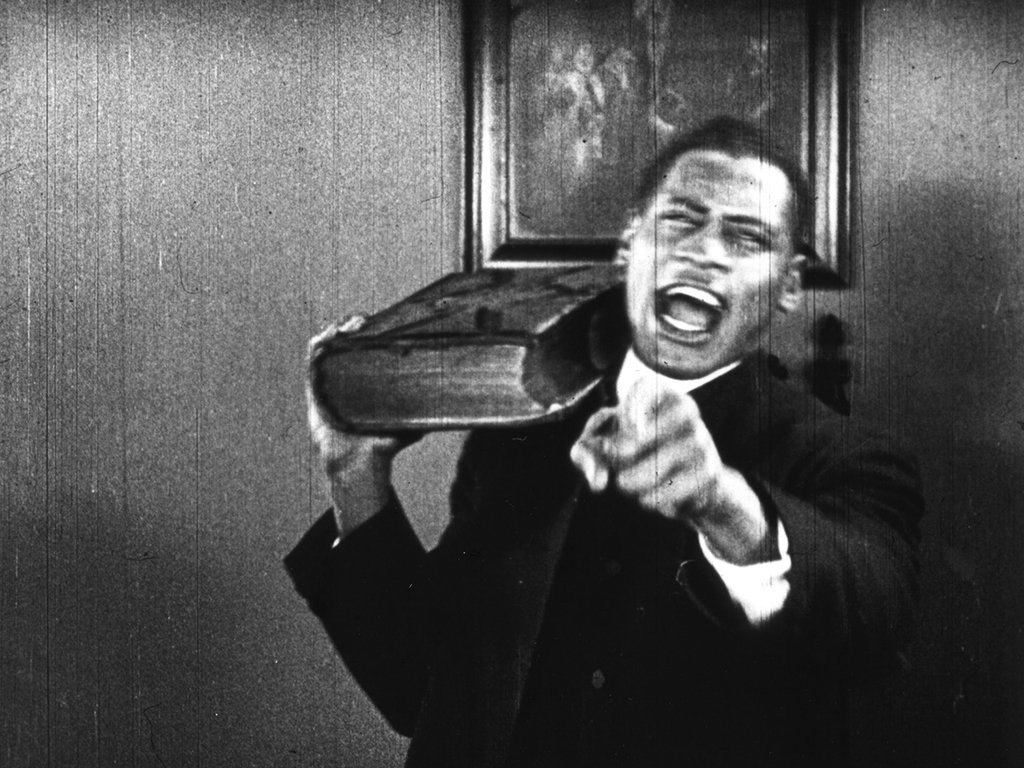
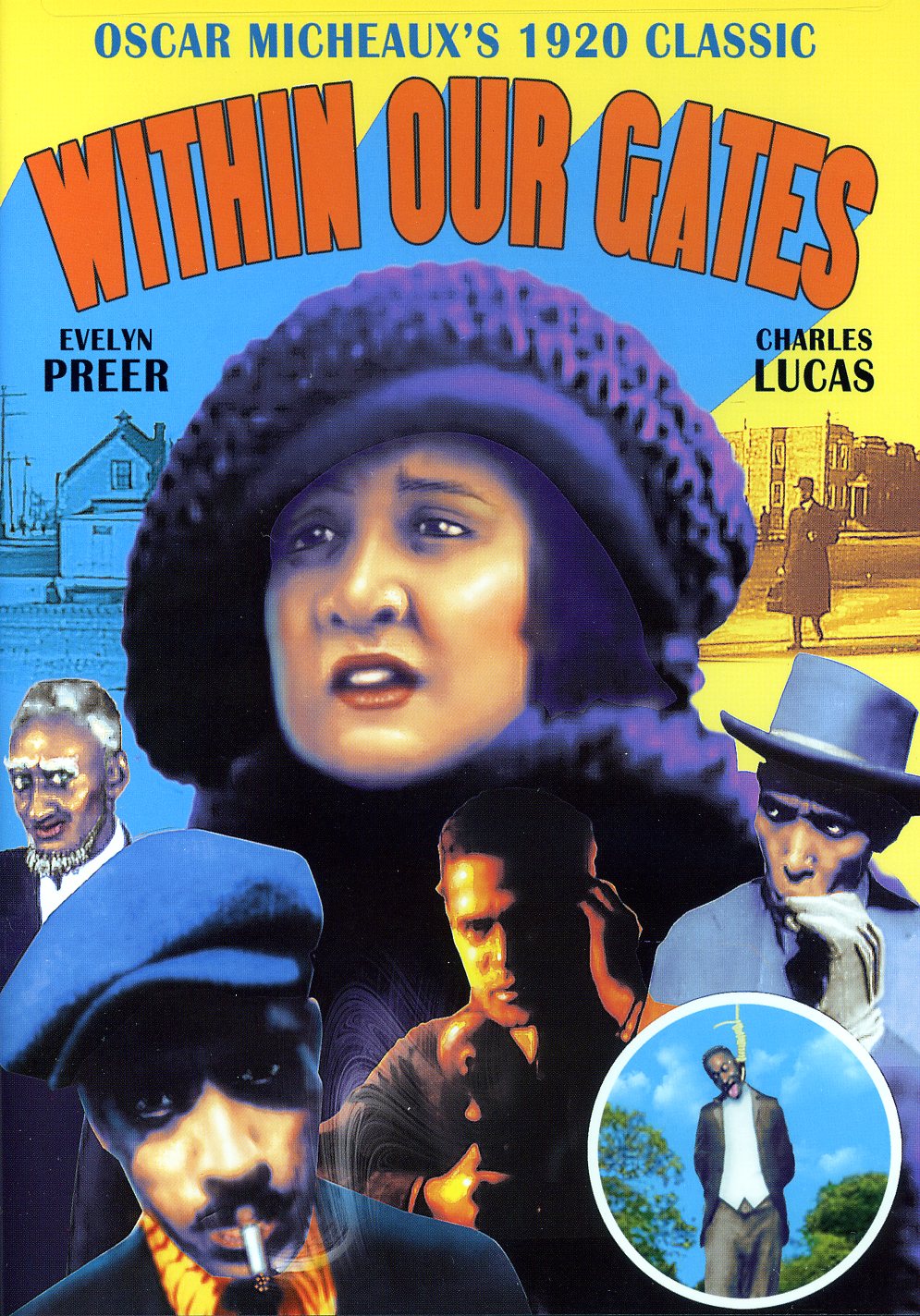
From the beginning of his filmmaking career, Oscar Micheaux’s earnestness, and his view that art could uplift and inspire the downtrodden, was on full display. In 1920’s Within Our Gates, his narratively clever semi-response to The Birth of a Nation, this took the form of passionate calls for educating the Black community and pushing for self-determination. Body and Soul, based on his own novel, is never so high-minded, opting instead for lurid melodrama. What Body and Soul does do, however, is mark the screen debut of Paul Robeson – and if Micheaux’s ambition was to demonstrate the potential star power of Black actors in cinema, then mission wildly accomplished.

Robeson is a towering figure in 20th century history, but in 1925 he was largely unknown outside of the New York stage scene. Three years later, this would change drastically: Robeson’s appearance in Kern and Hammerstein’s Show Boat immediately transformed him into one of the central Black performers known throughout the country, and the most beloved (for a time).

But in 1925, he was 27 years old, a Columbia-educated lawyer pursuing acting, and appearing in one of Micheaux’s “race movies,” financed, as always, outside of the Hollywood system and filmed on a miniscule budget. Body and Soul is compromised in many ways – since it was hacked away at by the New York censors, we have only a truncated version handed down from history, with Micheaux’s original vision completely lost – but Robeson is a magnetic presence in every scene.

He plays dual roles: an odious phony pastor calling himself Rt. Rev. Isaiah T. Jenkins and also kindly Sylvester, Jenkins estranged twin brother. (Richard Corliss noted: “A good twin and a bad twin? ‘Body and Soul’’ is a silent film after all, and the movie employs the melodramatic formulas of the period.”)

“The Reverend” is an inveterate drunk, swindler, and con-man who has nevertheless secured the adoration of his flock in small-town Georgia. He’s the kind of guy who demands free booze from the local drinking establishment and then follows up by extorting the proprietor for a donation to the Church, casually threatening to expose the illicit operation if he doesn’t comply. Like Old Ned, the pastor in Within Our Gates, he’s a hypocrite through and through; unlike Ned, he is totally untroubled by his hypocrisy. To the contrary — he seems to take great pleasure in hamming it up on the pulpit, while robbing the community blind.

A stranger comes to town who knows who Jenkins really is, and wants in on the action. A parallel plotline follows young Isabelle, her beau Sylvester, and Isabelle’s mother Martha Jane, who has been working hard to save money for the eventual marriage. However, they have different ideas of who will be in that wedding. Mom looks down on broke Sylvester and dismisses him as an option: a startling exchange, and one of the few overtly didactic touches on Micheaux’s part, occurs when Martha Jane says, “What’s that nigguh got to marry you on?” and Isabelle replies, “Don’t say that ma, it’s vulgar.” It goes without saying that the man Martha Jane has in mind is none other than his twin brother, the godly Reverend Jenkins.

There’s a sense that Micheaux is hinting at a generational gap in terms of aspirations, and definitely in terms of their relationships to the Church. To a person, the older people in town revere the Reverend because that’s what one does – it’s even in his title. For Isabelle, that’s not an option, and not just because she loves Sylvester.

Martha Jane cheerfully arranges for the Reverend and Isabelle to be alone together, ostensibly to talk about saving her soul, and takes her leave. She’s no sooner out the door than he physically assaults Isabelle, twisting her arm behind her back violently. The scene ends without further explanation, and, in a bold narrative move, it’s not until the end that we find out the context.

Still, left to our own imaginations (or especially so), it’s unsettling to read Jenkins’ reply when Martha Jane asks if she’s returned too early in the next scene: “It was a great struggle, Sister Martha, but the Lord’s Will be done.”

Isabelle flees town while her mom is at the store, hopping a train to Atlanta. Back at home, Martha Jane discovers all her savings are missing, and a note from Isabelle claiming to have taken them.

Months later, we’re treated to some lovely rooftop views of the big city, which seem to stand in contrast with the dirt roads and ramshackle structures back home. However, amid all this majesty, we eventually find Isabelle destitute and starving, walking hesitantly and slightly hunched like Lillian Gish in Broken Blossoms.

Martha Jane tracks her down in Atlanta, and Isabelle’s last act is tell her the true story that led to this tragic end. A flashback reveals that the Reverend, in addition to all his other reprehensible qualities, is a rapist as well. (This scene, while unpleasant, is one of Micheaux’s more visually experimental moments in the film — the shot focuses only on a man’s shows entering a half-lit room, and then exiting. In a film that seems largely uninterested in expressionistic touches, this stands out.) We circle back around via yet another flashback and learn what became of the money – surprise, it’s who you think it is. But that was never in doubt – Micheaux’s interest seems to be in the telling more than the story.

The film ends with a concession forced by the censors that’s totally at odds with the film. It deploys one of the great clichés we return to again and again, and it’s either laughable or regrettable (or both). I won’t spoil it but you can probably guess. One lesson is that censors usually don’t help a film stick the landing.

In any case, as in Within Our Gates, Micheaux favors flashbacks and circular structures, holding off on the reveal and then presenting it as a memory or a story being told. It’s an effective narrative technique that also serves an ideological purpose: it shows that these characters have a kind of interiority, that they remember, and relay. Unlike the Black caricatures of The Birth of a Nation or minstrel shows, and in even in this fairly broad melodrama, they are more than surface-level representations.

Robeson is incredible in his scenery-chewing villainous role, and charming as Sylvester (although he doesn’t get much to do, at least in the version that exists). He went on to star in many other films but seems invariably unhappy with the end products, which he felt were still caricatures and didn’t suit his increasingly militant politics. He, of course, went on to become a huge force in civil rights and social justice movements in addition to his work in the U.S. and abroad.

Body and Soul drew condemnation from the Black press at the time, as well as from the censors – its attack on corruption in the Black Church especially didn’t sit well, and many of Micheaux’s themes proved controversial (its inclusion of the threat of sexual assault from a Black protagonist uncomfortably recalls Griffith). But here, in the context of a melodrama rather than a polemic, it’s a depiction of a vile person and a corrupt system, not an argument that all such people are vile or all such systems corrupt.

Another quote from Micheaux: “We want to see our lives dramatized on the screen as we are living it, the same as other people, the world over.” It’s unlikely too many people are living lives filled with the over-the-top drama of Body and Soul – or dealing with the threat posed by Evil Twins, for that matter – but there are surely recognizable aspects.

Watching it now, it’s clear Micheaux’s films allowed for a range of characterization that mainstream cinema invariably denied. His narrative structures remain fascinating, and Robeson is a star in his first film. If the “race movies” lacked the finesse and visual experiments of their contemporaries, that was because there was no money, but also because the goal was different. For Micheaux and other filmmakers at the time, simply telling these stories represented a triumph.

Next up: Lotte Reiniger’s The Adventures of Prince Achmed

April 19, 2015 0 comments
0 FacebookTwitterPinterestEmail
FilmGreat Movies: The Counter ProgrammingReviews

Within Our Gates (Oscar Micheaux, 1920) – Counter Programming The Great Movies

by rick April 13, 2015
written by rick

Part of an ongoing effort to watch a set of films from non-White, non-U.S., non-male, and/or non-straight filmmakers and depart a little from the Western canon. The intro and full list can be found here.

What if The Birth of a Nation, D W Griffith’s groundbreaking and deeply nasty epic, had been made by Black people in the U.S., the community it most excluded, caricatured, and vilified? Oscar Micheaux’s moving 1920 silent Within Our Gates suggests one answer.

Micheaux himself claimed his second film was not in direct response to Griffith’s notorious requiem for “the empire of the South,” but the mirror-image nature of Birth of a Nation’s plot structure and use of technical devices make that more than a little difficult to believe. Even taking Micheaux at his word and leaving aside questions of intention and influence, the similarities are fascinating and hard to miss.

While Birth of a Nation begins with white family members from the North visiting relatives on a plantation in the South, Micheaux’s film introduces us in its early scenes to Sylvia Landry, a Black Southern school teacher visiting her cousin Alma in the North. Sylvia’s waiting for her beau Conrad to return, in the hopes they will be married. Micheaux paints a lived-in, believable portrait of bourgeois Northern Black life – barely a white person to be seen until the movie’s half over – and lays the groundwork for a classic melodrama.

Alma, we learn, also loves Conrad, and so she engineers a situation in which Sylvia looks compromised, off alone in a room with another man (and a white one, at that). After a rage-fueled, but not lethal, attack on his beloved, Conrad  flees, and we never hear from him again. (Apparently, he goes to Brazil, but this footage has been lost.) Uninterested in other local options, like Alma’s brother-in-law Larry, a petty thief and gambler, Sylvia returns home, to the South and to her school.

The school, Piney Woods, is facing tough times. Devoted to the education of Black children in the South, it is underfunded and overcrowded. Rev. Jacobs, who runs it, can’t bring himself to refuse any children who want to come, since he believes it’s both a Christian mission to accept them and a secular responsibility to future generations. This resonates throughout: the film frequently echoes W.E.B. Dubois in its call for education as a means of empowerment and self-determination, but also shows all the roadblocks – financial, ideological, and prejudicial – thrown in the way. While Jacobs and Sylvia believe an educated populace will be better positioned to fulfill their potential and less likely to be duped and abused, the wider society – mostly Whites, but some Blacks too – actively wants to maintain the status quo.

On the brink of bankruptcy, Sylvia again travels north, this time trying to raise the needed funds to keep the school open. She has little luck, until a White woman hits her with her car one day. (An extreme but effective source of school funding.) It’s an accident – Sylvia had pushed a child out of the car’s way – but the vehicle’s owner turns out to be a wealthy, forward-thinking philanthropist, and hearing Sylvia’s pitch, agrees to fork over the money. Their interaction has a bit of the flavor of Birth of a Nation’s Ben Cameron in the hospital after being wounded sheltering a Northern soldier: in both cases, their selflessness and willingness to put their bodies on the line for those on the other side of the ranks are rewarded.

The sequence in which Sylvia explains her predicament is the first time, of several, that Micheaux deploys a flashback. For all its lauded cutting between locations, Birth of a Nation was never so audacious. As she describes the school, we get a soft dissolve to earlier footage of a father dropping off his kids to Rev. Jacobs, entrusting him with their future, and then back to Sylvia. It’s a technique we take for granted now, but the first time I’ve seen it in any of the films on the Great Movies list.

Of course, this is the same year that The Cabinet of Dr. Caligari was messing with perspective and time and a full five years since Birth of a Nation came out, but it’s notable all the same. The audience is meant to understand that events depicted on screen are not happening in sequential time, that memories are being invoked for current action. And we do, instantly.

Even more elaborate flashbacks are in store. After securing the school’s funding, over the objections of a deeply racist acquaintance of the benefactor, Sylvia’s story comes to light. The film effectively leaps backwards in time, and then circles around to show how her history impacts the story in the present. While Within Our Gates is aesthetically pretty staid, content with mid-shots for the most part, its narrative structure is daring.

Our leap back to Sylvia’s past reveals that her own education, and her ability to recognize her adoptive parents were being ripped off by the landlord, leads to the lynching of her entire family. We understand that her passion for education is rooted in this. Unlike Birth of a Nation, Within Our Gates shows the horror of lynching in full, in this case cross-cut with an attack on Sylvia by a white man (who ends up being much closer to her than either of them realize).

Where Griffith’s film was fixated on the ever-present threat of Black male sexuality (representing the dangers of a new social order), Micheaux focuses on the much more proximate (and real) horror of white terror. It’s a terrifying vision, and the film argues there are few ways out.

There are several lynchings in the film, and even more references to them. This is a world apart from Griffith’s bucolic South, and offers a welcome corrective.

Micheaux also levels his sights at the palliatives of religion – embodied in the figure of Old Ned, a hypocritical pastor who tells the congregation to keep their heads low and wait for heaven – and Efrem, a shucking and jiving kissass who mainly wants to curry favor with the whites in power. It doesn’t end well for either of them, despite their allegiances.

However, even Old Ned and Efrem are extended sympathy from the film. There’s the sense that individuals are doing what they feel they need to get by, and that the social order itself is sick.

Like many a story before it, Within Our Gates closes with a marriage. It signals hope for a better day, and the title cards urge Black folks to acknowledge their centrality to the nation and resist notions of Otherness – “We were never immigrants,” one character says.

The film, as it exists today, is in many ways a bit artless, but that’s an incredibly radical sentiment for 1920, accidentally evoking Malcolm X’s famous statement, “We didn’t land on Plymouth Rock. The rock landed on us.”

Within Our Gates is generally grouped with what were known as “race movies” – that is, movies that featured largely Black casts and dealt with these issues in the teens and 20’s. But it’s also a fascinating interrogation of contemporary norms and a challenge, to Griffith specifically (no matter what its creator says). It’s generally considered the oldest film from a Black director that has survived.

Even in 1920, filmmakers like Micheaux were trying to capture the nuances of everyday lives that we don’t usually see on screen. Whether he did it to open the field up for different representations, as a response to mainstream depictions, or just because these stories spoke to him, it can’t help but stand in contrast to the larger, whiter paradigm that dominated then, and continues to dominate now.

Watching Within Our Gates now, I’m most struck by how much is packed into this thing: an anti-racist narrative, anxieties about mixed race heritage, women’s suffrage and white Northern women’s racist opposition to it, the Great Migration, long discourses on education and the desire of parents everywhere that their kids will do better than they did. It’s amazing how many themes Micheaux hits which still resonate.

Mostly, I’m struck by the blending of its characters’ longing for a better world, and the brutality of the one in which they find themselves. Some things don’t change.

Next up: Body And Soul, another from Micheaux, starring Paul Robeson.

April 13, 2015 0 comments
1 FacebookTwitterPinterestEmail
Counter Programming The Great Movies dog
CommentaryFilmGreat Movie ProjectGreat Movies: The Counter Programming

Great Movies Project: The Counter-Programming

by rick April 5, 2015
written by rick

When I first decided to embark on a quest to watch each of the films in Roger Ebert’s Great Movies series, I couldn’t help noticing that the list of familiar names and titles excluded vast parts of the filmmaking and -watching world.

This isn’t to Ebert’s discredit – the movies that have received the most attention and acclaim are the ones he sought to highlight, and those have mostly issued from traditions and movements that historically showcase white, male, straight filmmakers from the U.S., England, and Europe (with a healthy dollop of Kurosawa in the mix).

So when I considered tackling the already fairly unreasonable 370 films in his list, I also thought I’d counter-program The Plan with an equal number of movies that diverged from expectation. The Counter-Programming The Great Movies list I’ve finally arrived at is below. I’m going to watch all of these too.

A few words on methodology are needed. It immediately became clear how different this Great Movies project was from the first – in the case of Ebert’s list, there’s a ready-made canon to explore (or re-explore, in the case of films I’ve already seen). But making up a new one out of whole cloth would be impossible – fundamentally, it’s just impossible to make a list of “great movies you mostly haven’t seen.” It would become a random enterprise.

So, I solicited suggestions from knowledgeable friends, and looked around for guidance. I went through the entirety of the 1,000 greatest films of all time composed by the folks at They Shoot Pictures, Don’t They?, and segmented out films from non-white, non-Western, non-male, and/or non-straight filmmakers. I also relied heavily on the Great Movie lists posted on MUBI, the House Next Door, this Flavorwire compilation, and a bunch of Letterboxd offerings, especially Death To The Western Canon. I also dropped the titles that do appear on Ebert’s list.

In an ironic but unsurprising way, it’s hard to compose a list of movies you haven’t seen or heard of, in order to familiarize yourself with things you haven’t seen or heard of. Many of these titles and directors (though not all) are completely unknown to me, so their inclusion below started to seem random: it’s completely and totally based on the advice of others.

I briefly toyed with the idea of weighting them in different ways – how many lists they appear on, how many awards they’ve won, just how removed from the mainstream they are, limiting number of movies for a given year, etc. – but quickly decided that was a terrible idea and not in keeping with the project. The last thing anyone needs is for a white, straight guy from the U.S. to assign relative values to these films in order to assess their importance. There’s also the very real danger of Great Movies tokenism – like getting one film from each demographic I can think of – which is something I hope to avoid.

That said, a number are on here simply because I want to see them, or plug specific gaps in my knowledge (examples: independent Black U.S. cinema, early cinema from outside the U.S., Korean and Indian films in general, and especially films from across the African continent). So this should not be thought of as a one-to-one corollary to Ebert’s Great Films – I haven’t even seen most of these to call them great. That’s the point. But they have at least been recognized as important by someone I trust (even if just a friend), which is good enough for me.

In a final twist, I’ve left 30 spots blank at the end. I know beyond all doubt that I’ve missed obvious things, and I hope you can tell me what those great movies are. (Bonus points for early cinema – just kidding, there are no points, but that would be helpful.) Since this is yet another enormous list, there’s no rush, but I’d appreciate some suggestions to round things out.

I’m looking forward to this, and hope you are, too! Like the Great Movies page, I will update this one as I progress.

Let’s do this thing.

Film Year Director
Within Our Gates 1920 Oscar Micheaux
Body and Soul 1925 Oscar Micheaux
The Adventures of Prince Achmed 1926 Lotte Reiniger
Crossroads 1928 Teinosuke Kinugasa
Limite 1931 Mario Peixoto
The Blood of a Poet 1932 Jean Cocteau
The Dancing Girl of Izu 1933 Heinosuke Gosho
The Goddess 1934 Yonggang Wu
Our Neighbor, Miss Yae 1934 Yasujirô Shimazu
Let’s Go With Pancho Villa! 1936 Fernando de Fuentes
Street Angel 1937 Muzhi Yuan
God’s Step Children 1938 Oscar Micheaux
The Blood of Jesus 1941 Spencer Williams
Meshes of the Afternoon 1943 Maya Deren
The Ball at the Anjo House 1947 Kôzaburô Yoshimura
Fireworks 1947 Kenneth Anger
Spring In a Small Town 1948 Mu Fei
Children of the Beehive 1948 Hiroshi Shimizu
A Hometown in Heart 1949 Yong-Kyu Yoon
Un Chant d’Amour 1950 Jean Genet
Awaara 1951 Raj Kapoor
Where Chimneys Are Seen 1953 Heinosuke Gosho
Wild Geese 1953 Shiro Toyoda
An Inn at Osaka 1954 Heinosuke Gosho
A Bloody Spear on Mt. Fuji 1955 Tomu Uchida
You Were Like A Wild Chrysantheum 1955 Keisuke Kinoshita
Pyaasa 1957 Guru Dutt
Snow Country 1957 Shirô Toyoda
The Flower in Hell 1958 Sang-ok Shin
The Pathetic Fallacy 1958 Ritwik Ghatak
Cairo Station 1958 Youssef Chahine
Blessings of the Land 1959 Manuel Silos
Daughters, Wives, and a Mother 1960 Mikio Naruse
The Cloud-Capped Star 1960 Ritwik Ghatak
Immortal Love 1961 Keisuke Kinoshita
My Mother and her Guest 1961 Sang-ok Shin
The Given Word 1962 Anselmo Duarte
Kanchenjungha 1962 Satyajit Ray
The Twelve Chairs 1962 Tomás Gutiérrez Alea
Barren Lives 1963 Nelson Pereira dos Santos
Dry Summer 1963 Metin Erksan
Flamin Creatures 1963 Jack Smith
The Servant 1963 Joseph Losey
Flaming Creatures 1963 Jack Smith
The House Is Black 1963 Forugh Farrokhzad
En Un Barrio Viejo 1963 Nicholas Guillen Landrian
Eros 1964 Walter Hugo Khouri
The Guns 1964 Ruy Guerra
Scorpio Rising 1964 Kenneth Anger
Black God, White Devil 1964 Glauber Rocha
I Am Cuba 1964 Mikhail Kalatozov
Nothing But A Man 1964 Michael Roemer
Chronica de un Nino Solo 1965 Leonardo Favio
A Fugitive From The Past 1965 Tomu Uchida
The Brick and the Mirror 1965 Ebrahim Golestan
My Hustler 1965 Andy Warhol and Chuck Wein
Le Bonheur 1965 Agnes Varda
The Round-Up 1965 Miklos Jancso
Come Drink With Me 1966 Sammo Hung, King Hu
And So It Is 1966 Jorge Sanjinés
Black Girl 1966 Ousmane Sembene
Daisies 1966 Vera Chytilova
The Night It Rained 1967 Kamran Shirdel
Memories of Underdevelopment 1968 Tomás Gutiérrez Alea
Terra Em Transe 1967 Glauber Rocha
The Jungle 1967 Charlie “Brown” Davis, Jimmy “Country” Robinson, and David “Bat” Williams
Oh, Sun 1967 Med Hondo
Camp De Thiaroye 1967 Ousmane Sembene
The Hour of the Furnaces 1968 Octavio Getino, Fernando E. Solanas
Lucia 1968 Humberto Solás
Teorema 1968 Pier Paolo Passolii
Symbiopsychotaxiplasm 1968 William Greaves
The Story of a Three-Day Pass 1968 Melvin Van Peebles
The Land 1969 Youssef Chahine
Invasion 1969 Hugo Santiago
Our Daily Bread 1970 Mani Kaul
Antonio Das Mortes 1969 Glauber Rocha
The Learning Tree 1969 Gordon Parks
Hope 1970 Serif Gören, Yilmaz Güney
Trash 1970 Paul Morrissey
Watermelon Man 1970 Melvin Van Peebles
The Courage of the People 1971 Jorge Sanjinés
A Touch of Zen 1971 King Hu
Death in Venice 1971 Luchino Visconti
Sunday Bloody Sunday 1971 JohnSchlesiner
Shaft 1971 Gordon Parks
Sweet Sweetback’s Baadassss Song 1971 Melvin Van Peebles
The Brickmakers 1972 Marta Rodríguez, Jorge Silva
The Bitter Tears of Petra Von Kant 1972 Rainer Werner Fassbinder
Pakeezah 1972 Kamal Amrohi
Pink Flamingos 1972 John Waters
Black Girl 1972 Ossie Davis
Super Fly 1972 Gordon Parks Jr.
Castle of Purity 1973 Arturo Ripstein
Sambizanga 1973 Sarah Maldoror
The Dupes 1973 Tewfik Saleh
Touki Bouki 1973 Djibril Diop Mambéty
27 Down 1973 Awtar Krishna Kaul
The Holy Mountain 1973 Alejandro Jodorowsky
Daily Life in a Syrian Village 1974 Omar Amiralay
Weighed But Found Wanting 1974 Lino Brocka
Still Life 1974 Sohrab Shaheed Salles
Ankur 1974 Shyam Benegal
Female Trouble 1974 John Waters
The Battle of Chile – Part I 1975 Patricio Guzman
In Two Minds 1975 Mani Kaul
Promise of the Flesh 1975 Kim Ki-young
Xala 1975 Ousmane Sembene
Fox and His Friends 1975 Rainer Werner Fassbinder
Jeanne Dielman, 23 Quai Du Commerce, 1080 Bruxelles 1975 Chantal Ackerman
The Dislocation of Amber 1975 Hussein Shariffe
Let’s Do It Again 1975 Sidney Poitier
Cornbread, Earl and Me 1975 Joseph Manduke
Friday Foster 1975 Arthur Marks
Sao Bernardo 1976 Leon Hirszman
Harvest: 3,000 Years 1976 Hailie Gerima
Manthan 1976 Shyam Benegal
Three Godless Years 1976 Mario O’Hara
Insiang 1976 Lino Brocka
Je, Tu, Il, Elle 1976 Chantal Ackerman
The Ascent 1976 Larisa Shepitko
Harlan County USA 1976 Barbara Kopple
News From Home 1976 Chantal Ackerman
The Long Night 1976 William King, Jr.
The Ritual 1977 Girish Kasaravalli
Perfumed Nightmare 1977 Kidlat Tahimik
The Rites of May 1977 Mike De Leon
The Battle of Chile – Part II 1977 Patricio Guzmán
Ceddo 1977 Ousmane Sembène
Io Island 1977 Kim Ki-young
Bhumika: The Role 1977 Shyam Benegal
Donkey in a Brahmin Village 1978 John Abraham
The 36th Chamber of Shaolin 1978 Lau Kar-leung
In a Year of 13 Moons 1978 Rainer Werner Fassbinder
Killer of Sheep 1978 Charles Burnett
A Dream Is What You Wake From 1978 Larry Bullard and Carolyn Johnson
And Quiet Rolls The Dawn 1979 Mrinal Sen
Jaguar 1979 Lino Brocka
From The Clouds To The Resistance 1979 Jean-Marie Straub and Daniele Huillet
Penitentiary 1979 Jamaa Fanaka
The Age of the Earth 1980 Glauber Rocha
Too Early, Too Late 1981 Jean-Marie Straub and Daniele Huillet
Will 1981 Jessie Maple
Querelle 1982 Rainer Werner Fassbinder
Yol 1982 Serif Goren & Yilmaz Guney
God’s Gift 1982 Gaston Karore
Ashes and Embers 1982 Haile Gerima
Illusions 1982 Julie Dash
Sugar Cane Alley 1982 Euzhan Palcy
The Wind 1982 Souleymane Cisse
Losing Ground 1982 Kathleen Collins
Suzanne, Suzanne 1982 Camille Billops
El Sur 1983 Victor Erice
The Times of Harvey Milk 1984 Rob Epstein
Black Devil Doll From Hell 1984 Chester Novell Turner
My Beautiful Laundrette 1985 Stephen Frears
Taipei Story 1985 Edward Yang
The Time To Live and the Time To Die 1985 Hou Hsiao-hsien
Vagabond 1985 Agnes Varda
Sarraounia 1986 Med Hondo
Handsworth Songs 1986 John Akomfrah
Ethnic Notions 1986 Marlon Riggs
She’s Gotta Have It 1986 Spike Lee
Red Sorghum 1987 Zhang Yimou
Yeelen 1987 Souleymane Cisse
Brightness 1987 Souleymane Cisse
Superstar: The Karen Carpenter Story 1988 Todd Haynes
Landscape In The Mist 1988 Theo Angelopoulos
Looking For Langston 1988 Isaac Julien
Tongues Untied 1989 Marlon Riggs
Time Of The Gypsies 1989 Emir Kusturica
Yaaba 1989 Idrissa Ouedraogo
Chamelon Street 1989 Wendell B. Harris Jr.
Tongues Untied 1989 Marlon Riggs
I Am Somebody 1989 Madeline Anderson
The Garden 1990 Derek Jarman
Paris is Burning 1990 Jennie Livinston
An Angel At My Table 1990 Jane Campion
The Law 1990 Idrissa Ouedraogo
To Sleep With Anger 1990 Charles Burnett
Night Cries: A Rural Tragedy 1990 Tracey Moffatt
A Dance For Heroes 1990 Cheick Oumar Sissoko
Tilai 1990 Idrissa Ouedraogo
Def By Temptation 1990 James Bond III
My Own Private Idaho 1991 Gus Van Sant
Tinpis Run 1991 Pengau Nengo
Boyz N The Hood 1991 John Singleton
Daughters of the Dust 1991 Julie Dash
New Jack City 1991 Mario Van Peebles
The Living End 1992 Gregg Araki
The Lon Day Closes 1992 Terence Davies
And Life Goes On 1992 Abbas Kiarostami
Hyenes 1992 Djibril Diop Mambety
Quince Tree of the Sun 1992 Victor Erice
Malcolm X 1992 Spike Lee
One False Move 1992 Carl Franklin
Deep Cover 1992 Bill Duke
Finding Christa 1992 Camille Billops and James Hatch
Just Another Girl On The I.R.T. 1992 Leslie Harris
Totally F***ed Up 1993 Gregg Araki
Blue 1993 Derek Jarman
D’Est 1993 Chantal Ackerman
The Piano 1993 Jane Campion
The Puppetmaster 1993 Hou Hsiao-hsien
The Man By The Shore 1993 Raoul Peck
Africa, I Will Fleece You 1993 Jean-Marie Teno
Sankofa 1993 Haile Gerima
Guelwaar 1993 Ousmane Sembene
Satantago 1994 Bela Tarr
Through The Olive Trees 1994 Abbas Kiarostami
Little Women 1994 Gillian Armstrong
Silences of the Palace 1994 Moufida Tlatli
Ulysses’ Gaze 1995 Theo Angelopoulos
Underground 1995 Emir Kusturica
Friday 1995 F. Gary Gray
When It Rains 1995 Charles Burnett
Devil In A Blue Dress 1995 Carl Franklin
The Watermelon Woman 1995 Cheryl Dunye
Beautiful Thing 1996 Hettie Macdonald
The Delta 1996 Ira Sachs
A Moment of Innocence 1996 Mohsen Makhmalbag
John Henrik Clarke: A Great and Might Walk 1996 St. Clair Bourne
Pickpocket 1997 Jia Zhangke
The River 1997 Tsai Ming-liang
Eve’s Bayou 1997 Kasi Lemmons
Skirt Power 1997 Adama Drabo
Buud Yam 1997 Gaston Jabore
Those Who Love Me Take The Train 1998 Patrice Chereau
Kisangani Diary 1998 Hubert Sauper
Beau Travail 1999 Claire Denis
Sicilia! 1999 Jean-Marie Straub and Daniele Huillet
Boys Don’t Cry 1999 Kimberly Pierce
The Little Girl Who Sold The Sun 1999 Djibril Diop Mambety
Genesis 1999 Cheick Oumar Sissoko
The Gleaners & I 2000 Agnes Varda
Platform 2000 Jia Zhangke
Set Me Free 2000 Lea Pool
Adanggaman 2000 Roger Gnoan M’Bala
Lumumba 2000 Raoul Peck
The Blackboard 2000 Samira Makhmalbaf
Love and Basketball 2000 Gina Prince-Bythewood
Punks 2000 Patrik-Ian Polk
La Cienaga 2001 Lucrecia Martel
Shrek 2001 Vicky Jenson
The Taste of Others 2001 Agnes Jaoui
Fat Girl 2001 Catherine Breillat
Kandahar 2001 Mohsen Makhmalbag
Atanarjuat: The Fast Runner 2001 Zacharias Kunuk
Blissfully Yours 2002 Apichatpong Weerasetakul
Talk To Her 2002 Pedro Almodovar
Ten 2002 Abbas Kiarostami
How I Killed My Father 2002 Anne Fontaine
Morvern Callar 2002 Lynne Ramsey
Italian for Beginners 2002 Lone Scherfig
Monsoon Wedding 2002 Mira Nair
Our Father 2002 Mahamat-Saleh Haroun
My Voice 2002 Flora Gomes
Baadasssss Cinema 2002 Isaac Julien
Waiting for Happiness 2002 Abderrahmane Sissako
The Rosa Parks Story 2002 Julie Dash
25th Hour 2002 Spike Lee
Son Frere 2003 Patrice Chereau
American Splendor 2003 Shari Springer Berman
Lost In Translation 2003 Sofia Coppola
Chaos 2003 Coline Serreau
City of God 2003 Katie Lund
Whale Rider 2003 Niki Caro
Open Hearts 2003 Susanne Bier
Sisters In Cinema 2003 Yvonne Welbon
Bad Education 2004 Pedro Almodovar
Tropical Malady 2004 Apichatpong Weerasetakul
The Raspberry Reich 2004 Bruce La Bruce
Mysterious Skin 2004 Gregg Araki
Brother To Brother 2004 Rodney Evans
The Blossoming of Maximo Oliveros 2005 Auraeus Solito
Two Drifters 2005 Joao Pedro Rodrigues
The Intruder 2005 Claire Denis
Look At Me 2005 Agnes Jaoui
Innocence 2005 Lucile Hadzihailiovic
Dry Season 2005 Mahamat-Saleh Haroun
Cave of the Yellow Dog 2005 Byambasuren Davaa
The Bubble 2006 Eytan Fox
Syndromes and a Century 2006 Apichatpong Weerasetakul
Old Joy 2006 Kelly Reichardt
Water 2006 Deepa Mehta
The Amazing Grace 2006 Jeta Amata
When The Levees Broke 2006 Spike Lee
Bamako 2006 Abderrahmane Sissako
Inside Man 2006 Spike Lee
4 Months, 3 Weeks and 2 Days 2007 Christian Mungiu
Silent Light 2007 Carlos Reygadas
Persepolis 2007 Marjane Satrapi
Away From Her 2007 Sarah Polley
The Savages 2007 Tamara Jenkins
The Namesake 2007 Mira Nair
After The Wedding 2007 Susanne Bier
Stephanie Daley 2007 Hilary Brougher
Wendy and Lucy 2008 Kelly Reichardt
The Last Mistress 2008 Catherine Breillat
Hunger 2008 Steve McQueen
Medicine for Melancholy 2008 Barry Jenkins
A Good Day To Be Black And Sexy 2008 Dennis Dortch
The Hurt Locker 2009 Katherine Bigelow
35 Shots of Rum 2009 Claire Denis
An Education 2009 Lone Scherfig
Bright Star 2009 Jane Campion
The Headless Woman 2009 Lucrecia Martel
Barking Water 2009 Sterlin Harjo
Uncle Boonmee Who Can Recall His Past Lives 2010 Apichatpong Weerasetakul
Sita Sings The Blues 2010 Nina Paley
Winter’s Bone 2010 Debra Granik
The Kids Are Alright 2010 Lisa Cholodenko
Fish Tank 2010 Andrea Arnold
The Secret of Kells 2010 Nora Twomey
Please Give 2010 Nicole Holofcener
The Nine Muses 2010 John Akomfrah
A Screaming Man 2010 Mahamat-Saleh Haroun
Submarine 2010 Richard Ayoade
I Will Follow 2010 Ava Duvernay
Night Catches Us 2010 Tanya Hamilton
Freedom Riders 2010 Stanley Nelson
In The Family 2011 Patrick Wang
Tomboy 2011 Celine Sciamma
A Separation 2011 Asghar Farhadi
The Turin Horse 2011 Bela Tarr
Restless City 2011 Andrew Dosunmu
Brooklyn Boheme 2011 Nelson George
Pariah 2011 Dee Rees
Yelling To The Sky 2011 Victoria Mahoney
Laurence Anyways 2012 Xavier Dolan
Middle of Nowhere 2012 Ava Duvernay
An Oversimplification Of Her Beauty 2012 Terence Nance
12 Years A Slave 2013 Steve McQueen
Abuse of Weakness 2013 Catherine Breillat
Through A Lens Darkly: Black Photographers and the Emergence of People 2013 Thomas Allen Harris
Il Futuro 2013 Alicia Scherson
Fruitvale Station 2013 Ryan Coogler
Selma 2014 Ava Duvernay
Beyond The Lights 2014 Gina Prince-Bythewood
The Smiling Madame Beudet / The Seashell and the Clergyman  1922 / 1928  Germaine Du Lac
The Hitch-Hiker / The Bigamist  1953  Ida Lupino
??
??
??
??
??
??
??
??
??
??
??
??
??
??
??
??
??
??
??
??
??
??
??
??
??
??
??


April 5, 2015 7 comments
0 FacebookTwitterPinterestEmail
FilmGreat Movie ProjectReviews

Great Movies Project #4: The Cabinet of Dr. Caligari (Robert Wiese, 1920)

by rick April 4, 2015
written by rick

Part of an ongoing effort to watch each of the films in Roger Ebert’s Great Movies series. The introduction and full list can be found here.

caligari3

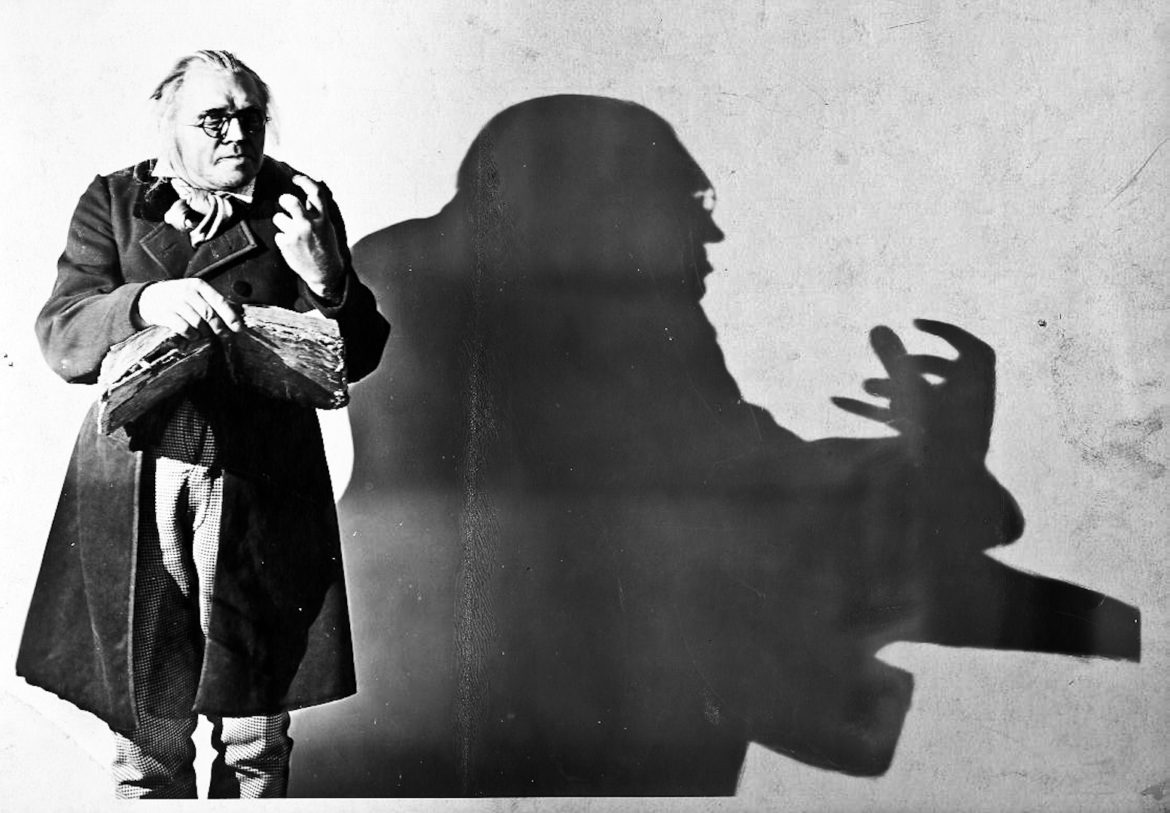
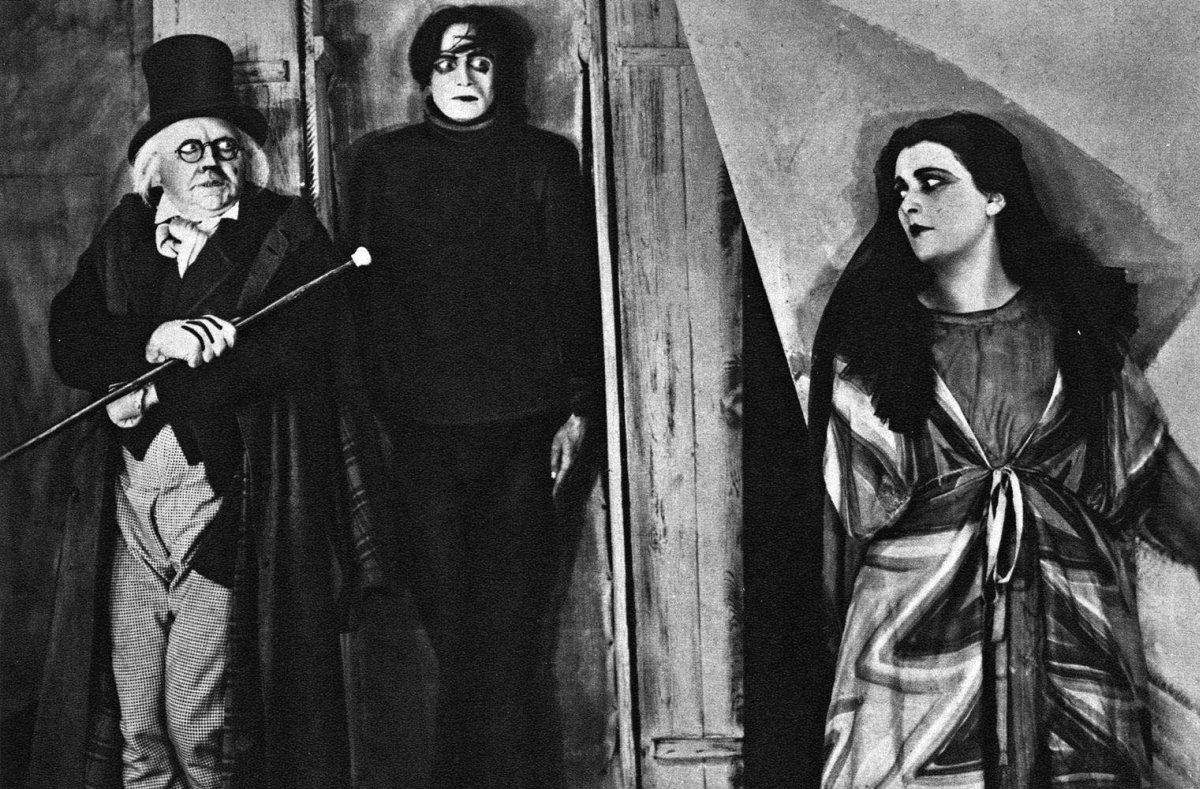
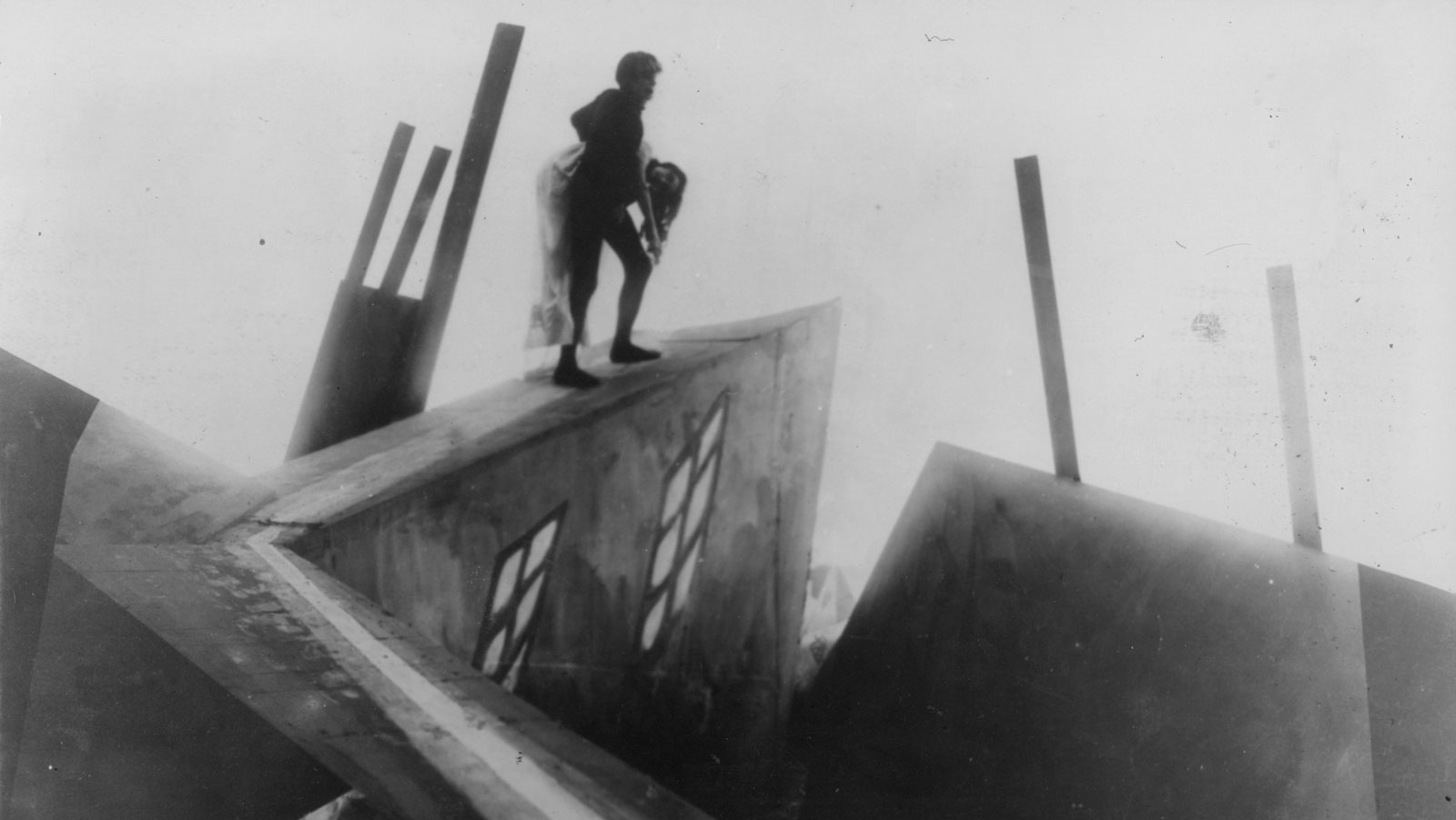
For the first time in this series, my viewing of The Cabinet of Dr Caligari marks a return to familiar material rather than a first showing. It’s a welcome return. Robert Wiene’s film, based on a story from Carl Mayer and Hans Janowitz, has lost none of its power to scare and amaze. Its jagged sets, crazy painted backdrops, and moments of pure terror all had a huge impact on movies to follow, especially horror movies, but even on its own terms, it still holds its own.

What struck me most rewatching it was how far we’d come in visual storytelling from even a few years prior. It was revolutionary for Birth of a Nation to cross-cut from a battle scene to a scene at home occurring simultaneously, and Griffith expanded on that in Broken Blossoms.

But in Caligari, there is a scene that cuts from the present day to the pages of a book people are reading, to a reimagining of the past when that book was being written, to the memories of its writer that inform its writing, to the present day where he is sleeping elsewhere, and on and on. (In fact, the entirety of this is a story someone even further on is telling, but let’s leave that aside for a moment).

It’s completely clear what’s happening, even though there are frames within frames, narratively. The idea that audiences couldn’t follow this sort of thing has apparently been left far behind. Storytelling — and unique, interesting, visual ways to tell those stories — has come to the fore.

But more on that later. In the first of the movie’s six acts, we meet Francis, who sits in the woods and recounts to another man his strange tale. His love and fiancée, Lucy, wanders through the frame, looking ghostly and/or angelic. It’s calm but there’s already a sense of foreboding, especially since Francis opens by claiming what they’ve been through in their town is far stranger than any story the man could tell.

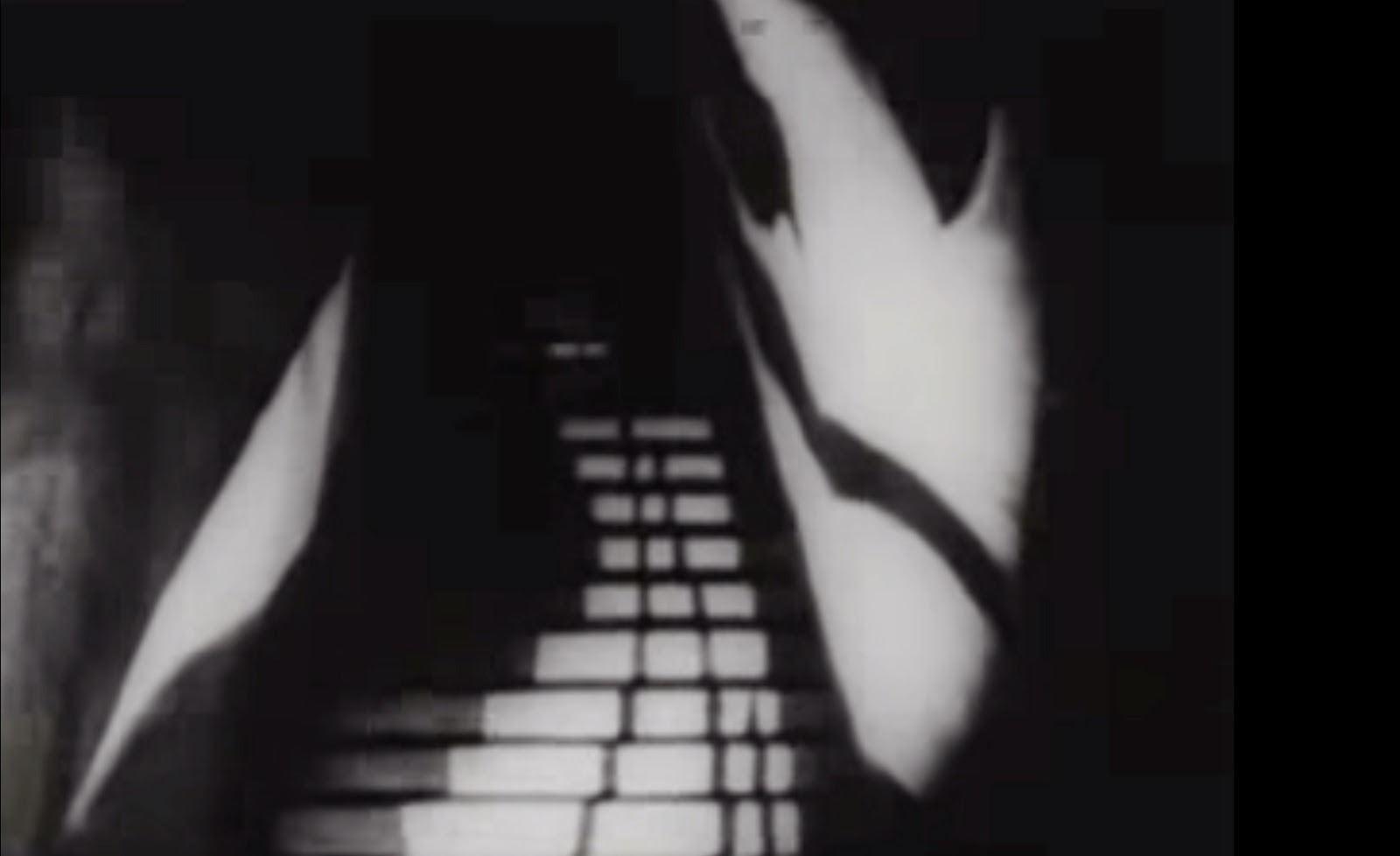
caligari17We flash back to his town, disorientingly rendered as a painted backdrop of compressed buildings, and from the bottom left of the screen, our title character emerges from slanted stairs.

We also are introduced to Francis’ friend Alan, not long for this world. The two are close, and in an apartment full of windows, doors, and chairs at odd angles, we learn there’s a fair in town. Francis and Alan rush out to visit.

Caligari visits the town clerk, awkwardly perched on an improbably high post in his weird office, and secures a permit to present at the fair. He has a sleepwalker, or somnambulist, to display. The fair scenes are surreal – in a recurring motif, a tip-taking monkey is shown in the upper right corner of the screen as the image reveals hustle and bustle around him. There are spinning wheels in against the static, painted background, fairgoers of all sorts mill about in the front, and carnival performers pass by unremarked. Tod Browning’s Freaks might have borrowed a note or two here 12 years later.

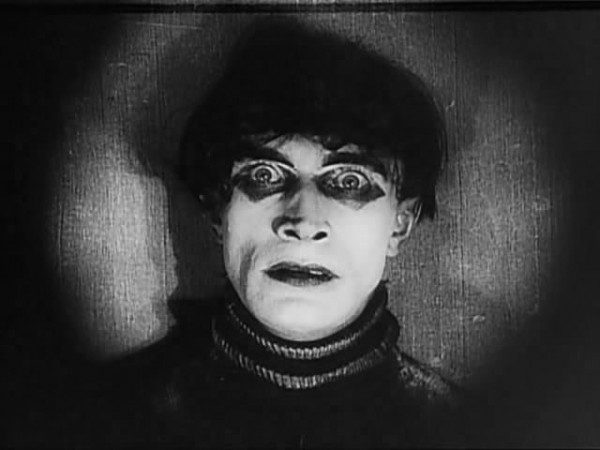
caligari14Caligari displays his somnambulist, named Cesare (Conrad Veidt), to the frightened crowd. For some reason, Cesare bears a resemblance to Transformer-era Lou Reed.

And for some reason, Cesare also knows the past and sees the future, so his services are on offer. Alan impetuously rushes forward to ask how long he will live, and Cesare gives an answer familiar to anyone who’s ever seen a horror movie: “until the break of dawn.” Wrong question, Alan. He’s understandably distraught, and the friends flee the carnival tent.

By morning, there’ve been some murders. Alan’s in particular is innovative and frightening, shot entirely in silhouette. Future gialli and slasher movies would recreate this over and over.

Francis learns of his friend’s fate, and the rash of murders across the city, and gradually connects it the somnambulist and his master, Caligari. But just as he and the cops close in, another suspect is rounded up, trying to kill an old woman. He’s a copycat taking advantage of the situation, but it’s enough to stall things for the real culprits.

caligari15Throughout these sequences, the images become more and more jarring, off-kilter, moody, and stark. The castle-like stairs to the police station, for instance. There’s a nightmarish sense that things might not be all they seem. Calagari’s house is set at an impossible tilt, and his office is a whirlpool of books and boxes, and his famous cabinet, where Cesare rests and feeds.

The suspect denies the earlier two crimes, and Francis is all-too-ready to believe him. He sets out for Caligari’s house to spy on him, and confirms Cesare’s presence there. But in the meantime, Lucy is attacked – terrifyingly – by someone who sure seems like Cesare. Either unwilling or unable to murder her, Cesare kidnaps her and runs out, through the zigzagging skyline.

caligari10He eventually is pursued by townsfolk and abandons her to escape. Lucy recounts her horrible experience to Francis, who realizes there must be shenanigans afoot. He checks in with the cops, who rush to Caligari’s house and discover the body in the cabinet is a doll, a puppet. The real Cesare has been on the prowl this whole time.


Francis pursues the mad doctor to (where else) the Insane Asylum, but there are surprises in store. Caligari is not the escaped patient he expects, but in fact the director of the place. And his name is not “Caligari.” In one of the great horror tropes, Francis and the other doctors discover a secret cache – an old, mystical text and a diary written by Caligari himself.

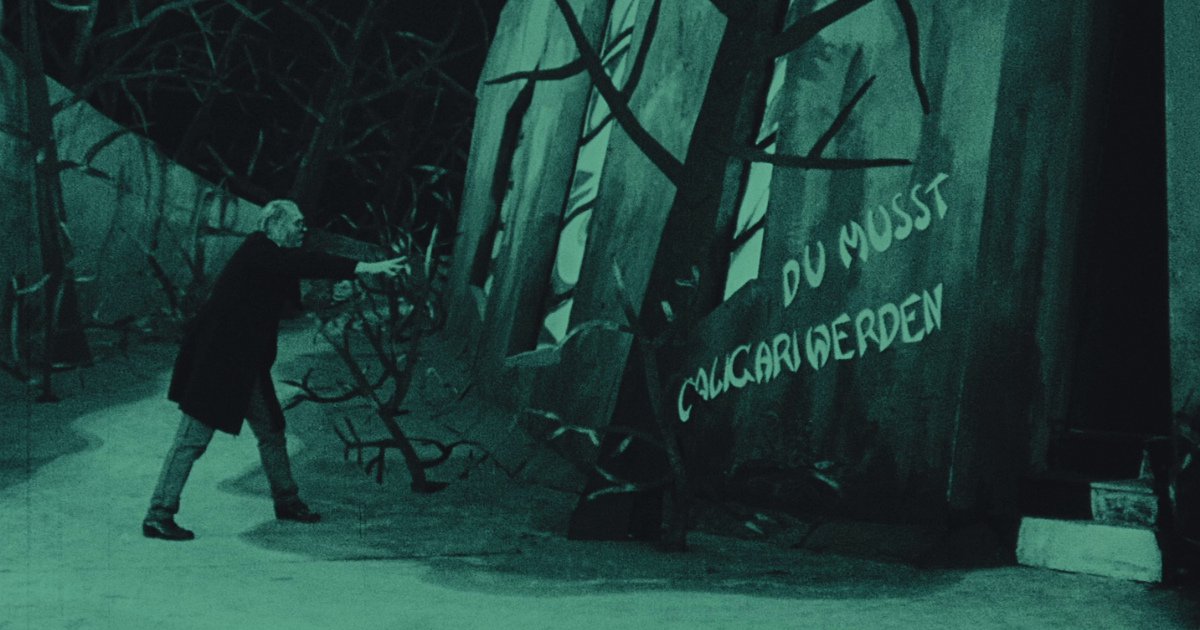
caligari16To continue making a short story long, they read both and discover the awful truth – the doctor has modeled himself after an 18th century mystic who could control the bodies of sleepwalkers and get them to commit evil acts. In one of the film’s most incredible sequences, mentioned above, we watch them read, read the book ourselves, flash back to Caligari learning, and flash forward to Caligari’s obsession, expressed on screen by the proliferation of overlaid text: “You must become Caligari!” This text appears in different fonts, sizes, in disjointed ways, but repeating the same maniacal sentence.

It’s a truly frightening vision of madness. The number of times we’ve heard someone’s inner demon scream at them has made it a cliché, but there’s no denying its power here.


In its final act, Caligari is confronted in his office and Francis demands he unmask himself. The mad doctor attacks one of his underlings, and is locked away.

But as we cut back to Francis and the man talking in the woods, it’s clear the pieces don’t fit. A final twist reveals things are, again, not what they seem.

Or are they? Apparently, the film’s writers objected to its ending, which was foisted on them by the studio. It’s an interesting question, especially in light of the many readings of the film that see it primarily as a warning about bowing to irrational authority, and how easily good men can be led to kill. Obviously, this has some resonances for German history – and both Mayer and Janowitz were disillusioned veterans of the first world war, and committed pacifists.

I won’t pretend to know. There does seem to be a hasty “But you’ll never guess what happened next!” sense to the ending, and I think it would work better without it. But even that has proved influential, as any fan of The Twilight Zone or detractor of M. Night Shyamalan will tell you.

Taken as a whole, The Cabinet of Dr. Caligari is an extraordinary film – technically, narratively, visually, and in terms of its influence. The deep expressionism of its incongruous sets and the boldness of its storytelling alone would’ve carved out its place in history. The performances are broad, but so are the images, so it makes sense. This was and remains one of my favorite films of all time.

Favorite Ebert line:

A case can be made that “Caligari” was the first true horror film. There had been earlier ghost stories and the eerie serial “Fantomas” made in 1913-14, but their characters were inhabiting a recognizable world. “Caligari” creates a mindscape, a subjective psychological fantasy. In this world, unspeakable horror becomes possible.

Next up: F.W. Murnau’s Nosferatu.

April 4, 2015 0 comments
0 FacebookTwitterPinterestEmail
FilmReviews

Foodfight! (Lawrence Kasanoff, 2012)

by rick March 29, 2015
written by rick

Bad movies come in many varieties. There are the dull ones, the ones with continuity errors and sloppy technical aspects, the ones with howlingly bad performances. There are offensive ones, or ones that simply don’t work on their own terms. There are the ones whose sheer terribleness provokes amazement and joy – the “so bad, it’s good” entries in the cinematic pantheon.

And then there is Foodfight!

The brain child of Lawrence Kasanoff, who headed up Threshold Animation Studios, Foodfight! exists in an alternate dimension, where prosaic terms like “good” and “bad” have become meaningless. To call it a “poor film” is to do it a disservice – it is so inexplicably, inexpressively awful that it seems more like a fever dream than a movie. It is so misconceived, so ugly to look at, and so deeply unfunny and unenjoyable that it has carved out a unique spot for itself – it’s virtually an anti-film, a pun-filled, 90 minute long commercial for corporate products no one should, could, or will ever want again. In some ways, it’s a triumph for all our worst impulses and a showcase for the most incredible lack of taste Hollywood has to offer.

It’s also, allegedly, a movie intended for children. No one who has met a child – or met someone who used to be a child, or perhaps was once a child themselves – could condone this in any way.

As detailed for posterity in his My Year of Flops series, Nathan Rabin provides the back story in one of the greatest and funniest film reviews of all time (and one which makes this particular review kind of superfluous, but bear with me – I need to expunge Foodfight! from my psyche). Originally intended as an answer to Pixar’s dominance, Threshold wrangled a bunch of voice talent – by which I mean Charlie Sheen, Hilary Duff, and Wayne Brady – for their CGI spectacular and sank $65 million into this nearly unwatchable thing. (According to IMDB, it made a profoundly justifiable 1% of this back at the box office before being hastily removed from public view.)

Everything about the project seems to indicate the gods, in their wisdom, didn’t wish for Foodfight! to see the light of day – the original version was apparently stolen (presumably by a concerned citizen), compelling the filmmakers to start over.

The message was clear – fate and decency itself rebelled against Foodfight!’s existence – but the message went sadly unheeded.

Instead, its creators soldiered on, intent on delivering the goods – goods so questionable they pose existential questions. Why would this be a worthwhile idea? Why should it exist when other things do not? Can I really be said to “exist” when Foodfight! does, too? What do we mean by “existence”?

But exist it does, available on Netflix and elsewhere. Kasanoff’s terrifying dystopian vision that thinks it’s an amusing family-friendly romp follows the incredibly mundane adventures of Dex Dogtective (Sheen), a cartoon dog whose style alternates between Harrison Ford as Indiana Jones and Humphrey Bogart as Casablanca’s Rick (every kid’s favorite cinematic WWII café owner, of course. “Let’s play ‘Rick and Ilsa!’, as the kids always shout. “Why does Billy always get to be Sidney Greenstreet?” as they always add.).

Dex is the protector, the law and order, the wheeler and dealer of an alternate reality: you see, every night, when the grocery store closes down, the people leave, but the corporate mascots come alive! That’s exciting, right? (No, it is not.)

It’s an elaborate universe, the kind of place where streets are filled with what seem to be Wii avatars and wildly gesticulating CGI whatsits, where Mr. Clean roams the aisles with Mrs. Butterworth, and a cheese logo amusingly passes gas, much to the dismay of his tidier and more polite zombie pitchmen. It’s filled with cars (?) and all kinds of goings-on that, for all intents and purposes, look like first-generation video games. More than once, I thought, “Man, I wish this was How To Train Your Dragon 2.” And I hated How To Train Your Dragon 2.

Dex Dogtective (whose full name I enjoy writing, actually) is in love with a raisin mascot, Sunshine Goodness (Duff), an uncanny and nightmarish hybrid between actual Hilary Duff, a cat, and a busty human woman, with eyes that never focus on anything and a eerie, childlike demeanor. Even leaving aside the implications of interspecies sex implicit in this relationship, it is uniquely horrifying to pair her up with Dex Dogtective – like the real Sheen and Duff (oh no, have I started making Foodfight!-esque bawdy puns? Please god, no), there’s a clear age difference that doesn’t sit quite right, and the way in which they look past each other with their dead, impossible eyes is deep, deep in the uncanny valley.

Dex and Sunshine have a friend in Daredevil Dan, an incompetent pilot who is also a chocolate squirrel, and also, on some level, Wayne Brady. In one of its more egregious violations of all that is good and right with the world, Foodfight! tries to get comic mileage from Dan’s blackness (he’s chocolate, remember) – hollering out his airplane window at a character I assume is a Latina sex worker working one of the seedier aisles in the store, he shouts, ““Oh Mamacita! Yo, sweetcakes! Ooh, Nice packaging! How about some chocolate frosting! I’d like to butter your muffin!” Later, a gay and rather predatory Count Chocula hits on him in a deeply traumatizing fashion.

Again, Foodfight! is, at least by its own estimation, supposed to be for kids. I can’t emphasize this enough.

The plot, such as it is, kicks into gear. A nefarious operation known as Brand X seeks to take over the store shelves, and bend all the lovable corporate icons to its will. (Did I mention that the icons are known colloquially as “Ikes” in their nightmare-land? This is true, and stupid.) Led by a BDSM (and occasionally schoolgirl)-styled sexpot known as Lady X (Eva Longoria), Brand X wants nothing less than total market domination, and is willing to go to extremes to get it.

Backed by jackbooted, goose-stepping, Heil Hitlering minions, Brand X is not merely fascist in a general symbolic sense, but is specifically meant to evoke the Nazis. Dissenters – indeed, in the film’s language, “undesirables” – are rounded up and placed in a camp devoted to their “discontinuation.” They are “forcibly recalled.” In a dramatic scene that is sure to stir the blood of all the children in attendance, the recalled products even band together one day to sing a food-themed La Marseillase to drown out the militant chanting of Brand X thugs … just like in that movie that 5 year olds like so much, Jean Renoir’s La Grande Illusion! Ha ha ha!

It’s up to Dex Dogtective to mount la resistance, and perform the ultimate act of heroism – sending an email to corporate headquarters alerting them to the danger posed by this generic, presumably cheaper product that’s threatening to drive the corporations from the store. And also to explain, in endless exposition, what’s going on, because none of it makes any sense at all.

A final battle ensues – let’s call it, oh I don’t know, a “food fight” – in which numerous food items are hurled, catapulted, and poured on the enemy forces in a pitched street battle. Later there’s an aerial war, too. I don’t know why there’s not a sea of cheese for macaroni armadas to contest, but I’m guessing that got left on the editing room floor.

Not much else did, though. Foodfight! is some of the longest 90 minutes you will ever spend watching a film. Here’s a transcript of an actual conversation with my viewing companion:

Viewing Companion: “How much is left in this fucking thing?”

Me: “Um [checks DVD] … wow. 20 minutes.”

Viewing Companion: “How is that possible?”

Responding that 20 minutes are left usually implies that the film is almost over. In Foodfight!’s case, it borders on an incomprehensible insult, a leering injustice, just another mystery of many.

As mentioned previously, farting plays a key role in its appeal for laughs, but the film’s main strategy is the pun. The stupid, stupid pun. In keeping with its inscrutable assumption that children just love Casablanca, Jean Renoir, and gangster movies, Dex Dogtective eventually heads up a club, The Cocabanana. In a kiss-off scene, he boldly declares, “Frankly, my dear? I don’t give a Spam.” Lady X, a detergent icon, is so evil that she has stains that will never come out. This never, ever stops.

An almost unbelievable moment arrives, in this most unbelievable movie, when Dex turns to the camera and calls Lady X “a cold, farted itch.” I actually rewatched this later to ensure that it wasn’t a joke I made earlier in the film. Sheen’s delivery is one for the ages, in the sense that the kind, merciful passing of time will obliterate it, like a shattered dam flooding a factory in the valley below.

And all the while, corporate mascots mingle awkwardly in the background; as Rabin notes, they’re not even part of the story really, so that’s yet another mystery. Why acquire the rights to 80 logos, only to shove them in the back of the frame? Surely there was something Mr. Clean could’ve done apart from getting things hilariously spilled on him (see, that makes him dirty, so it’s funny). Sure, the Chiquita Banana can dance, but is that all she can do? How does Mrs. Butterworth get around with no feet? You get the distinct sense that even the fucking cartoons don’t want to be here.

Foodfight! doesn’t just raise more questions than it answers. It raises a set of disreputable questions that, the more you consider them, the more horrifying they become. Let’s say Sunshine Goodness and Dex Dogtective do have kids and live happily ever after – what will their kids’ eyes be like? This isn’t a rhetorical question. It’s the kind of thing that’s now keeping me up at night. Will there be a Rosemary’s Baby reference about Satan’s spawn, to amuse the tots? Will Sunshine Goodness scream, “What’s the matter with its eyes?” and a tiny dog-cat-person jump up and sing Jeepers creepers, where did you get those peepers? I am troubled by the possibility.

But rest assured — the film wraps things up tidily. In the end, the corporate icons vanquish their generic, Nazi doppelgangers, and all is right with the world. Or the worlds, I should say – the store is no longer offering discount goods to daytime human shoppers, thanks to the forced recall of Brand X, and Mr. Clean, Mrs. Butterworth, Charlie Tuna, and their compatriots continue to generate top dollar, affirming once and for all the supremacy of late capitalism. At nighttime, the 1% of corporate logos frolic.

And Dex Dogtective, Sunshine Goodness, Daredevil Dan the chocolate squirrel, and all their made-for-Foodfight! (and incongruously off-brand) personas continue to thrive.

Somewhere, even today, the California Raisins are serenading a party where the Chiquita Banana salsa-dances with Cap’n Crunch. In the distance, the fascists plot revenge — dreaming up yet more references, perhaps to Metropolis, Last Tango in Paris, or Edward Penishands 3 — and more puns are aggressively foisted on the world, almost certainly related to bodily excretions and viscous dairy products.

Rest easy, children.

March 29, 2015 0 comments
0 FacebookTwitterPinterestEmail
FilmReviews

Beyond The Lights (Gina Prince-Bythewood, 2014)

by rick March 27, 2015
written by rick

If anyone doubts that Gugu Mbatha-Raw deserves to be a star, Beyond The Lights would like to have a word with you.

As pop star Noni (dressed and outfitted in a vaguely Rhianna and/or Beyonce mold), Mbatha-Raw is captivating in every frame.

In the film’s early scenes, she effortlessly conveys her character’s confusion and sadness, which lie just behind the mask she puts on for the lucrative spectacle, engineered in no small part by her mom (Minnie Driver); in its later ones, as she comes into her own, she’s formidable but calm, having wrested control over her own life from everyone else. Her rendition of Nina Simone’s “Blackbird,” which plays a key role in the film, is mission statement and revolutionary decree. Mbatha-Raw earns every bit of it.

There’s the unmistakable sense of an actress completely inhabiting a character. In a fantastic interview with Tasha Robinson of The Dissolve, director/screenwriter Gina Prince-Bythewood — who also made the widely adored Love and Basketball — reveals that she secured financing for Beyond The Lights by shopping around a short video showcasing Mbatha-Raw. That’s entirely appropriate – hers is a star-making turn.

As it happens, the film around her is wonderful, too.

We meet Noni as a young girl on the way to a talent show. Her white mom can’t do her hair, so in desperation they visit a black-owned salon. This could’ve been the kind of treacly sentiment the (most) recent “Kevin Costner Saves The Off-White Folks” vehicle Black or White shows every sign of being, but the scene instead grounds the film, and comes off honest. Issues of assimilation, otherness, and perception are the film’s main focus. The scene is particular and pointed, and builds its characters.

As Macy Jean, Driver is dealt the film’s worst hand – the oblivious show-biz mom – but even she finds empathy in the role … despite demanding Noni throw away her runner-up prize. There’s no place for losers here — a sentiment that both showcases her severity and her determination that her daughter succeed, which is basically born of compassion. Even in broad strokes, I think many people know parents like this.

We jump forward to the awards shows and afterparties to come. Noni is the celebrated, and highly sexualized, backup performer for the scummy Kid Culprit (Machine Gun Kelly), and her solo album is about to drop. She should be on top of the world, but, as she hastily interacts with fans and looks anxiously at Macy Jean, still running the show from the sidelines, it’s clear things aren’t right.

So it’s no surprise when she steps on the ledge of her hotel balcony.

She’s rescued by Kaz (Nate Parker, also terrific), short for Kazaam – “My parents thought it sounded African,” he notes. He’s an off-duty cop moonlighting for a security service, and being groomed for political office by his ambitious dad (Danny Glover) and his dad’s powerful friends.

The rest of the film tracks their relationship, and the ways in which they try, succeed, and fall short of determining their own destinies in the face of manipulation, commerce, and the expectations of those they love.

Beyond The Lights also has a lot to say about celebrity culture and the representation of female bodies in mainstream culture, but it does so in ways that serve the story. And that story is, ultimately, in the classic romance genre – it is not a romantic comedy, it doesn’t assume a tidy ending or wink at you about how silly romance movies are. It’s as earnest as its characters, which is incredibly refreshing.

Beyond The Lights is everything everyone says they want to support, but rarely do (it made a respectable $14 million back on its $7 million budget, but wasn’t exactly a breakout hit). It boasts a Black female director/screenwriter; an almost entirely non-white cast; an actual romance in the classic sense (it shares more than a little with Roman Holiday, in which actual princess Audrey Hepburn flees the confines of her expected role to run around Rome with Cary Grant … always a good plan); and nuanced, believable characters, with two star-making roles for its leads. It’s a mid-budget picture played to a wide audience (it’s not a comic book movie, franchise installment, or navel-gazing indie). It has the added bonus of being really smart, really well-done, and starring two impossibly attractive humans falling in complicated love.

I wish I’d seen it last year so I could’ve railed about how little recognition it got. I didn’t, and you might not have either. Time to fix that.

March 27, 2015 0 comments
0 FacebookTwitterPinterestEmail
FilmReviews

Listen Up Philip (Alex Ross Perry, 2014)

by rick March 26, 2015
written by rick

The Philip addressed in the title is Philip Louis Friedman (Jason Schwartzman). He’s an author – his second book has just come out, after his first received significant acclaim. His mentor is Ike Zimmerman (Jonathan Pryce), a famous but reclusive, long-in-the-tooth writer who had tremendous success himself decades prior, but now spends most of his time playing the role of The Great Author, rather than actually writing.

They are creative geniuses, and total fucking assholes.

Egomaniacs who mistreat those closest to them, Philip and Ike process the world in a comically self-absorbed way, and don’t even notice how their behavior affects other. It doesn’t help that the rarefied worlds of literary mini-celebrity and academia enable their worst impulses, exalting them for behavior that we’d loathe from anyone else.

Fed up with the stress of New York and the commercial demands of his publisher, Philip meets Ike and promptly takes him up on the offer of something like a sabbatical at Ike’s summer home. This is advantageous, since he feels he needs time to focus and unwind, and also because he’s broke. He effectively abandons his girlfriend/meal ticket Ashley (Elisabeth Moss) without a second thought and heads to the country.

Ashley has a corollary in Melanie Zimmerman (Krysten Ritter), Ike’s alternately ignored and berated daughter – both female characters see through the bullshit the men in their life spew, and grapple with wanting to love them anyway but being rebuffed by the epic power of their smugness and self-absorption. The reality is no one could love Ike and Philip as much as Ike and Philip do.

Director Alex Ross Perry lays it on pretty thick, almost daring the viewer to find anything redeemable about his two leads. The atmosphere in the city is suffocating, and the halls of the small liberal arts school upstate (where Ike lands Philip a gig) aren’t much better. The constant is Philip’s contempt for anyone he deems lesser than him intellectually, which is to say everyone.

I could write about the plot points, but they’re really tangential to the film’s main concern: depicting the destructive forces of ego and obliviousness, and taking aim at literary or creative pretension in particular. At one point, the narrative shifts to Ashley, and it’s an almost visceral relief – “Thank god, we’re away from Philip for a while,” I said out loud, to my dog. The inclusion of this second act segment, and a stand-out monologue from Melanie later, help balance the film, elevating Moss’ and Ritter’s roles from shrew/doormat to something much more suffused with desire and melancholy.

In a recent conversation about “escapism” in cinema – meaning, some folks’ often stated desire to take a break from their daily lives or routines through light fiction, instead of more “challenging” or “important” fare (whatever that means) – some familiar notes were hit. On the one hand, commenters bemoaned that tendency, pointing out how much quality art people miss out on by falling back on tried-and-true popcorn entertainment; on the other, there was the recognition that people have a lot going on in their lives, and might not want to return from a long day at work, a recent break-up, or grapple with [insert anxiety here] by settling into a nice, comfortable viewing of Lars Von Trier’s body of work.

Alex Ross Perry is not Lars Von Trier, and Listen Up Philip isn’t the most grueling time at the movies. But I’d be lying if I said I didn’t spend the first half thinking, “This movie would be much better if all the actors were different, these characters weren’t involved, and it starred Liam Neeson as a man with a particular set of skills breaking people’s heads and/or punching a CGI wolf.”

So I guess that’s where I come down on escapism. In the end, though, while Philip and Ike are unpleasant to be around, Listen Up Philip rewards you for sticking with it.

March 26, 2015 0 comments
0 FacebookTwitterPinterestEmail
FilmReviews

Oculus (Mike Flanagan, 2013)

by rick March 25, 2015
written by rick

Oculus is a horror movie about a killer mirror that kills people, with death.

It jumps back and forth between an adult brother and sister investigating it in the present day and their earlier childhood experiences with its misdeeds, when it terrorized their family. This is a thing killer mirrors often do, as I’m sure you’re aware. The mirror can’t be smashed, since it protects itself with something like a psychic forcefield, and it skews the perspectives of people in its vicinity, leading them to commit terrible crimes.

In an incredible achievement, Oculus is somehow not ridiculous – and even legitimately scary – for over an hour. Unfortunately, just past the halfway point, the film can’t escape the fact that it could’ve been titled Death Mirror – The Mirror That Deaths, and the whole thing falls apart. But it’s fun while it lasts.

We’re introduced to Tim Russell (the remarkably vacant Brendan Thwaites) as he exits a mental institution, where he’s spent the past decade plus. He’s made a lot of progress overcoming the minor childhood trauma of killing his dad, who killed his mom, and he’s ready to meet the world on his own terms. His sister Kaylie (Karen Gillan, better) is there to greet him.

Tim’s been through an awful lot, but he carries himself with an air of self-possession, thanks to his therapy and newfound self-knowledge. Kaylie, waiting for him with a mix of glee and self-assurance, appears to be in the corporate workforce, though it’s unclear what she does in her office. In any case, Oculus is uninterested in any of that – there are clearly other things afoot.

Kaylie seems manic and preoccupied from the start. We learn that she’s tracked down a particular mirror, and has had it shipped to an antiques warehouse. In the warehouse scene, she pulls the sheet off of it and stares it down like a nemesis; on cue, statues move behind her in its reflection.

Why would she acquire the very Death Mirror that killed her parents and got her brother locked up, especially on the day he got out? Good question! It turns out the two of them made a pact to destroy it when they were kids. And in the years since, Kaylie has also apparently become obsessed with the notion of demonstrating its evil, and thus exonerating her mom, dad, and brother, who only committed their terrible acts thanks to its influence.

They return, with the Death Mirror, to their childhood home, because of course that’s what you do. But this time, Kaylie has the entire space tricked out, and the movie sells her fanatical devotion to capturing the truth: there are cameras everywhere, multiple laptops collecting real-time information, a series of timers set to different phenomena she’s discovered in her extensive reading on the mirror’s history, even a fail-safe, in the form of barbell-weighted poking-thing (not the technical term) that can swing down from the ceiling and smash the mirror in case of emergency.

Kaylie breathlessly tells Tim (and us) that the mirror dates back centuries, and has left a staggering number of tragedies in its wake. In an initially interesting, increasingly grating fashion, Tim plays the part of the rational observer, as he’s learned in therapy. It’s not supernatural, there are explanations – Kaylie’s theories are attempts to displace responsibility and blame. Which is crazier – that their dad killed their mom, and Tim killed him, or that centuries of murder orchestrated by a Death Mirror led to that fateful day?

It’s a compelling point. It’s also incorrect.

The mirror eventually kicks into gear, and Flanagan cuts between the telling of their childhood story with their present circumstances. It’s occasionally effective. The mirror is tricky, so that allows the film to build jump and gross-out scares at its leisure, since it’s never clear what’s happening and what’s imagined/induced. (One scene of a character pulling broken glass out of their mouth stands out.)

But after a while, it gets tiresome to watch people to realize it was all a dream over and over, until it’s not. The film gets too obsessed with the childhood trauma subplot, and it closes exactly where you expect it will 40 minutes prior.

Which is too bad. Despite jump-scares being generally (and rightly) considered the laziest form of horror, there was a lot of mileage in the notion of forcing audiences to pay attention to reflections in a mirror. Oculus fits squarely in the Paranormal Activity mold as far as the narrative is concerned, but the self-consciousness implicit in focusing on a mirror seems like it could have been something more. In movies and series as different as Peeping Tom, The Blair Witch Project, Halloween, Candyman, or that one scene in Twin Peaks where Bob is glimpsed in the bottom of the frame, it’s scary when things you weren’t expecting pop up , and there’s a rich vein of horror to mine in the disconnect between how things appear and how they really are.

Oculus doesn’t reach that far in the end, opting instead for a melodrama that just happens to feature a murderous death mirror as one of its central characters.

March 25, 2015 0 comments
0 FacebookTwitterPinterestEmail
FilmGreat Movie ProjectReviews

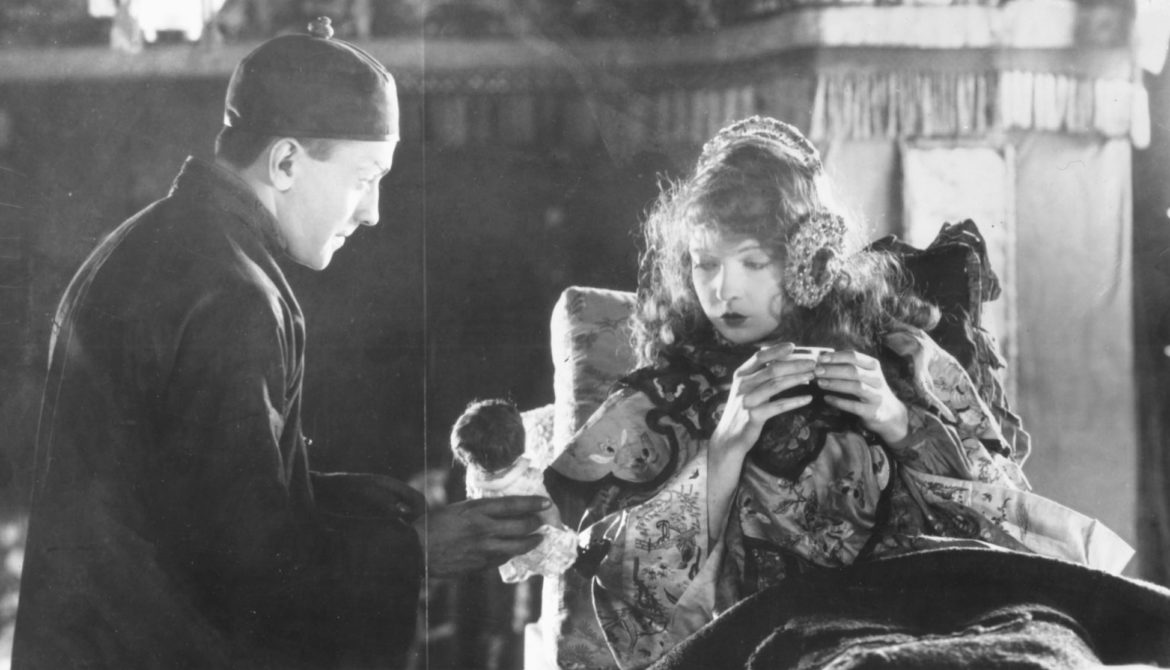
Great Movies Project #3: Broken Blossoms (D.W. Griffith, 1919)

by rick March 17, 2015
written by rick

Part of an ongoing effort to watch each of the films in Roger Ebert’s Great Movies series. The introduction and full list can be found here.

“It is a tale of temple bells, sounding at sunset before the image of Buddha; it is a tale of love and lovers; and it is a tale of tears.”

So begins Broken Blossoms. That opening title card conveys much of the film. Deeply melancholy, poetic, and rushing headlong into tragedy, the film draws from a deep well of exoticism but still manages something approaching empathy.

Unlike Griffith’s revered/reviled Birth of a Nation, its heart is firmly in the right place. Where his film from 5 years prior exalted racist terror groups, turned history on its head to suggest that southern whites were merely defending themselves from black tyranny, and could only conceive of interracial relationships in terms of assault and violation, Broken Blossoms is at its best depicting the halting, dangerous love between a Chinese merchant and an abandoned white girl cruelly abused by life.

Her tormentor is her boxer father Battling Burrows, but more generally it’s white, patriarchal society to blame, along with rigid class structures. Most of the Broken Blossom’s outrage and sorrow is directed at poverty and its consequences, with a strong rebuke of the anti-Asian xenophobia of its white characters. Many critics argue that Broken Blossoms is Griffith’s attempt to atone for Birth of a Nation. Watching the two in relatively close proximity, it’s not at all an implausible theory. In some ways, they are mirror images of each other.

In other ways, they are not. Birth of a Nation’s blackface is replaced by lead Richard Barthelmess’ yellowface, as well as Edward Peil Sr.’s, in the role of “Evil Eye.” This is a film subtitled “The Yellow Man and The Girl”, and one in which Barthelmess’ very nuanced, tender protagonist is also called “Chinky” (in a tender moment with Lillian Gish’s Lucy, no less) and plays a flute to help his would-be lover back to health. He’s a mysterious Other positioned as an early, Chinese incarnation of the Magical Negro – steadfastly bringing the Buddha’s message of peace to the whites to help them find themselves, while also nursing beaten and abused white women back to health with his love, and flute music. But he’s doomed by the strictures of a racist society. Broken Blossoms wants to castigate an unjust society that would deem this love illegitimate and fail to recognize what he has to offer the world (peace, flute music), and it wants to do this by playing up every exotic aspect of his being for a white audience.

Even when racists try to atone for their racism, they end up kind of racist.

On the other hand, having just watched Birth of a Nation for the first time, I will gladly take this version of Griffith. The shots are beautifully composed, there are numerous depictions of street life that feel real while managing to avoid condescension, and title cards are for long sections of the film nonexistent (relying on the actors to convey the drama, especially the wondrous Gish, who almost literally shines here).

lillian gish in broken blossoms

And ultimately, for all its exoticism, it’s never really nasty, at least by Birth of a Nation standards – the film carries a humanist and empathetic message, even as it bows to the convention of the time by casting a white actor in the lead role and relegating actual Chinese people to the margins. It repudiates the violence of white supremacy and patriarchy, and instead exalts love and kindness, though it doubts they can triumph in this world.

All of which is much, much better than watching the Klan ride heroically into town.

We open with Barthelmess trying, and failing, to make peace between squabbling white soldiers. (I will refer to the actor throughout, largely because I am just not going to write “The Yellow Man” over and over.) He is positioned from the start of Broken Blossoms as a proselytizer for peace in a hostile world of violent, irrational whites, preaching the Buddha’s message (which it turns out is a verbatim rendering of the Golden Rule) and being roundly ignored. He’s shaken by the experience but, determined, takes leave of his family to make his way in the world, and hopefully make it a better place. One of the relatively few cards hints at Griffith’s tone and intent, describing the advice of the young man’s father: “Word for word such as a fond parent of our land would give.” The appeals to empathy and cross-cultural understanding come early and often.

Barthelmess ends up in the slums of London years later, making a living as a storekeeper and frequently haunting the neighborhood’s rather well-attended opium den. His disillusionment is clear, and Griffith’s framing in the opium den scenes conveys it well – this is not what he signed up for. The slums of London don’t seem ready for the message of the Buddha.

His one ray of light is Lucy, who he spies from time to time from his shop window. She’s angelic but also beaten down by the world, literally – her contemptible boxer dad abuses her both physically and emotionally, playing cruel tricks on her for fun when not beating the shit out of her outright. Gish staggers about through Broken Blossoms with a hunched back, furtive, downcast eyes, and a deep sadness – when dad demands she smile, she has to use her fingers to try and simulate one. It would be a corny gesture now, but in context, it’s awfully sad. That Griffith expends so much energy on close-ups of her face doesn’t hurt – the unmistakable sense is of ethereal beauty in the gutter, and the deep injustice of good people dealt bad hands.

So Barthelmess and Lucy are both adrift in the world, without family in one case and all too burdened with family in the other. After a particularly vicious beating, Lucy escapes to the street and passes out in front of his shop. Without a thought, he takes her in and appoints her upstairs in a bed to rest.

Over time, her wounds heal, a bond forms between the two broken souls, and she presumably comes to adore the sonorous sounds of Barthelmess’ flute. Lucy is transformed in the absence of her dad and previous circumstances, turning luminous and beautiful, much like Ally Sheedy in The Breakfast Club if Ally Sheedy hadn’t already been gorgeous before Molly Ringwald did her hair. In any case, these scenes in Broken Blossoms are intimate and tender; cross-cut with Battling Burrows in the boxing ring, dismantling his opponents, they’re also packed with dread. Their idyllic romance can’t last.

And indeed it doesn’t. Burrows hears about their connection from a local spy and laughs it off as ridiculous, that anyone could love someone so humble and without note as, well, Lillian Gish. Upon realizing that this particular anyone is a Chinese storekeeper, he flies into a rage and confronts them, with predictably tragic consequences.

The cross-cutting between the would-be lovers and the boxing ring, between scenes of exquisite tenderness and proto-Raging Bull violence, is one of the film’s key achievements. Griffith explored this in Birth of a Nation, juxtaposing battle scenes with a somber family dinner, but here it’s much more accomplished and effective at building tension. There’s little doubt where things are headed, and his set-up is more than a little heavy-handed, but the feeling is palpable: you root for Barthelmess and Lucy’s gentle kindness, even as the evidence mounts that the world has no place for it.

I don’t mean to paper over the exoticism, but it really is deployed in this case for something like noble ends. Broken Blossoms is firmly with us on the side of the lovers, and horrified but unsurprised at the xenophobia and injustice of the larger society they inhabit. Unfortunately, Griffith once again, even despite himself, gave form to pernicious stereotypes that haunt movies to this day. As in Birth of a Nation, which he really seems not to have noticed was virulently racist, these ideas are taken for granted. Unlike Birth of a Nation, this is a story worth telling, even if it’s been told a thousand times, and it carries a clear message – love might not conquer all, but it’s better than the alternative.

Ebert’s review is here. Favorite line:

Griffith in 1919 was the unchallenged king of serious American movies (only C.B. DeMille rivaled him in fame), and “Broken Blossoms” was seen as brave and controversial. What remains today is the artistry of the production, the ethereal quality of Lillian Gish, the broad appeal of the melodrama, and the atmosphere of the elaborate sets (the film’s budget was actually larger than that of “Birth of a Nation”).

And its social impact. Films like this, naive as they seem today, helped nudge a xenophobic nation toward racial tolerance.


There is all of that, and then there is Lillian Gish’s face. Was she the greatest actress of silent films? Perhaps; her face is the first I think of among the silent actresses, just as Chaplin and Keaton stand side by side among the men. When she was filming “The Whales of August” in 1987, her co-star was another legend, Bette Davis. The film’s director, Lindsay Anderson, told me this story. One day after finishing a shot, he said, “Miss Gish, you have just given me the most marvelous closeup!” “She should,” Bette Davis observed dryly. “She invented them.”

Next up: The Cabinet of Dr. Caligari

March 17, 2015 0 comments
0 FacebookTwitterPinterestEmail
Newer Posts
Older Posts

About

About

Towards a provisional theory of the cinema, or, failing that, just some shit about movies

Authors
Rick Kelley
Lark Lundberg

Keep in touch

Facebook Twitter

Categories

  • Conversation
  • Film
  • Film By Film
  • Great Movie Project
  • Great Movies: The Counter Programming
  • Guest
  • News
  • Other
    • Commentary
    • Film
    • Interview
    • Reviews
    • Song for a Sunday
  • Streaming Selections
  • TV
  • Uncategorized
  • Vegan Horror

Archives

  • April 2019
  • March 2019
  • January 2019
  • December 2018
  • November 2018
  • October 2018
  • September 2018
  • August 2018
  • July 2018
  • June 2018
  • May 2018
  • April 2018
  • March 2018
  • February 2018
  • January 2018
  • December 2017
  • November 2017
  • October 2017
  • September 2017
  • August 2017
  • July 2017
  • June 2017
  • May 2017
  • April 2017
  • March 2017
  • February 2017
  • January 2017
  • December 2016
  • November 2016
  • October 2016
  • September 2016
  • August 2016
  • July 2016
  • June 2016
  • May 2016
  • April 2016
  • March 2016
  • February 2016
  • January 2016
  • December 2015
  • October 2015
  • September 2015
  • August 2015
  • July 2015
  • June 2015
  • May 2015
  • April 2015
  • March 2015
  • February 2015
  • January 2015
  • December 2014
  • November 2014
  • October 2014
  • August 2009
  • September 2008

Recent Posts

  • China Girls, Death Proof, and the Hidden Face
  • Old News: Old Noise Edition
  • Old News: April 1, 2019
  • Nicolas Winding Refn, Marginalia, and the Deaths of Cinema
  • And now, let us praise Kanopy

Recent Comments

  • Franklin Kat on Michael Shannon shines again in Frank & Lola
  • Sean Tempesta on Cinema and dream-logic in Meshes of the Afternoon
  • ludditerobot on The Left-Wing Slapstick and Iconic Songs of 1937’s Street Angel
  • Franklin Kat on The Left-Wing Slapstick and Iconic Songs of 1937’s Street Angel
  • Arijit Mukherjee on Great Movies Project: The Counter-Programming
  • Facebook
  • Twitter

@2021 - All Right Reserved. Designed and Developed by PenciDesign


Back To Top
Luddite Robot
  • Reviews
  • Commentary
  • Great Movie Project
    • Great Movie Project
      Bride of Frankenstein is a movie for and…

      January 25, 2018

      Great Movie Project
      The Enduring Appeal of Nick and Nora in…

      November 29, 2017

      Great Movie Project
      The Ahistorical Fever Dream of The Scarlet Empress

      August 2, 2017

      Great Movie Project
      Dreams, Mundanity, and the Anarchist Yearnings of L’Atalante

      July 12, 2017

      Great Movie Project
      Duck Soup Is And Will Always Be A…

      April 19, 2017

  • Counter Programming
    • Great Movies: The Counter Programming
      Walking and Talking in the Shadow of Kanchenjungha

      March 7, 2018

      Great Movies: The Counter Programming
      A Brief Encounter in My Mother and Her…

      February 9, 2018

      Great Movies: The Counter Programming
      Horror’s Refusal in Farrokhzad’s The House Is Black

      October 13, 2017

      Great Movies: The Counter Programming
      The rage and beauty of The Cloud-Capped Star

      October 3, 2017

      Great Movies: The Counter Programming
      The daylight noir and social issue empathy of…

      June 22, 2017

  • Vegan Horror
    • Vegan Horror
      Julia Ducournau doesn’t think her film Raw is…

      June 7, 2017

      Vegan Horror
      Licking our wounds: The vampiric masculinity of Ravenous

      December 13, 2016

      Vegan Horror
      Eggertsson and animals: An approach to horror cinema

      September 15, 2016

      Vegan Horror
      “It’s Not My Nature” – Vegetarianism, Body Horror,…

      August 30, 2016

      Vegan Horror
      Bodies and Carcasses in Predator 2

      August 23, 2016

  • Interview
    • Interview
      Jasmine Leyva’s doc The Invisible Vegan aims to…

      May 3, 2017

      Interview
      Bridging The Abyss: An Interview With The Directors…

      November 28, 2016

      Interview
      7 Days in Ohio: An Interview with Nathan…

      September 12, 2016

      Interview
      Film Critic Phil Dy talks New Filipino Cinema

      June 17, 2016

      Interview
      “I Love Seeing Film Projected.” A Conversation with…

      March 22, 2016