Top Posts
Madeline’s Madeline: An Unclassifiable Panic Attack Maybe-Masterpiece
Shoplifters Steals Moments of Wonder from the Mundane
Burning and Forgetting What’s Not There
Kusama: Infinity Expands Beyond The Canvas
Mandy Risks Little, Wins Little
In We The Animals, The Children Are Away...
The Seagull Isn’t Quite Chekhov, But It’s Still...
5 Million Ways Boots Riley Isn’t Sorry To...
American Animals’ and the Queasiness of the Heist
A Star Is Born In Hearts Beat Loud
  • Reviews
  • Commentary
  • Great Movie Project
    • Great Movie Project
      Bride of Frankenstein is a movie for and…

      January 25, 2018

      Great Movie Project
      The Enduring Appeal of Nick and Nora in…

      November 29, 2017

      Great Movie Project
      The Ahistorical Fever Dream of The Scarlet Empress

      August 2, 2017

      Great Movie Project
      Dreams, Mundanity, and the Anarchist Yearnings of L’Atalante

      July 12, 2017

      Great Movie Project
      Duck Soup Is And Will Always Be A…

      April 19, 2017

  • Counter Programming
    • Great Movies: The Counter Programming
      Walking and Talking in the Shadow of Kanchenjungha

      March 7, 2018

      Great Movies: The Counter Programming
      A Brief Encounter in My Mother and Her…

      February 9, 2018

      Great Movies: The Counter Programming
      Horror’s Refusal in Farrokhzad’s The House Is Black

      October 13, 2017

      Great Movies: The Counter Programming
      The rage and beauty of The Cloud-Capped Star

      October 3, 2017

      Great Movies: The Counter Programming
      The daylight noir and social issue empathy of…

      June 22, 2017

  • Vegan Horror
    • Vegan Horror
      Julia Ducournau doesn’t think her film Raw is…

      June 7, 2017

      Vegan Horror
      Licking our wounds: The vampiric masculinity of Ravenous

      December 13, 2016

      Vegan Horror
      Eggertsson and animals: An approach to horror cinema

      September 15, 2016

      Vegan Horror
      “It’s Not My Nature” – Vegetarianism, Body Horror,…

      August 30, 2016

      Vegan Horror
      Bodies and Carcasses in Predator 2

      August 23, 2016

  • Interview
    • Interview
      Jasmine Leyva’s doc The Invisible Vegan aims to…

      May 3, 2017

      Interview
      Bridging The Abyss: An Interview With The Directors…

      November 28, 2016

      Interview
      7 Days in Ohio: An Interview with Nathan…

      September 12, 2016

      Interview
      Film Critic Phil Dy talks New Filipino Cinema

      June 17, 2016

      Interview
      “I Love Seeing Film Projected.” A Conversation with…

      March 22, 2016

Luddite Robot
Film critique, theory, and assorted nonsense.
CommentaryFilm

China Girls, Death Proof, and the Hidden Face

April 14, 2019

Old News: Old Noise Edition

April 8, 2019

Old News: April 1, 2019

Nicolas Winding Refn, Marginalia, and the Deaths of Cinema

CommentaryFilm

And now, let us praise Kanopy

January 24, 2019

Warren Sonbert and the Relief of Anti-Narrative

January 14, 2019

The World Is Ending and It Doesn’t Matter

The Best Films of 2018

FilmReviews

Madeline’s Madeline: An Unclassifiable Panic Attack Maybe-Masterpiece

December 21, 2018

Shoplifters Steals Moments of Wonder from the Mundane

December 11, 2018

Burning and Forgetting What’s Not There

Alien, Musicology, and Reading Soundtracks

CommentaryFilm

Shocktober III: Halloween 2018 Edition

October 24, 2018

Shirley Jackson’s The Lottery Traumatized Schoolkids in 16 mm

October 18, 2018

Shocktober 2018 II: Another Reshockening (of Horror)

Häxan is a movie made by a movie character

CommentaryFilm

Shocktober 2018

October 7, 2018

Unprofessional! Spring Night, Summer Night

October 3, 2018

The Wild Boys: A Luddite Robot Conversation

Kusama: Infinity Expands Beyond The Canvas

birth of a nation
FilmGreat Movie ProjectReviews

Great Movies Project #2: Birth of a Nation (D.W. Griffith, 1915)

by rick March 8, 2015
written by rick

Part of an ongoing effort to watch each of the films in Roger Ebert’s Great Movies series. The introduction and full list can be found here.

“The past is never dead. It’s not even past.” – William Faulkner

It’s hard to figure out how to approach The Birth of a Nation, released 100 years ago this month.

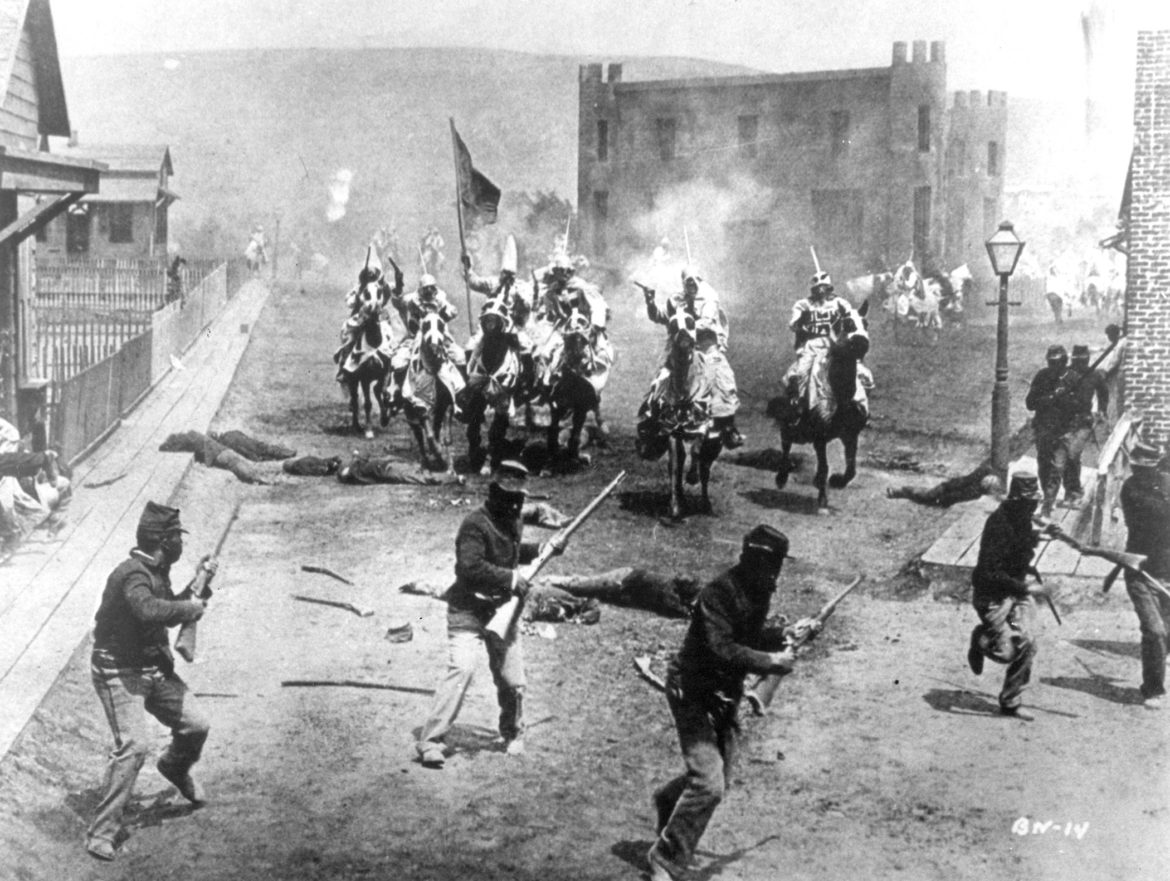
It’s white supremacist propaganda that also had a huge technical and aesthetic impact on later cinema. Birth of a Nation features incredible wide shots, mixed with a number of other styles, depicting carefully orchestrated battlefields and dancehalls that still prove exciting today, and it is also downright jubilant about the rise of the Ku Klux Klan under Reconstruction. (During the KKK’s so-called “second era,” it was shown as an actual recruitment video). It is a touchstone for every movie that came after, and also, thematically, beneath contempt.

Watching any early film, there are several steps of remove. Stepping into a darkened theater for a screening, or loading things up on streaming services, downloaded files, Blu-Ray, and DVD, we watch images captured a century ago on film. The world depicted isn’t ours, the behaviors can seem odd (and fast), and the assumptions have changed about people’s roles. They are cultural artifacts, which were received by audiences once and enjoyed or rejected; they are cultural artifacts we can consider now, gauging how they play aesthetically and what resonance they still have, and why; and they are lenses through which to consider how both art and history function.

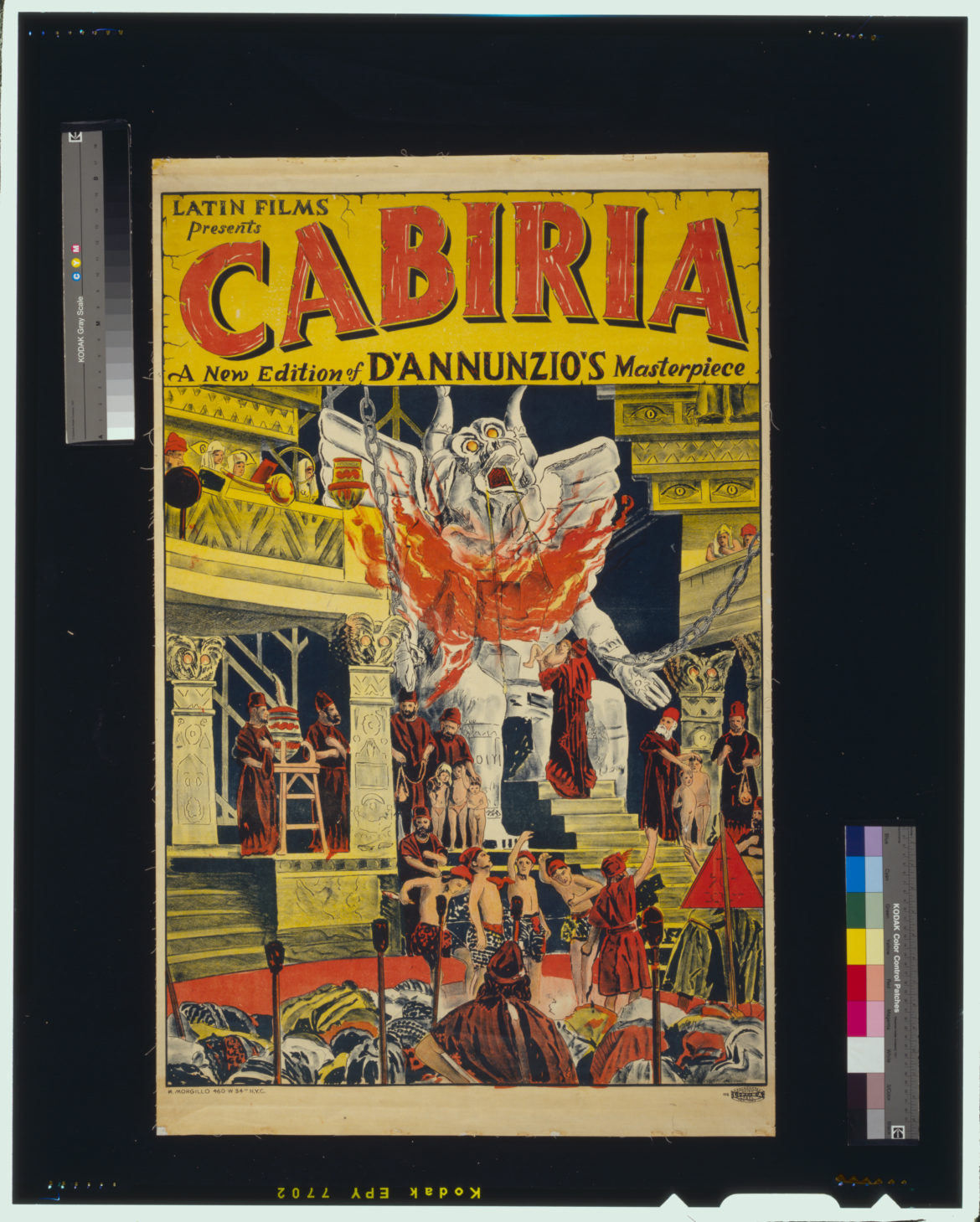
With epics like Cabiria, and now Birth of a Nation, there’s another remove. Like all epics, they are located in a time and place but look further back themselves – Cabiria to the Punic Wars, Birth of a Nation to the Civil War (or, as I’m certain Birth of a Nation would have it, the “War of Northern Aggression”).

And like all epics, they don’t magically appear in the cultural imagination. From The Iliad to The Aeneid to The Inferno and beyond, epics share numerous characteristics, not least among them their association with empire, with foundational myths and the political and socially charged fantasies that animate the moment of their creation. Pastrone’s Cabiria took the opportunity of the 1911-1912 Libyan War victory to remember Rome’s triumph over Carthage in the 3rd century B.C., Griffith’s groundbreaking epic does something similar, but Birth of a Nation maps that fantasy onto dreams of the South rising at last, casting off its figurative chains (now that that the literal ones the South relied on were no more) and reasserting its wounded primacy. “The Empire of the South,” Hoover’s phrase, is instructive – Birth of a Nation is a requiem for a lost way of life (invariably depicted as bucolic and, if not perfect, certainly better than the through-the-looking-glass chaos of Reconstruction) and a fist-in-the-air protest against modernity, embodied in the form of lascivious Black bodies upsetting the social order. In a heavy irony, modernity, in the form of the camera lens, gives this deeply nasty vision its ability to be seen.

That D.W. Griffith’s film is a foundational text is beyond dispute: it announces as much in its title. Birth of a Nation played a huge role in introducing film vocabulary we now take for granted. Examples include differentiating the motivations of people in the foreground and background, cutting between a scene and another one elsewhere that it affects, and alternating between wide shots, mid shots, and close-ups in battle scenes (especially the climactic final one), managing to both convey a vast scope and focus intimately on the individual characters. If you have ever seen a movie, and especially a war movie or a western, you’ve seen something Griffith had a large hand in laying the groundwork for. There are also moments of great interpersonal pathos between characters, and Griffith coached nuanced performances from his central cast – which is to say, the white ones who aren’t in blackface. Everyone else in Birth of a Nation is a caricature, or worse, an absence.

He also, incontrovertibly, created a 3-hour-long recruitment video for the Ku Klux Klan. Despite protests from the NAACP, Birth of a Nation was the first film ever to be screened inside the White House. The latter shouldn’t be too surprising, as a galling quote from Woodrow Wilson, U.S. President at the time, features prominently in the film.

It’s all well and good to take a look at its aesthetics but, more than most films, these contexts can’t be shrugged off as “extratextual” – the film’s white supremacy and fear are part of its DNA, just as they are of the country that birthed it.

As Alyssa Rosenberg notes, the aesthetics vs. racism division is a crude one, and arguably gets it wrong – to say that Griffith was a technical master but also a white supremacist is to imply a chasm between the two, when in many ways, his mastery of technique elevates the importance of his racism to the discussion. If Birth of a Nation were unwatchable garbage, technically, no one would talk about it 100 years later. Perversely, despite its punishing three and half hour running time and unmitigated bigotry, it’s eminently watchable. This is especially true in Part 1, which focuses on the war and its immediate aftermath before Part 2 gets down to the business of defending oppressed white society from being trampled under the heel of Black tyranny.

Kino Video’s restored version, which is the one I watched, opens with a prelude – later footage depicting Griffith in conversation with Walter Huston. As Huston oohs and aahs over the film, Griffith refuses to take full credit, attributing the positive critical and popular reception to the resonance of the story itself. And as if to remove any doubt about where he’s coming from (and how little he is prepared to cede to critics of his movie’s white supremacist narrative), he describes Birth of a Nation as his father’s story, who fought for the South and lived under Reconstruction, and his mother’s, who herself sewed robes for the Klan. The KKK, he intones with a mixture of regret and defiance, “was needed at the time.” Oboy.

An introductory title card, under the header “A plea for the art of the motion picture”, reads: “We do not fear censorship, for we have no wish to offend with improprieties or obscenities, but we do demand, as a right, the liberty to show the dark side of wrong, that we may illuminate the bright side of virtue.” To his credit, the film does showcase the venality of opportunistic white politicians, and it is at pains to emphasize the common humanity of soldiers on both sides of the battles. To his deep, lasting discredit, not a touch of this empathy or nuance is extended to anyone but whites, and those depictions of political venality are reserved solely for the abolitionists, carpetbaggers, and drunken, endlessly ridiculous caricatures of newly freed blacks, who simply don’t know how to behave in civilized society, much less govern a state.

We open on the Cameron estate in Piedmont, South Carolina, meeting each of the members of the family as they visit. The elder Cameron, patriarch, sits on a porch, lazily petting two dogs and a cat (a quiet, naturalistic touch far removed from the epic staginess of Cabiria). The family tours the grounds, from the tree-lined thoroughfare to the bucolic cotton fields filled with happy slaves to the slave quarters themselves, whose denizens are only too enthusiastic to dance and cavort like live-action cartoons for the pleased whites. It’s profoundly unpleasant, but the overall look and feel is bright, orderly, sun-lit … just lovely all around, if you’re a Cameron.

This is the Old South, and it’s on its way out. Not but moments later, we are in Washington, where Lincoln has signed an executive order issuing a call for volunteers. I was surprised by how fast the war arrived in the film – only 30 minutes in and it’s begun. Interestingly, the scene depicting the signing of the executive order is, a title card tells us, based on a photographic facsimile, which Griffith even cites specifically (this technique occurs twice more over the course of the film). The shot opens with its participants carefully arranged, clearly reproducing an external image, before awkwardly kicking into gear and motion. Griffith seems to announce that his film is not a mere telling but History itself – you can check the book to verify, if you like; the photo is there, and the source helpfully provided.

It also announces a marked difference in approach: whereas Cabiria sought to distinguish film from theater and opera through grand stagings and dramatic depictions of light and dark, Griffith’s ambition seems for film to subsume other forms, including photography. Film will do all the things Pastrone aimed for but more, liberally stealing from those traditions and rerouting them for its own uses. Film will be the new all-encompassing performative and representative medium for the 20th century.

Time flies at this point. After the Battle of Bull Run, celebratory bonfires rage in the streets (it looks like a riot to me, but I’ve never been to a celebratory urban bonfire that wasn’t a riot) while a ball commences indoors among the well-to-do. The ball is a wonderfully shot sequence, as the couples weave in and out gracefully, their expressions distinct and identifiable. It’s no small thing to choreograph dozens of dancing couples in finery without things being reduced to visual mush – here, Griffith makes it look easy. What’s more, as the announcement that the Confederate soldiers in their ranks are needed, there is simultaneous excitement, pride, sorrow, and worry reflected on different faces in different interactions, in foreground and back. We can see them all at once, and it’s never confusing. There’s a feeling of life in this scene, and intimacy, of different people with different motivations reacting in individual ways in a crowd. It’s a neat trick, and testifies to Griffith’s ability to coach his cast, as well as shoot them.

After the soldiers march heroically off to cheers (including those of their slaves), Piedmont is raided by a guerrilla regimen of Northern Blacks, under the lead of a “scallywag” white officer. They burn buildings and kill many as they ransack the town. Again, the visual language is crisp and precise – there’s little confusion over who is who or what is happening, and it is, somewhat guiltily, pretty exciting. For the first, but not the last time, I was reminded of the quote attributed to Truffaut, that an anti-war depiction of battle is impossible, since action argues for itself. Whether the viewer is horrified by the destruction (as Griffith no doubt intended) or feels that it’s a justified as part of the battle against slavery (a more likely modern reaction), the scene is simply exciting, full stop.

Two of the Cameron daughters hide in a crawlspace as the building catches flames, and it is very difficult indeed not to align ourselves with these cornered protagonists, the very picture of innocent and pure Southern young womanhood. The Confederates rush back to the town’s rescue, a street fight ensues, and we close on the image of a Northern and a Southern fighter dead in each other’s arms. It’s perniciously sentimental, but it’s hard to ignore what Griffith pulls off here.

From here on out, Birth of a Nation depicts Atlanta burned to the ground by Sherman’s forces and a title card announces “The last days of the Confederacy.” A final monster battle follows between a well-supplied Union regimen and a Southern battalion cut off from their food supply train. All the stops are pulled: there’s an artillery duel to break the Union lines, then a glorious wide shot of opposing entrenchments trading fire, smoke everywhere from the guns, field artillery riding through the frame, mortar explosions, dead bodies and writhing wounded ones as far as the eye can see, a final, desperate moment of hand-to-hand combat and bayonet blades. It’s masterfully done. And then, contrary to earlier notions that audiences wouldn’t understand anything more complicated than a mid-shot, Griffith twice cuts between the battle and the Cameron family praying at home, adding another element to the tension and pacing while widening the already enormous scope of the battle to include the worried family far from the front.

In Birth of a Nation‘s most affecting moment, a simple, mournful title card reads, “War’s peace”, as the camera surveys a grotesque tableau of mangled bodies, slumped corpses, and hollow eyes. This is the high point of the movie. Unfortunately, there’s 2 more hours.

Ben Cameron survives the battle, and wins the admiration of Union soldiers by sheltering one of their wounded own during the fight (testifying to his true Southern decency). He’s hospitalized with a card relaying his heroism and asking that he be treated well by the North. By chance, the hospital he lands in is where Elsie Stoneman, daughter of a prominent abolitionist and cousin to his friend, serves as a nurse. Ben has loved Elsie ever since he saw her photograph, which he, despite never having met her, kind of creepily carried with him throughout the travails of the war (I guess this testifies to the romantic bent of Southern masculinity, although it comes across more stalker-y than anything … maybe Griffith was just looking forward to future romantic comedies).

Unfortunately for Ben, the radical abolitionists (those bastards) have been agitating for the hanging of all Southern officers. Somehow, Elsie and the matriarch of the Cameron clan get an audience with Lincoln himself to plead their case and, after some initial reluctance, he grants Ben clemency. Rosenberg is right to cite this scene as another of the most affecting, on a small scale: the mother reacts to the news in several stages, reaching out to hug the President, refraining and pulling back, looking ready to collapse. It’s a believable and emotional moment.

With another facsimile, Robert E. Lee (gracious but pained) surrenders to Grant (cigar-chomping and arrogant), and the war is over. The South is humbled. Ben returns to Piedmont to find a ruined town, a family subsisting on meager fare, and a younger sister who has glued cotton to her plain dress for the occasion, in a sad attempt at past glory.

And then Lincoln is killed, opening a path to the ascendancy of the radical Northerners, who want not only to punish the South but to kill it once and for all.

Part 2 is where Birth of a Nation tips into pure racist propaganda. (One imagines that, for KKK recruitment purposes, they didn’t even show Part 1.) For all its rosy depictions of the pre-war South, Part 1 has a narrative drive and (a limited number of) nuanced characterizations that’s completely missing from the film’s back half. We’ve left behind any attempt at artistry and, in its account of the rise of the KKK, have moved into cold, racist political calculation. It’s horrific to behold.

Griffith’s title card, sounding suspiciously like a man addressing a future jury, argues that “This is an historical presentation of the Civil War and Reconstruction Period, and is not meant to reflect on any race or people of today.” Well, that’s nice, anyway.

In another prelude, Huston and Griffith return to discuss the film. The filmmaker trots out this whopper from Woodrow Wilson (our 28th President, ladies and gentlemen), which no doubt sped up its historic screening in Wilson’s White House:

Adventurers swarmed out of the North, as much the enemies of one race as of the other, to cozen, beguile and use the negroes. The white men were aroused by a mere instinct of self-preservation — until at last there sprung into existence a great Ku Klux Klan, a veritable empire of the South, to protect the Southern country.

Griffith adds, “It’s rather true, isn’t it?”

By Birth of a Nation‘s telling, under Reconstruction the Northerners came en masse to the South, displacing long-standing parliamentarians, changing voter registration rules to exclude whites (ahem), and bribing ignorant black voters. The result? A statehouse composed of 101 blacks “against” (the film’s word) 23 whites. These idiotic legislators pass bottles around, take off their shoes and put their feet up on their desks, and, worst of all, legalize interracial relationships. (Title card: “Later the grim reaping begins.”) Black juries absolve obvious Black criminals of guilt. Mobs beat up fellow Blacks who didn’t vote for the right candidate.

All is lost, all is lost for (actual title card) “the oppressed white minority.”

The plot focuses on Silas Lynch, a “mulatto” who attains the position of Lt. Governor mainly as the tool of radical Northerner Austin Stoneman (Elsie’s father, if you’re keeping score). He’s a leering, lecherous figure, power-mad in his new freedom and jubilant at the opportunity to take the whites down a notch.

Ben Cameron has had enough of this world turned upside down, but it’s not until he despondently sits on a hill to think on how crazy the world has become that he gets his inspiration. Several Black children are playing nearby; two cover themselves in a sheet, then jump up and scare the others. Eureka! The KKK is born.

That the most violent and notorious hate group the U.S. has ever produced was the brainchild of a man observing Black children at play might be Birth of a Nation‘s most nauseating suggestion, but the film has no time for such thoughts. The KKK begins fighting back against the over-reach and scandalously degenerate behavior of the free Blacks, first through intimidation and then murder. Lynch retaliates and a local war begins.

By the time the youngest Cameron daughter is chased by Gus, a free Black who wants a white woman as his wife, through the woods, up the hilltop, and to her death, Birth of a Nation has become almost unwatchably reprehensible. The implication that slavery was the only thing that kept the Black male libido in check, and that white Southern women would be better served by flinging themselves from hilltops to the rocks below than allow their modesty to be sullied in such a fashion, is par for the course at this point. On an aesthetic note, their chase is shot like a proto-horror film (Texas Chainsaw springs immediately to mind, along with Halloween). This is not to the film’s credit.

The KKK track Gus down in a gin joint where he’s cowardly hiding, put him on trial before a truly horrific assembly of hooded Klan members, kill him, and leave him on the statehouse steps, with a note pinned to his chest depicting their logo and a skull and crossbones. I think we’re supposed to cheer for this retribution.

Birth of a Nation winds down with Lynch “proposing” to Elsie (the proposal escalates immediately to threats of violence), her refusal, and her rescue by the Klan. Lynch can no longer be controlled by Stoneman, who himself, hypocrite that he is, can’t stomach the notion of a non-white marrying his daughter, however much he may support miscegenation as a politically-motivated wedge issue. There is a call for all the neighboring Klans to ride together and save Elsie’s imperiled white womanhood, and both former Union and Reb soldiers, recognizing their joint investment in “defence of their Aryan brotherhood,” ride as one to stop the forced marriage. This new unity leads to the heroic re-disenfranchisement of blacks, who also have to turn in all their guns, and order is restored. We close with expression of love between two whites, a crazy last image of the wastefulness of the death in the war, and a plea to find brotherhood in Christ.

That’s actually what happens in this fucking movie. This is incredibly long, but after watching 3.5 hours of this business, I feel like I’ve earned the right to recount it. And, at 3.5 hours, I’ve also left out quite a bit.

The lingering question remains: why watch Birth of a Nation, though? It’s reprehensible. We have Wikipedia and IMDB, so we know it’s racist. Yes, Griffith made technological innovations and huge impacts on the visual language of cinema, but … why watch it?

I don’t think there’s anything inherently virtuous in watching it. Birth of a Nation is not like a gauntlet one has to run through in order to have an opinion on its content, context, or aesthetic. If others would prefer to ignore it, or at least not engage with it, I would be the last person to say that’s incorrect.

I watched it because of this project, and also because I’d long been curious exactly how fucked up it was. Lesson learned: Birth of a Nation is very fucked up. And I’d also long been curious to know why it’s so often cited as a “great film,” despite its loathsome narrative. Lesson also learned: the staging of the battle and ballroom scenes in Part 1, the subtle reaction shots between individuals, the contrast between foreground and background characters, the stunts (I didn’t get into that – the guy jumping out a window onto a horse was neat), and the cutting between different locations that opens up the narrative beyond just the 2 (or 200) people on screen at any given time. It continues to bewilder me that people thought audiences wouldn’t understand, say, a cut between a battlefield and a family hundreds of miles away, praying about the battle. But it was Griffith, among others, who made clear that we would understand, and that is a huge contribution to visual storytelling.

Also, as a white guy in America, I wanted to engage with it because of where we are as a society now. This film screened in the White House 100 years before Mike Brown was executed on a street in Ferguson, before Tamir Rice was gunned down in a Cleveland playground, before Oscar Grant was shot in the back on the platform of the Fruitvale BART. Before we locked up more black folks in jails and prisons, or monitored them under state control, than anywhere in history. Many, many more. White anxieties about black bodies, especially black male bodies, are as prevalent as ever, though no one would think to make Birth of a Nation today. There’s an appalling honesty to Griffith’s production that in some ways gives the lie to liberal myths of progress. It’s not “better” to be openly racist, but it’s sure a lot more revealing than the bromides about colorblind societies or expanded opportunities of access or reducing everything to interpersonal stories divorced from larger structures (not to mention the White Savior myths that do-gooders and the well-intentioned can’t seem to stop themselves from promulgating). Looking back at Birth of a Nation shouldn’t be an opportunity to marvel at how prevalent white supremacy once was; it should be a bracing reminder at how much it persists and underwrites our daily lives.

And some more than others. After the credits rolled, I sat thinking on it for a little while – about the film, about representation or lack thereof, about white supremacy and racism and structures of power and stories, about the violent policing of non-white bodies and the myths we still tell to justify the unjustifiable.

But I got exhausted, and depressed. So I took my dogs for a walk. I didn’t feel like thinking or writing any more about white supremacy. Because, as a white person in America, that’s a thing I can do.

Ebert’s review is here. Favorite quote:

To understand “The Birth of a Nation” we must first understand the difference between what we bring to the film, and what the film brings to us. All serious moviegoers must sooner or later arrive at a point where they see a film for what it is, and not simply for what they feel about it. “The Birth of a Nation” is not a bad film because it argues for evil. Like Riefenstahl’s “The Triumph of the Will,” it is a great film that argues for evil. To understand how it does so is to learn a great deal about film, and even something about evil.

Next up: Broken Blossoms
March 8, 2015 0 comments
1 FacebookTwitterPinterestEmail
FilmReviews

Schizopolis (Steven Soderbergh, 1996)

by rick March 5, 2015
written by rick

“In the event that find certain sequences or ideas disturbing, please bear in mind that this is your fault, not ours. You will need to see the picture again and again, until you understand everything.”

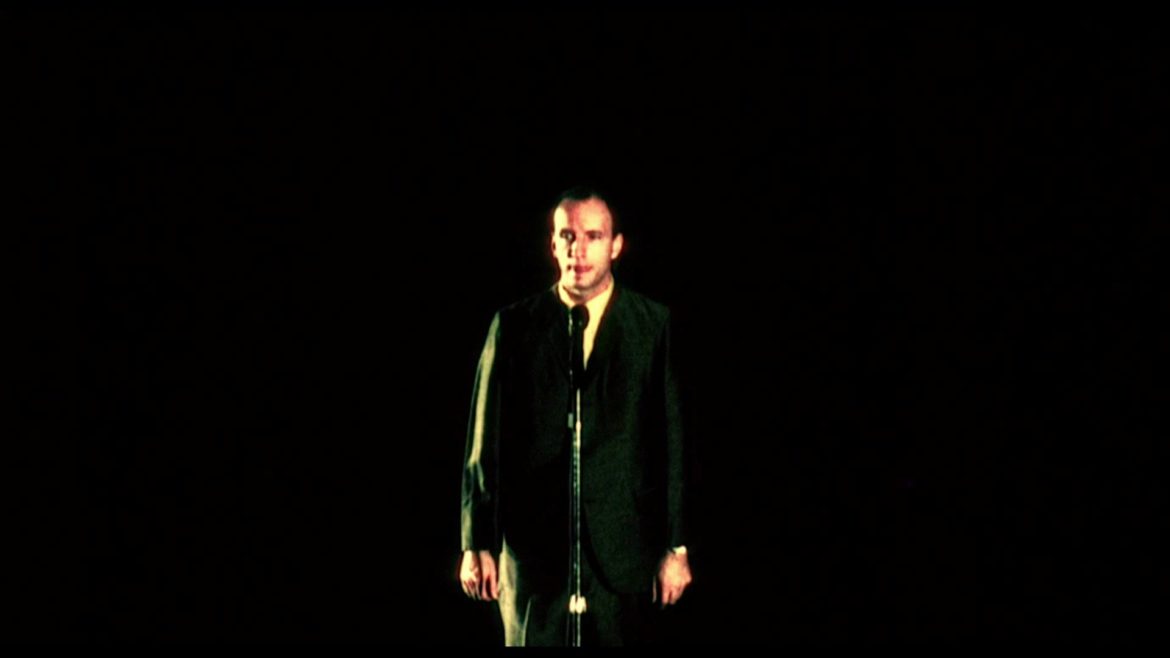
This delightfully caustic warning, uttered by director/star Steven Soderbergh in the first moments of the film, sets the tone for Schizopolis. Entering and exiting the stage half-bowed, like a carnival barker or a cut-rate Hitchcock directing from the proscenium (my new favorite word), he adds that you should pay full-price.

It’s a bitter, angry joke, but it’s still pretty hilarious. There are a lot of those in Schizopolis. The surprise is how melancholy things get. This is a film with no intro or ending credits, that spins wildly between comic plots in its typically Soderberghian three-act structure, and one which begins and ends with a pantsless man on a bicycle. Yet, beneath the breathless antics and absurdist shenanigans, it still manages to suggest a deep weariness.

Soderbergh plays both Fletcher Munson, an office grunt with higher ambitions, in the employ of one Theodore Azimuth Schwitters, an L. Ron Hubbard-like bullshit artist and founder of “Eventualism” (sample dogma: “Eventualism is not a cause, a course, a fashion, or a religion. Eventualism is a state of mind.”).

He also plays Dr. Jeffrey Korchek, a vainglorious, frequently jogging suit-clad dentist having an affair with Munson’s wife, who gets in over his head thanks to his own proclivity for writing notes to his female patients. These notes veer wildly between unfortunately misguided lyricism and, let’s say, inappropriate honesty. “Attractive Woman #2”, as she’s known, receives this sentiment in the mail, surely what every woman wants from her dentist:

I may not know much, but I know that the wind sings your name endlessly, although with a slight lisp that makes it difficult to understand if I’m standing near an air conditioner … I know that if for an instant I could have you lie next to me, or on top of me, or sit on me, or stand over me and shake, then I would be the happiest man in my pants.

Unsurprisingly, this bold gesture has professional consequences, along with personal ones. It’s a rough day. And that’s not even taking into account the unsavory type out to get to him thanks to his addict brother, and the subsequent theft of all of his money.

Laying out the plot further is a fool’s errand, mainly because Schizopolis is as much an interrogation of plot devices as it is an actual movie in the traditional sense.

For instance, one of its key figures, an exterminator named Elmo Oxygen who speaks in a carefully orchestrated nonsense language, is introduced in the first act only to renounce his participation in the film in the second, leaving to start his own reality show, and return to play a key role in the third. Before things fall apart, Soderbergh’s Korchek gleefully notes that he’s having an affair with his own wife (which is to say, Soderbergh’s Munson’s wife). At its conclusion, Munson flash-forwards to let us know how things turn out for him: with mock pathos, he tells that, in eight years, he will be drunkenly fall asleep in the snow at a wedding in Alaska and be discovered months later … and successfully thawed. When director Soderbergh (as opposed to Korchek or Munson) returns to take questions from the audience, we hear his answers but not the questions from the imaginary audience: “Yes. Yes. Foot-long veggie on wheat. Yes. Thank you.” The entire movie is a Dadaist dive into the meta.

It’s also an acerbic examination of the use, and the mis-use, of language. The examples are too numerous to list – they essentially constitute the film. Elmo’s repeated use of “nose army” and assorted lunatic vernacular. The confusion between Korchek and the strongman trying to extort him, as they repeat the sentence “Your brother, eight hours, fifteen thousand dollars” to each other, growing increasingly puzzled. Banal conversation is exchanged in descriptions of its contents, like this portrait of a sexless marriage:

– Ooh, really well-rehearsed speech about workload and stress.
– Genuine sorrow.
– Um, truthful-sounding promises of future satisfaction? Enticement to agree?
– Accepted.
– Gratitude.

Entire scenes are played with one character overdubbed in different languages, and then are replayed later with yet other languages substituted. There’s frenetic action everywhere you look in Schizopolis, and constant wordplay, but no one can understand each other.

This gets to the heart of the very funny movie’s sad center. In an invaluable conversation about Schizopolis on The Solute, two of its contributors point out that Munson’s wife (and Attractive Woman #2) is played, excellently, by Betsy Brantley, Soderbergh’s ex-wife. Without that knowledge, one gets the sense that deep personal pain informs this madcap piece of cinema; knowing that, it’s impossible to ignore. It also came at a time of professional frustration for Soderbergh, and, in consistently inventive ways, showcases a talented director both taking aim at the industry and exorcising his own demons.

The film is at once hilariously irreverent and deeply mournful. It’s a gonzo masterpiece and I’ve never seen anything like it.

March 5, 2015 2 comments
0 FacebookTwitterPinterestEmail
FilmGreat Movie ProjectReviews

Great Movies Project #1: Cabiria (Giovanni Pastrone, 1914)

by rick February 28, 2015
written by rick

Part of an ongoing effort to watch each of the films in Roger Ebert’s Great Movies series. The introduction and full list can be found here.

“A text could be written about the impact of Pastrone’s experiments in lighting and camera movement, decisive in freeing the movies from the proscenium.”

~ Kevin Thomas, Los Angeles Times (quoted at the beginning of Kino Video’s restored Cabiria)

“Proscenium” is a word I was unfamiliar with when it appeared on the screen during my first viewing of Cabiria. It refers to “the part of a theater stage in front of the curtain.” So Thomas’ point is clear: Pastrone’s 1914 Italian epic (and I do mean epic) landmark marks one of the earliest attempts to chart a vocabulary and approach distinct from theater and opera, to create a film that draws from those traditions but is uniquely “a film.” There are moments over the course of its 2-hour-plus running time that it succeeds wildly, and other moments when the struggle between forms, or of a new form fighting its way into the world, is clear as day. It’s a fascinating tension, and a gripping experience.

Cabiria is epic in every way: in its scope, its setpieces, its ambition. It aims to tell both the entire story of the 3rd c. (BC) Punic Wars through the eyes of multiple protagonists, as well as chart their personal journeys and struggles, and to do so by making use of the new opportunities film presents.

We escape volcanic eruptions, walk through the gaping and terrifying mouth of an entrance to the staggering Temple of Moloch, climb mountains, scale fortified walls, trudge through gorgeously shot deserts. There are adventures galore, and cruelty, greed, the elaborate death throes of suicide by poison, mercy, and love. Pastrone seems intent on providing both the intimacy and heightened emotion of the stage with the grandeur of natural locations and wide shots of a cast that must rank in the thousands.

Our story begins one lovely, sun-lit morning in Sicily, on a palatial estate. Young Cabiria and her nurse play with toys on the lawn while servants start their day’s tasks. The eruption of Mt. Etna disturbs this, and the ensuing destruction (incredibly rendered, in ways I still can’t figure out exactly) destroys the home. Cabiria is presumed dead in the rubble.

Actually, she is spirited away by the fleeing servants. But, as usually happens when fleeing volcanic eruptions (if my experience is any guide), all are caught by Phoenician pirates, and sold into slavery in a Carthaginian marketplace. Cabiria is destined for human sacrifice to appease Moloch, the God of Bronze. (Alongside the servants pausing to collect as much treasure as they can carry, putting everyone’s lives in danger, this is an early note of the prominence of greed in the story. And not the last one.)

She is only one of the “100 innocent children” destined to be burned alive to curry favor with the divine. The scene in the Temple of Moloch is legitimately terrifying and completely surreal. The masses head into the temple through a gaping mouth set in stone under a bright, sunny sky; inside, it’s mostly lit by flames held aloft, and the sacrificial fire that is set inside a huge stone idol/crematorium. Priests and others hold up strange, oversized fake hands, palms upright, and Pastrone holds the shot – we are left with the flicker of fire and the unnatural appendages. It’s incredibly disconcerting. One by one, naked, resisting children are fed to the flames, the aperture closing behind them and then smoke emanating from the god’s stone head. These grim proceedings go on for several minutes, far longer than I would’ve expected audiences to tolerate in 1914. Or now — It’s as scary as anything from a modern horror film, and scarier than most.

But not to fear, too much. (At least not for Cabiria – pretty sure 99 naked children were burned alive, but let’s not dwell on that.) Through a series of stagy interventions, Cabiria is rescued by the Roman Fulvilo Axilla and his faithful “servant” (that means “slave”) Maciste, an improbably muscular, Johnny Weismuller-type who later even climbs a tree limb and swings on a rope. Escape is short-lived, however – the trio is split up in the ensuing chase, and each must find their own way. Some are captured, some manage to flee to fight another day.

There are reconnections between them, but the film then shifts from the personal to the political. The machinations of war grind on, in ways too complicated to go into very much, and our focus seems to shift to Fulvilo and Maciste more than Cabiria, which is sort of odd in a movie called Cabiria. And then to the leaders of Carthage, Rome, and elsewhere, and court drama behind them, and proto-femme fetales in a vaguely Cleopatra mold. Pastrone’s epic intent, and his uneasy update of Shakespearian history tropes to the screen, are clear in some of the almost hilariously wordy intertitles that serve as awkward exposition. Here’s a favorite, which introduces Episode 6:

Syphex, King of Cirta, has stripped Massinissa of his realm. Massinissa has vanished into the desert. Hasdrupal gives his daughter, Sophonisba, to the more powerful suitor and secures from this aging son-in-law an alliance against Rome.

Got that? Good.

And that’s not even a particularly confusing one. Viewers might want to bring a list of characters to the film – it approaches Pynchonian levels at points.

The intertitles deserve some mention themselves, as they might be the most evident aspect showcasing the tension between the stage and early cinema. While later silents – like those of Harold Lloyd, Buster Keaton, or Charlie Chaplin – would work to make the action and motivation apparent on the screen with minimal overlaid text, rightly figuring people weren’t coming to the movies to read, Pastrone did not. (There are also virtually no close-ups on faces, a defining feature of “later” early cinema.)

Introductory text explains every scene, as though the filmmakers were nervous audiences simply wouldn’t understand the goings-on through image alone. On the one hand, this can be kind of annoying to modern eyes (mine, anyways). On the other hand, they provide a wonderful test of Ebert’s maxim that “It’s not what the movie is about, but how it’s about it.” Since you know going in what will occur, more or less, you’re somewhat freed to examine how it occurs. This has nothing to do with Pastrone’s intention and everything to do with how we watch movies, but it’s pretty interesting. He also manages some quite witty moments: a title card that reads “Maciste convinces the innkeeper” is followed by Maciste grabbing the innkeeper by the collar and thrashing him a bit, which is pretty funny. That’s one meaning of “convince,” I suppose.

Those intertitles are also flowery to a degree most would find absurd now, but suggest Pastrone and others wanted to connect their film to previous traditions that contemporary audiences might know and relate to. There are many examples, but I loved this exchange, between a woman of privilege and her attendant, about the guy who just sent her an invitation to meet for a tryst in the woods:

–    What is he like? Tell me?
–    Like the spring wind that crosses the desert on feet of clouds bearing the scent of lions and the message of Astarte!

I don’t even know what the message of Astarte is, but I was hoping she’d reply, “So, he’s hot, then, I guess?” Unsurprisingly, this is not the direction things headed, but definitely showcases the lyrical sensibility that guides the film’s approach.

As the film goes on, the epic aspects increase – battles are fought, kings are captured, armies surrender, towns are sacked. But the main interest here is how the technique reflects the interests of the time, and how it points to future developments.

According to that Kino Video prologue, D.W. Griffith was so struck by Cabiria that he radically changed the project he was working on, which would be released as Intolerance. I’ll be watching that in coming weeks, but what’s clear from Pastrone’s film is how the camera itself is coming into play, and how lighting affects scenes and suggests character’s states of mind. It’s staggering: there are shots that seem to have crawled off the wall of a gallery.

And there are sequences that are startling in their forward-thinking technique. One to cite, in particular: in Episode 6, a steady shot is held from close to the street as one of the main characters approaches, and he, obviously, increases in size until he comes to loom over the viewer, suggesting authority and swagger. As he walks away, headed towards danger, his figure, obviously, diminishes, until it’s just his feet and those of his companions we see in the distance. The camera doesn’t move in these shots, just observes, but you get the sense of power in the first shot, resignation and danger in the second. It called Kurosawa immediately to mind. Which is to say, it brought cinema to mind.

Other scenes play with natural light (much of the film is shot outside, again diverting from the confines of the stage). They hide characters in the shadows while others are fully illuminated. We watch the sun fade over the desert and the slow motion of people across it. Pastrone’s intent couldn’t be clear if he actually put up text saying, “This is a movie, everybody. Movies could be a thing, and different.”

The film ends on a triumphant note, affirming Rome’s supremacy over the all the people of the world (er…) and the power of love (aw…). The film’s release came on the heels of Italy’s victory in the Libyan War of 1911-12, and it’s one of many epics produced just prior to World War I (which, I wager, might have sapped some of the enthusiasm for violent historical epics out of the movie-going public, at least for a little while). That might be a dreaded “extra-textual,” but it helps explain why Pastrone, in 1914, wanted to make a film about the triumph of Rome in the 3rd c.

But Cabiria is anything but a history lesson on the Punic Wars. (For one thing, I don’t think Archimedes constructed a huge mirror to blow up enemy ships using the power of the sun. Correct me if I’m wrong.) That’s one aspect, but it’s also about the tragic collision of doomed lovers, the moral corrosion of power, the omnipresence of greed, and the redemptive elements of love and mercy.

More than anything, though, it’s about how to use cameras, light, darkness, imagery both surreal and naturalistic, and episodic, cross-cut storytelling to distinguish film from other media. Its real legacy is the very idea that captured images can be arranged to delight and amaze, that this sort of magic is possible. For all the merits of the stage, you can’t actually trudge through the mountains, or construct a half-pyramid shape with actor’s shields to climb the walls of a fortified building while things are on fire, or cast 1,000 people to mount a battle in a wide-shot.

That’s a job for a different medium, and Pastrone was trying to figure out how it worked. He was enormously successful.

Ebert’s review is here. Favorite line:

What we are now beginning to realize, as more silent films are rediscovered and restored, is that no one film was a breakthrough but excitement and innovation were everywhere in the air; since films from all nations could play anywhere just by changing the languages of the title cards, what directors learned from Sweden tonight was in the films they were making tomorrow in Italy or America.

Next up: Birth of a Nation. Oboy.

February 28, 2015 0 comments
0 FacebookTwitterPinterestEmail
CommentaryFilmGreat Movie Project

Project: Ebert’s Great Movies

by rick February 25, 2015
written by rick

So, now that the awards season is blissfully over, let’s talk about some other movies. Specifically, 370 of them.

After watching Steve James’ remarkable documentary Life Itself (excuse me while I go weep), I got to thinking about Roger Ebert. His books are cultural touchstones for film fans, and, like many other people, I’ve related to him fiercely. Reading Ebert’s review is often one of the first things I want to do when I see a film I admire. And then, I remember watching At The Movies as a kid, and specifically as a kid who didn’t even go to very many movies. I was excited to see the clips, and interested in the two mismatched dudes who got all worked up about them. He seemed like everyone’s mostly genial uncle, who also happened to have a lot of thoughts about every movie imaginable.

Later, I came to appreciate Ebert for his populist sensibility and unwavering enthusiasm. He put out clear, smart writing in a distinct voice, more or less relating what he thought of the movie (which he always wanted to enjoy and hoped wouldn’t disappoint) and what he thought you, the reader, would find if you checked it out.

If you get technical about it, Ebert’s famous notion of film as an “empathy machine” might not be exactly right. But that generous, humanistic sentiment is valuable, and neatly encapsulates everything admirable about his approach.

More pragmatically, as several folks in Life Itself point out, he raised the profile of the films he championed, giving vital access to filmmakers (Erroll Morris, Gregory Nava, Ava Duvernay, Ramin Bahrani, among others, not to mention Hoop Dreams‘ Steve James, who also made Life Itself) who might not have found an audience without him, and he might’ve even literally saved a few people along the way.

And last but not least, in his eminently understandable reviews throughout Roger Ebert’s Great Movies series, he provided his own canon. It’s ironic that he’s so associated with categorical and canonical judgements, since he is on record as despising “best of” lists and the dispiriting, professionally-mandated task of composing them. He preferred to just list movies side by side which he thought were “great,” rather than pitting them against each other like we do every year at awards shows. It’s a noble thought maybe undermined by itself; hierarchical or not, in the end, there’s still a list.

The films profiled (searchable on Ebert’s site, and listed below) represent one (extremely influential and sharp) person’s singular account of cinema history, so there are some unexpected entries. And a whole lot of omissions, since everyone has blind spots and even long lists exclude things by definition. But it’s also a pretty accurate and useful compilation of some of the films that linger in the cultural imagination.

Which brings me to The Plan, as I’ve started calling it (you can even hear the capitalization when I say it aloud): There are 370 movies here, and I plan to watch them all. Is it following Phish and Insane Clown Posse for a while, and slowly going mad? It is not. But it’s The Plan.

The Plan is also to watch them chronologically, revisiting those I’ve seen before and hopefully discovering new (or, more likely, old) masterpieces. I also Plan to write them up individually, with possible assistance from friends (seriously, people, pitch in a little here. You know who you are). I’ll update this page as I do so.

Because these titles tend to focus on U.S., European, and Japanese films, and mostly represent Global Straight Dude Cinema, The Plan gets even more involved: I’m also going to counter-program this series with something else. Why construct one elaborate project when you can construct two?

But that’s a story for another day (probably tomorrow). For now, I just hope that this project will clue me (and the viewing audience at home! Hi, you two!) into themes and echoes across the years, and lead to a better understanding of how an art form works.

And if I fail to clear that bar? At least I’ll still have Planes, Trains and Automobiles and Come and See to look forward to — both were hilarious, I think!

P.S. I was inspired, in part, to do this by the maniac/admirably committed cineaste over at Another Goddamn Movie Blog, who’s taken on something even more ambitious: all films mentioned in Marc Cousins’ The Story Of Film. This is a Werner Herzog-like reach for the impossible that should have everyone’s full support. In fact, that list also has a certain something going for it that this one lacks (it’s Robocop), so you should go read that stuff.

Cabiria 1914 Giovanni Pastrone
The Birth of a Nation 1915 D.W. Griffith
Broken Blossoms 1919 D.W. Griffith
The Cabinet of Dr. Caligari 1920 Robert Wiene
Nosferatu 1922 F.W. Murnau
Nanook of the North 1922 Robert J. Flaherty
Safety Last 1923 Fred C. Newmeyer
Souls for Sale 1923 Rupert Hughes
Greed 1924 Erich von Stroheim
The Last Laugh 1924 F.W. Murnau
The Phantom of the Opera 1925 Rupert Julian
The Battleship Potemkin 1925 Sergei Eisenstein
The General 1926 Clyde Bruckman, Buster Keaton
Faust 1926 F.W. Murnau
Sunrise 1927 F.W. Murnau
Metropolis 1927 Fritz Lang
The Passion of Joan of Arc 1928 Carl Th. Dreyer
The Circus 1928 Charlie Chaplin
The Fall of the House of Usher 1928 Jean Epstein
The Man Who Laughs 1928 Paul Leni
Man With A Movie Camera 1929 Dziga Vertov
Pandora’s Box 1929 Georg Wilhelm Pabst
Diary of a Lost Girl 1929 Georg Wilhelm Pabst
Un Chien Andalou 1929 Luis Bunuel
City Lights 1931 Charlie Chaplin
M 1931 Fritz Lang
Dracula 1931 Tod Browning
Trouble in Paradise 1932 Ernst Lubitsch
King Kong 1933 Various
Duck Soup 1933 Leo McCarey
L’Atalante 1934 Jean Vigo
The Scarlet Empress 1934 Josef von Sternberg
The Thin Man 1934 W.S. Van Dyke
Bride of Frankenstein 1935 James Whale
Triumph of the Will 1935 Leni Riefenstahl
Top Hat 1935 Mark Sandrich
Swing Time 1936 George Stevens
My Man Godfrey 1936 Gregory La Cava
The Only Son 1936 Yasujiro Ozu
Snow White and the Seven Dwarfs 1937 Various
Grand Illusion 1937 Jean Renoir
Make Way for Tomorrow 1937 Leo McCarey
The Adventures of Robin Hood 1938 Michael Curtiz, William Keighley
The Rules of the Game 1939 Jean Renoir
Stagecoach 1939 John Ford
Gone With The Wind 1939 Victor Fleming
The Wizard of Oz 1939 Victor Fleming
The Great Dictator 1940 Charlie Chaplin
The Bank Dick 1940 Edward F. Cline
Pinocchio 1940 Various
The Thief of Bagdad 1940 Various
The Grapes of Wrath 1940 John Ford
The Maltese Falcon 1941 John Huston
Citizen Kane 1941 Orson Welles
The Lady Eve 1941 Preston Sturges
Cat People 1942 Jacques Tourneur
Casablanca 1942 Michael Curtiz
Yankee Doodle Dandy 1942 Michael Curtiz
Shadow of a Doubt 1943 Alfred Hitchcock
The Life and Death of Colonel Blimp 1943 Michael Powell, Emeric Pressburger
Double Indemnity 1944 Billy Wilder
Laura 1944 Otto Preminger
Detour 1945 Edgar G. Ulmer
Children of Paradise 1945 Michael Carne
Ivan The Terrible, Part I 1945 Sergei Eisenstein
Notorious 1946 Alfred Hitchcock
Great Expectations 1946 David Lean
It’s a Wonderful Life 1946 Frank Capra
The Big Sleep 1946 Howard Hawks
Beauty and the Beast 1946 Jean Cocteau
My Darling Clementine 1946 John Ford
The Best Years of Our Lives 1946 William Wyler
Out of the Past 1947 Jacques Tourneur
Red River 1948 Howard Hawks, Arthur Rosson
The Treasure of the Sierra Madre 1948 John Huston
The Red Shoes 1948 Michael Powell, Emeric Pressburger
The Bicycle Thief 1948 Vittorio De Sica
The Third Man 1949 Carol Reed
Kind Hearts and Coronets 1949 Robert Hamer
Late Spring 1949 Yasujiro Ozu
Rashomon 1950 Akira Kurosawa
Sunset Boulevard 1950 Billy Wilder
Orpheus 1950 Jean Cocteau
All About Eve 1950 Joseph L. Mankiewicz
In A Lonely Place 1950 Nicholas Ray
Strangers on a Train 1951 Alfred Hitchock
Ace in the Hole 1951 Billy Wilder
The River (Le Fleuve) 1951 Jean Renoir
Diary of a Country Priest 1951 Robert Bresson
Ikiru 1952 Akira Kurosawa
The Life of Oharu 1952 Kenji Mizoguchi
Forbidden Games 1952 Rene Clement
Singin’ In The Rain 1952 Stanley Donen, Gene Kelly
Umberto D 1952 Vittorio De Sica
The Big Heat 1953 Fritz Lang
The Earrings of Madame D… 1953 Fritz Lang
Shane 1953 George Stevens
Mr. Hulot’s Holiday 1953 Jacques Tati
Beat The Devil 1953 John Huston
Ugetsu 1953 Kenji Mizoguchi
The Band Wagon 1953 Vincente Minnelli
Tokyo Story 1953 Yasujiro Ozu
The Seven Samurai 1954 Akira Kurosawa
Rear Window 1954 Alfred Hitchcock
On The Waterfront 1954 Elia Kazan
Touchez Pas Au Grisbi 1954 Jacques Becker
French Cancan 1954 Jean Renoir
Rififi 1954 Jules Dessin
Sansho The Bailiff 1954 Kenji Mizoguchi
Senso 1954 Luchino Visconti
Johnny Guitar 1954 Nicholas Ray
Ordet 1955 Carl Th. Dreyer
The Night of the Hunter 1955 Charles Laughton
Pather Panchali 1955 Satyajit Ray
Smiles of a Summer Night 1955 Ingmar Bergman
Rebel Without A Cause 1955 Nicholas Ray
Aparajito 1956 Satyajit Ray
Written on the Wind 1956 Douglas Sirk
Bob Le Flambeur 1956 Jean-Pierre Melville
The Searchers 1956 John Ford
A Man Escaped 1956 Robert Bresson
The Killing 1956 Stanley Kubrick
The Sweet Smell of Success 1957 Alexander Mackendrick
The Bridge on the River Kwai 1957 David Lean
Nights of Cabiria 1957 Federico Fellini
The Seventh Seal 1957 Ingmar Bergman
12 Angry Men 1957 Sidney Lumet
Paths of Glory 1957 Stanley Kubrick
Vertigo 1958 Alfred Hitchcock
Mon Oncle 1958 Jacques Tati
Ballad of Narayama 1958 Keisuke Kinoshita
Ivan The Terrible, Part II 1958 Sergei Eisenstein
Touch of Evil 1958 Orson Welles
The Music Room 1958 Satyajit Ray
Some Like It Hot 1959 Billy Wilder
Apur Sansar 1959 Satyajit Ray
The 400 Blows 1959 Francois Truffaut
Rio Bravo 1959 Howard Hawks
Pickpocket 1959 Robert Bresson
Floating Weeds 1959 Yasujiro Ozu
Psycho 1960 Alfred Hitchcock
The Apartment 1960 Billy Wilder
La Dolce Vita 1960 Federico Fellini
Breathless 1960 Jean-Luc Godard
Rocco and His Brothers 1960 Luchino Visconti
Peeping Tom 1960 Michael Powell
L’Avventura 1960 Michaelangelo Antonioni
Inherit The Wind 1960 Stanley Kramer
Yojimbo 1961 Akira Kurosawa
Last Year At Marienbad 1961 Alain Resnais
Victim 1961 Basil Dearden
Through a Glass Darkly 1961 Ingmar Bergman
Leon Morin, Priest 1961 Jean-Pierre Melville
West Side Story 1961 Jerome Robbins, Robert Wise
Viridiana 1961 Luis Bunuel
The Hustler 1961 Robert Rossen
Cleo from 5 to 7 1962 Agnes Varda
Lawrence of Arabia 1962 David Lean
Jules and Jim 1962 Francois Truffaut
My Life To Live 1962 Jean-Luc Godard
The Man Who Shot Liberty Valence 1962 John Ford
The Manchurian Candidate 1962 John Frankenheimer
The Exterminating Angel 1962 Luis Bunuel
Harakiri 1962 Masaki Kobayashi
What Ever Happened To Baby Jane? 1962 Robert Aldrich
An Autumn Afternoon 1962 Yasujiro Ozu
8 1/2 1963 Federico Fellini
Winter Light 1963 Ingmar Bergman
The Silence 1963 Ingmar Bergman
The Leopard 1963 Luchino Visconti
My Fair Lady 1964 George Cukor
Woman in the Dunes 1964 Hiroshi Teshigahara
Pale Flower 1964 Masahiro Shinoda
The Gospel According to St. Matthew 1964 Pier Paolo Pasolini
A Hard Day’s Night 1964 Richard Lester
Dr. Strangelove 1964 Stanley Kubrick
Seven Up! 1946 Paul Almond
Red Beard 1965 Akira Kurosawa
Juliet of the Spirits 1965 Federico Fellini
Chimes at Midnight 1965 Orson Welles
The Battle of Algiers 1966 Gillo Pontecorvo
Persona 1966 Ingmar Bergman
Blow-Up 1966 Michaelangelo Antonioni
Au Hasard Balthazar 1966 Robert Bresson
The Good, The Bad and the Ugly 1966 Sergio Leone
Bonnie and Clyde 1967 Arthur Penn
La Collectionneuse 1967 Eric Rohmer
Playtime 1967 Jacques Tati
Le Samourai 1967 Jean-Pierre Melville
Belle de Jour 1967 Luis Bunuel
Samurai Rebellion 1967 Masaki Kobayashi
The Producers 1967 Mel Brooks
The Fireman’s Ball 1967 Milos Forman
In Cold Blood 1967 Richard Brooks
Cool Hand Luke 1967 Stuart Rosenberg
Romeo and Juliet 1968 Franco Zeffirelli
Yellow Submarine 1968 George Dunning
2001: A Space Odyssey 1968 Stanley Kubrick
Easy Rider 1969 Dennis Hopper
Army of Shadows 1969 Jean-Pierre Melville
The Wild Bunch 1969 Sam Peckinpah
El Topo 1970 Alejandro Jodorowsky
Five Easy Pieces 1970 Bob Rafelson
Le Boucher 1970 Claude Chabrol
Patton 1970 Franklin J. Schaffner
7 Plus Seven 1970 Michael Apted
Woodstock 1970 Michael Wadleigh
Mon Oncle Antoine 1971 Claude Jutra
WR: Mysteries of the Organism 1971 Dusan Makavejev
Walkabout 1971 Nicholas Roeg
The Last Picture Show 1971 Peter Bogdonovich
McCabe and Mrs. Miller 1971 Robert Altman
Solaris 1972 Andrei Tarkovsky
Last Tango In Paris 1972 Bernardo Bertolucci
The Godfather 1972 Francis Ford Coppola
Cries and Whispers 1972 Ingmar Bergman
The Discreet Charm of the Bourgeoisie 1972 Luis Bunuel
Aguirre, The Wrath of God 1972 Werner Herzog
Amarcord 1973 Federico Fellini
Day For Night 1973 Francois Truffaut
Mean Streets 1973 Martin Scorcese
Don’t Look Now 1973 Nicholas Roeg
The Long Goodbye 1973 Robert Altman
Badlands 1973 Terrence Malick
Spirit of the Beehive 1973 Victor Erice
The Conversation 1974 Francis Ford Coppola
The Godfather, Part II 1974 Francis Ford Coppola
A Woman Under The Influence 1974 John Cassavetes
Ali: Fear Eats the Soul 1974 Rainer Werner Fassbinder
Chinatown 1974 Roman Polanski
Bring Me The Head of Alfredo Garcia 1974 Sam Peckinpah
The Enigma of Kaspar Hauser 1974 Werner Herzog
Night Moves 1975 Arthur Penn
One Flew Over The Cuckoo’s Nest 1975 Milos Forman
Picnic at Hanging Rock 1975 Peter Weir
Nashville 1975 Robert Altman
Dog Day Afternoon 1975 Sidney Lumet
Barry Lyndon 1975 Stanley Kubrick
Jaws 1975 Steven Spielberg
Taxi Driver 1976 Martin Scorcese
Network 1976 Sidney Lumet
Heart of Glass 1976 Werner Herzog
21 Up 1977 Michael Apted
Star Wars 1977 George Lucas
Saturday Night Fever 1977 John Badham
3 Women 1977 Robert Altman
Stroszek 1977 Werner Herzog
Annie Hall 1977 Woody Allen
Killer of Sheep 1978 Charles Burnett
Gates of Heaven 1978 Errol Morris
Superman 1978 Richard Donner
Days of Heaven 1978 Terrence Malick
Apocalypse Now 1979 Francis Ford Coppola
Being There 1979 Hal Ashby
The Marriage of Maria Braun 1979 Rainer Werner Fassbinder
Alien 1979 Ridley Scott
Vengeance Is Mine 1979 Shohei Imamura
Nosferatu the Vampyre 1979 Werner Herzog
Manhattan 1979 Woody Allen
Mon Oncle D’Amerique 1980 Alain Resnais
Atlantic City 1980 Louis Malle
Raging Bull 1980 Martin Scorcese
The Big Red One 1980 Samuel Fuller
The Shining 1980 Stanley Kubrick
Pixote 1981 Hector Babenco
Mephisto 1981 Istvan Szabo
Diva 1981 Jean-Jacques Beineix
Body Heat 1981 Lawrence Kasdan
My Dinner With Andre 1981 Louis Malle
Raiders of the Lost Ark 1981 Steven Spielberg
Pink Floyd: The Wall 1982 Alan Parker
Fanny and Alexander 1982 Ingmar Bergman
Veronika Voss 1982 Rainer Werner Fassbinder
Blade Runner: The Final Cut 1982 Ridley Scott
E.T. The Extra-Terrestrial 1982 Steven Spielberg
Fitzcarraldo 1982 Werner Herzog
A Christmas Story 1983 Bob Clark
Scarface 1983 Brian DePalma
Tender Mercies 1983 Bruce Beresford
El Norte 1983 Gregory Nava
The Right Stuff 1983 Philip Kaufmann
28 Up 1984 Michael Apted
A Sunday in the Country 1984 Bertrand Tavernier
A Year of the Quiet Sun 1984 Krzysztof Zanussi
Amadeus 1984 Milos Forman
This Is Spinal Tap 1984 Rob Reiner
Paris, Texas 1984 Wim Wenders
Ran 1985 Akira Kurosawa
Shoah 1985 Claude Lanzmann
Come and See 1985 Elem Klimov
After Hours 1985 Martin Scorcese
Mishima: A Life In Four Chapters 1985 Paul Schrader
The Color Purple 1985 Steven Spielberg
Withnail and I 1987 Bruce Robinson
House of Games 1987 David Mamet
Planes, Trains and Automobiles 1987 John Hughes
The Dead 1987 John Huston
Au Revoir Les Enfants 1987 Louis Malle
Moonstruck 1987 Norman Jewison
Wings of Desire 1987 Wim Wenders
My Neighbor Totoro 1988 Hayao Miyazaki
Grave of the Fireflies 1988 Isao Takahata
The Last Temptation of Christ 1988 Martin Scorcese
Santa Sangre 1989 Alejandro Jodorowsky
Say Anything 1989 Cameron Crowe
Mystery Train 1989 Jim Jarmusch
Monsieur Hire 1989 Patrice Leconte
Do The Right Thing 1989 Spike Lee
Crimes and Misdemanors 1989 Woody Allen
The Match Factory Girl 1990 Aki Kaurismaki
After Dark, My Sweet 1990 James Foley
Goodfellas 1990 Martin Scorcese
The Hairdresser’s Husband 1990 Patrice Leconte
35 Up 1991 Michael Apted
La Belle Noiseuse 1991 Jacques Rivette
The Silence of the Lambs 1991 Jonathan Demme
The Double Life of Veronique 1991 Krzysztof Kieslowski
JFK 1991 Oliver Stone
A Woman’s Tale 1991 Paul Cox
Raise The Red Lantern 1991 Yimou Zhang
Unforgiven 1992 Clint Eastwood
A Tale of Winter 1992 Eric Rohmer
Howards End 1992 James Ivory
Leolo 1992 Jean-Claude Lauzon
Baraka 1992 Ron Fricke
Groundhog Day 1993 Harold Ramis
The Age of Innocence 1993 Martin Scorcese
Schindler’s List 1993 Steven Spielberg
The Blue Kite 1993 Zhuangzhuang Tian
Exotica 1994 Atom Egoyan
The Shawshank Redemption 1994 Frank Darabont
Pulp Fiction 1994 Quentin Tarantino
Hoop Dreams 1994 Steve James
Crumb 1994 Terry Zwigoff
La Ceremonie 1995 Claude Chabrol
Seven 1995 David Fincher
Leaving Las Vegas 1995 Mike Figgis
Richard III 1995 Richard Loncraine
Fargo 1996 Joel Coen
Secrets and Lies 1996 Mike Leigh
L.A. Confidential 1997 Curtis Hanson
Contact 1997 Robert Zemeckis
42 Up 1998 Michael Apted
Dark City 1998 Alex Proyas
The Big Lebowski 1998 Joel Coen
The Decalogue 1998 Krzysztof Kieslowski
The Terrorist 1998 Santosh Sivan
Magnolia 1999 P.T. Anderson
Werckmeister Harmonies 2000 Bela Tarr
Mulholland Dr. 2001 David Lynch
Spirited Away 2001 Hiyao Miyazaki
Waking Life 2001 Richard Linklater
The Pledge 2001 Sean Penn
A.I. Artificial Intelligence 2001 Steven Spielberg
The Grey Zone 2001 Tim Blake Nelson
Ripley’s Game 2002 Liliana Cavani
Adaptation 2002 Spike Jonze
25th Hour 2002 Spike Lee
Spring, Summer, Fall, Winter … And Spring 2003 Ki-duk Kim
Lost In Translation 2003 Sofia Coppola
Moolaade 2004 Ousmane Sembene
Eternal Sunshine of the Spotless Mind 2004 Spike Jonze
49 Up 2005 Michael Apted
Cache 2005 Michael Haneke
Babel 2006 Alejandro Gonzalez Inarritu
Pan’s Labyrinth 2006 Guillermo del Toro
A Prairie Home Companion 2006 Robert Altman
Chop Shop 2007 Ramin Bahrani
Departures 2008 Yojiro Takita
56 Up 2012 Michael Apted
February 25, 2015 6 comments
0 FacebookTwitterPinterestEmail
CommentaryFilm

The Oscars are bullshit, and we’re all fools: Picks #3

by rick February 22, 2015
written by rick

And the rest of the business for the Oscars. First part’s here; second part’s here.

Best Visual Effects

dawn of the planet of the apes

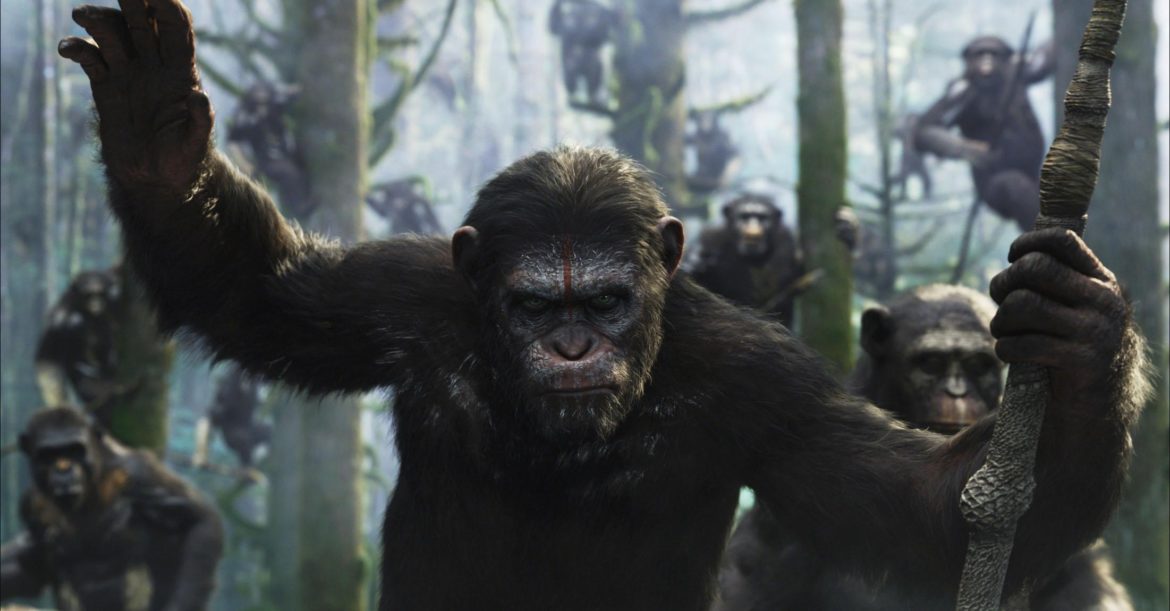
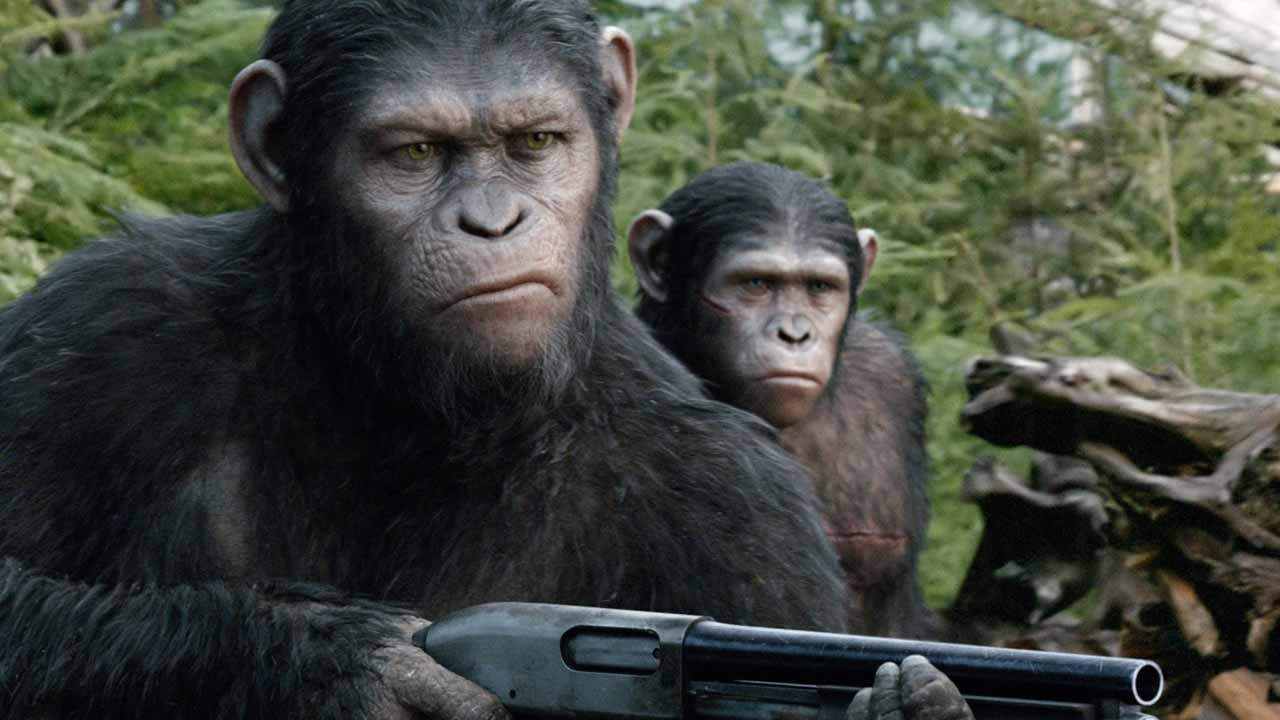
Will win – Dawn of the Planet of the Apes

I could see this going to either Captain America: The Winter Soldier or Interstellar instead, but Dawn of the Planet of the Apes features significantly more horseback-riding apes firing machine guns, always the “x factor” in decisions like these.

Should win – Guardians of the Galaxy

Guardians of the Galaxy probably doesn’t have the show-stopping visual bells and whistles of the other nominees, but a lot of its charm is wrapped up in its ramshackle look and feel (not to mention its raccoons wearing people clothes). I wasn’t as crazy about the movie as some folks I’ve read or spoken to, but it’s entertaining and ingratiating, in part because of those pleasingly modest effects.

Not nominated – Noah

For reasons I still can’t fathom, Darren Aronofsky’s Noah seems completely forgotten already, if not outright mocked or dismissed. That’s too bad – it’s a smart, searching examination of faith and doubt disguised as an epic disaster movie of literally Biblical proportions. Its spectacle aspect, though, is impressive both in the CGI renderings of a fallen world, and the way in which Aronofsky deploys those effects, in service to the story rather than crowding it out.

Best Documentary
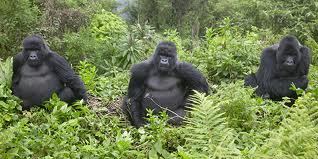
virunga
Will win – Virunga

Laura Poitras’ Edward Snowden doc Citizenfour has a lot going for it (on paper at least; I haven’t seen it) – it’s ripped from the headlines, by most accounts pretty gripping, and offers an unprecedented look at history as it unfolds. Finding Vivian Maier introduced audiences to an artist who deserves more attention, which I could see holding a certain amount of appeal to voters. But Virunga, which is focused on conservation efforts and attempts to save Africa’s oldest national park (in Democratic Republic of the Congo) from oil exploration and its wildlife from extinction, is going to pull an upset here. It’s an “issue film” that seems very much in line with past winners like 2005’s March of the Penguins, 2006’s An Inconvenient Truth, and 2009’s The Cove, and, while not everyone might support Snowden or care particularly about street photography, I doubt there are too many who come down on the “anti-endangered species, pro-fossil fuels and environmental devastation” side of the debate, at least among those voting. Having Leo Dicaprio as executive producer probably doesn’t hurt, either.

Should win – Abstain

The only nominee I’ve seen is Finding Vivian Maier, and I did not care for it at all.

Not nominated – Jodorowsky’s Dune

David Lynch’s adaptation of the cult classic sci-fi novel Dune is famously divisive, and had a tortured journey to the screen. Fascinatingly, iconoclast filmmaker (and very excitable man) Alejandro Jodorowsky tried for years to get financing to make it before Lynch came on board. It never happened, of course, but in Jodorowsky’s Dune we get to see what might have been, by way of his elaborately constructed and lovingly preserved book of images and drafts for the project. On camera, he supplements these with descriptions and digressions, all delivered with his inimitable manic enthusiasm – he must be one of the few people in the world who can talk with so much gusto and good nature about a passion project that didn’t work out. Frank Pavitch’s doc isn’t the film Jodorowsky wanted to make, but it’s probably the next best thing.

Best Supporting Actor

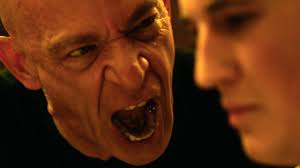
whiplash

Will win – J.K. Simmons, Whiplash

There’s no drama here. J.K. Simmons is the crazed heart and questionable soul of Damien Chazelle’s stellar Whiplash – his enormously intimidating, morally dubious music teacher dominates every scene he’s in to such a degree that the “supporting” part of the award almost doesn’t apply. Never has the phrase “Not really my tempo” struck fear into so many hearts. J.K. Simmons, a veteran character actor with a ton of great performances to his name, is basically even odds to win, and he deserves it.

Should win – J.K. Simmons, Whiplash

Yep.

Not Nominated – David Koechner, Cheap Thrills

E.L. Katz’s Cheap Thrills is a gratuitously violent, depraved, and brutal portrait of class struggle and how far we’re willing to go to get by. It’s also hilarious, mostly because of David Koechner (probably familiar to most viewers as Packer on the American version of The Office). Perfectly cast, he brings the same boorish behavior from that role to this one, except things go into much darker territory. It’s a dark night of the soul all around, but Koechner finds plenty of humor in the darkness.

Best Supporting Actress

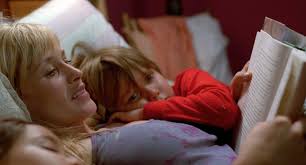
boyhood3

Will win – Patricia Arquette, Boyhood

Like J.K. Simmons’ predicted win, this seems pre-ordained. And like Simmons, Arquette deserves every bit of the acclaim. Her performance is nuanced, rich, utterly believable, and, in one incredible scene where she takes stock of her own life and reflects on the passage of time, heartbreaking. Arquette has never been better – she’s never been close to this good, as far as I know. She’ll win, and should.

Should win – Patricia Arquette, Boyhood

Yep.

Not nominated – Uma Thurman, Nymphomaniac Vol. 1

Lars von Trier’s controversial Nymphomaniac Vol. 1 is lighter in tone than the second installment released here in the U.S. (and better for that very reason), but it can still be pretty grueling. In the middle of all the sordid business, Uma Thurman shows up for about four minutes and leaves the biggest impression of anyone in the film. Walking her kids through our protagonist’s apartment, where she’s entertaining Thurman’s unfaithful husband, she carries on in the most bitter, cringe-worthy, and hilarious monologue imaginable, followed by a breakdown that’s like the emotional version of a car wreck – it’s impossible to look away. When she fake-cheerfully asks the children if they want to see “the whoring bed,” it’s simultaneously appalling and funny … a lot like the movie itself.

And the rest

I didn’t bother with several categories, either because I didn’t see enough (or any) of the nominees or because I didn’t have much to say. But for the sake of completeism (and so I can laugh at how wrong I was tomorrow), here are basically random, largely unfounded predictions for the rest:

Best Animated Short – The Dam Keeper
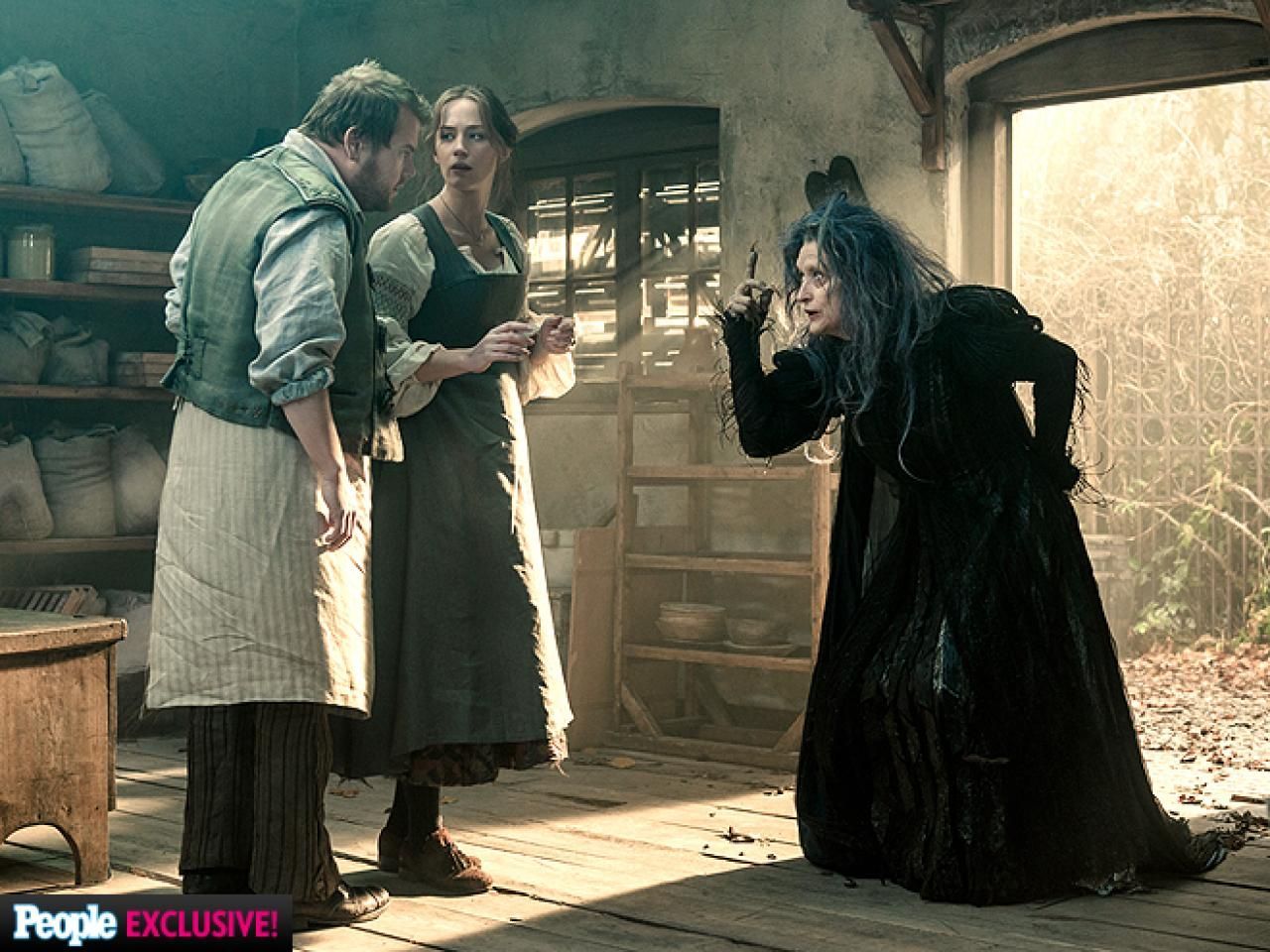
Best Costume Design – Into The Woods
Best Live Action Short – Aya
Best Documentary—Short – Crisis Hotline: Veterans Press 1
Best Makeup and Hairstyling – Foxcatcher
Best Original Score – The Theory of Everything
Best Sound Editing – American Sniper
Best Sound Mixing – Whiplash 

February 22, 2015 0 comments
0 FacebookTwitterPinterestEmail
CommentaryFilm

The Oscars are bullshit, and we’re all fools: Picks #2

by rick February 22, 2015
written by rick

Ok, some more picks for the Oscars. Previous entry here.

Best Foreign Language Film

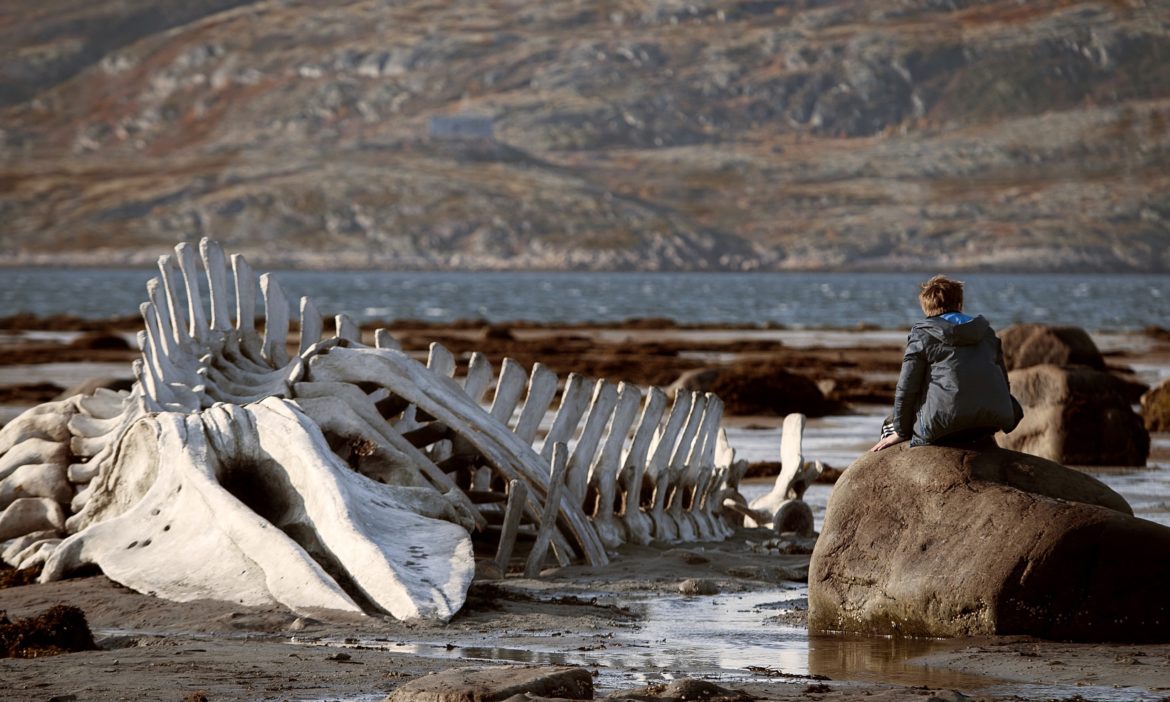
leviathan

Will win – Leviathan

In recent weeks, I feel like there’s some momentum behind Leviathan, a movie I haven’t seen but which certainly seems like a downer. On the other hand, it castigates Putin’s Russia (Academy +1), it is by all accounts very accomplished, and this one dude liked the poster, so there’s that.

Should win – Ida

Ida is not just my pick for this category – it’s my #2 film of 2014. It’s a complicated coming of age story which takes place under the shadow of atrocity, with resonant questions of faith and desire. I mean, c’mon.

Not nominated – Wetlands

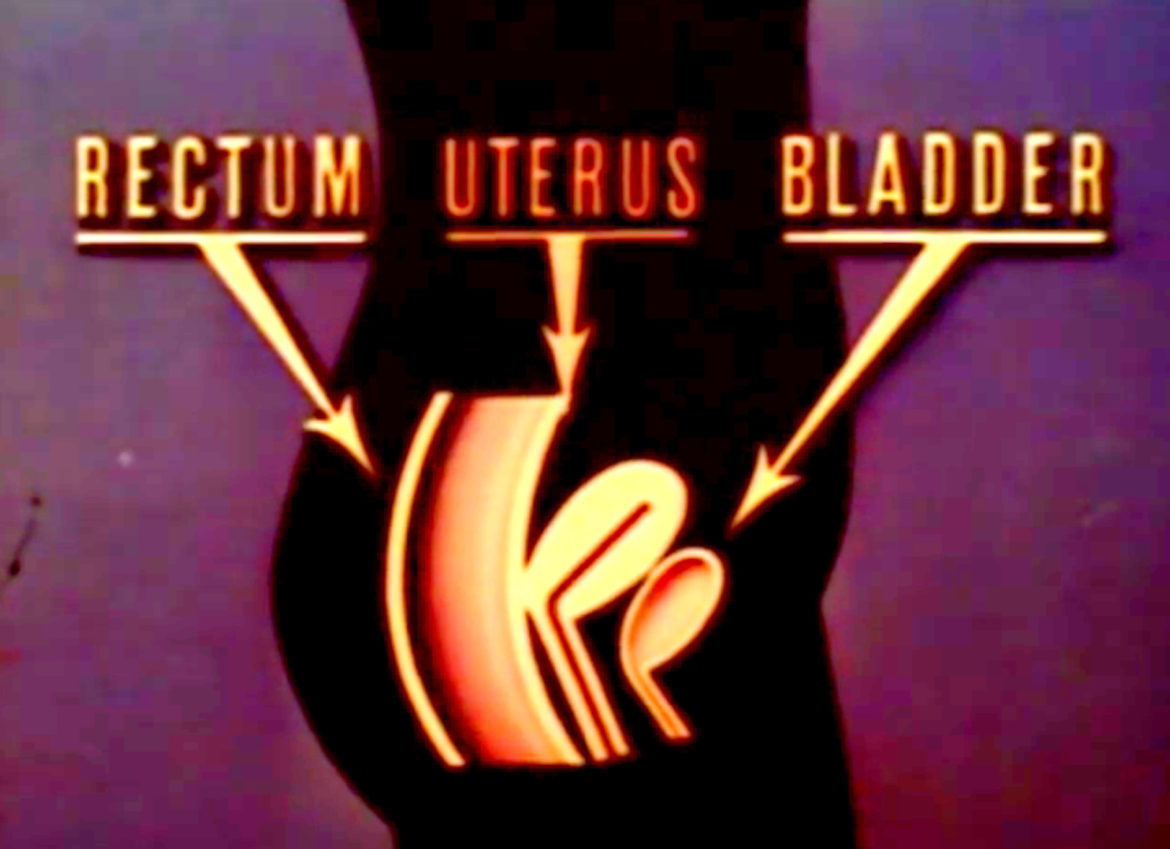
I enthusiastically reviewed Wetlands some time ago, and then referenced it again in my review of the Disney/Kotex production The Story of Menstruation some time later. And here we are again. Apparently, it’s the kind of movie that refuses to leave.

It’s also, incidentally, a fantastic character study animated by a winning performance, a punk rock rejection of politeness, and something like a bomb left under the table with a smile. I can’t recommend it highly enough.

Best Adapted Screenplay

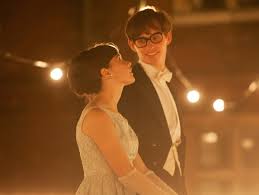
theory of e

Will win – The Theory of Everything

Again, I didn’t see this film, due to my biopic-allergy (it’s a real thing!), but the kudos it’s received makes me think it’s the sort of pleasant, inspiring, safe thing voters like.

Should win – Inherent Vice

This is a no-brainer. It’s the only nominee for which I read the source material and saw the film, and it makes me wonder to what degree actual voters have done the same with any or all of the titles listed. Is it higher than 0%? Maybe, who knows! In any case, I can firmly state that PTA’s Inherent Vice is a smart, intuitive translation of the novel to the screen; whole sections are taken from the book verbatim, which gives the film its particularly Pynchonian timbre and flow, but it’s not mindlessly respectful of the material, taking care to wed the literary shenanigans to the needs of cinema. I know reaction was mixed, but this is a film that will grow and find an audience, as much for its screenplay as its Lebowski-esque tomfoolery and gorgeous visuals.

Not nominated – We Are The Best!

Coco Moodysson’s punk rock graphic novel provided the template for her husband Lukas’ jubilant coming-of-age film, set in Stockholm and focused on three (rad) teenage girls. The film is enormously winning, and a lot of that comes from the noticeably graphic novel-like plotting, framing, and scenes. The fun, sometimes painful narratives of growth through punk rock and friendship, particularly those of the two central characters, made We Are The Best! one of the sharpest, most casually brilliant, and most unabashedly feminist films in years.

Best Original Screenplay

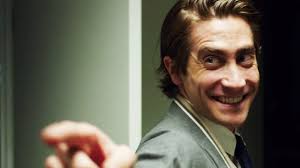
nightcrawler

Will win – Nightcrawler

Nightcrawler needs to win something, and this is its only spot. So there you go.

Should win – The Grand Budapest Hotel

For eminently understandable reasons, Wes Anderson gets associated with his meticulous production design, twee affectations, and consistently awesome soundtracks. The Grand Budapest Hotel is no different in that regard, but the intricacies of the screenplay are what really define it. In an almost impossible Wes Anderson-like fashion, the film is a Russian nesting doll of whimsy, melancholy, and farce.

Not nominated – Calvary

Screenwriter/playwright John Michael McDonagh’s script is taut, tense, and bitterly cynical, and Calvary is one of 2014’s most overlooked films. Brendan Gleeson, patron saint of filmic Irishness, is a doomed priest in a small town, surrounded by the most talkative sinners around. The language is flowery and stage-like, sure, but it’s also brilliant, and everything builds to an unbearable pitch before the climax, which is brutal and entirely appropriate. It’s a story about faith, grace, and sin told by someone who has thought a lot about these things, and has the mysterious ability to put them into words.

Best Animated Feature

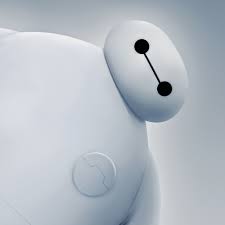
big hero 6

Will win – Big Hero 6

I saw exactly one of these, so I’m a very unreliable narrator at this point.

Should win – Song of the Sea and/or The Tale of Princess Kaguya

Unlike the Academy voter bewildered and angry that such “Chinese” nonsense like these, respectively, Irish and Japanese films could edge out his beloved Lego Movie, I’d love to see either win. I haven’t seen either yet, but Song of the Sea director Tomm Moore’s previous film The Secret of Kells is a favorite of mine, and Princess Kaguya looks like a lovely Studio Ghibli project, with all the care and beauty that implies. I mostly just don’t want How To Train Your Dragon 2 to win, the only nominee I saw. It is the kind of videogame-inspired, by-the-numbers cash grab that makes people avoid animated movies.

Not nominated – The LEGO Movie

For good reasons, a lot of attention was focused on Selma’s perceived snub, nominated only twice and not for Director or Actor. Down-ticket, the exclusion of The LEGO Movie is almost more bewildering, given the field of nominees. This was an enormously successful, critically welcomed movie that bucked every expectation – instead of a mercenary tie-in to a commercial product, it presented a fully lived-in world organized around the boxy, geometric nature of those toys, and populated it with memorable, funny characters. That’s exactly what this kind of movie should do. And on top of everything, its final reveal is charming and affirms the power of imagination and play. It’s sure as shit better than How To Train Your Dragon 2, which mainly reaffirms how important it is to domesticate dragons.

Best Film Editing

boyhood2

Will win – Boyhood

Even given the stellar performances and affectionate time-capsule aspects of Boyhood, it lives and dies on how well it flows together – not just as a film but as a slice of life (the first time I’ve used that expression and noticed it wasn’t a cliché in context). Sandra Adair and her team knock it out of the park. There are few signposts in Boyhood alerting us to the passage of time – no title cards or, Harry Potter book release aside (maybe), easy gimmicks. It’s all done through the construction of the film. And the film’s sense of this particular childhood, with its quiet rises and falls, is magic. That can be credited to Linklaters Richard and Lorelei for sure, and Ellar Coltrane, Ethan Hawke, and Patricia Arquette. But a huge amount of the credit should go Adair’s way. In some ways, Boyhood is about the assemblage of small details and how they fit together. That’s an editor’s job.

Should win – Boyhood

See above.

Not nominated– The Strange Color of Your Body’s Tears

Hélène Cattet and Bruno Forzani’s arthouse giallo is an imperfect film, but its editing showcases what it does best. In the great slasher tradition of Bay of Blood, Fulci, Argento, and the rest, it teases reveals throughout its running time, and builds tension through the juxtaposition of images and mounting dread. Both leads are terrific but, in a picture built around film references and movie logic, it’s the images and their force that stay with you.

Best Production Design

into the woods

Will win – Into The Woods

I don’t know. I didn’t see this thing, but I’m picking it primarily because Meryl Streep always wins something or other.

Should win – The Grand Budapest Hotel

In a just world, Wes Anderson’s films would win every year for production design. Even if they weren’t released that year. I’d be perfectly content if, say, Rushmore took the prize this time, despite being released some time ago. As it happens, there’s actually a Wes Anderson movie to vote for, and holy shit is it a Wes Anderson movie. It’s like the Platonic ideal of Wes Andersonism, with all that entails. And one thing it definitely entails is elaborate dollhouse staging and meticulous-verging-on-maybe-insane production design. The film is his career best, and its look and feel are a big part of it.

Not nominated – Inherent Vice

I will stop championing Inherent Vice soon (never!), but in this category it deserves mention. P.T. Anderson loves Southern California, loves the Valley and the beaches, and it always shows. Adapting Pynchon’s melancholy love letter to better days, he perfectly paints a moment in time, in this weird particular place, down to the smallest details, while also allowing that particularly Pynchonian sense of wackiness to run rampant. It should’ve been nominated for the office scene, if nothing else. It’s a beautiful and wistful and sad vision that wouldn’t work if its look was off. Its look is never off, not for a moment.

February 22, 2015 0 comments
0 FacebookTwitterPinterestEmail
CommentaryFilm

The Oscars are bullshit, and we’re all fools: Picks #1

by rick February 21, 2015
written by rick

Let’s start from a generally uncontroversial place: The Oscars are nonsense. Just utter bullshit. We are idiots for paying a single moment of attention to them.

And yet. Like many goofballs, I can’t turn away. It’s like playing craps in one of the less reputable Vegas casinos, in downtown rather than on the Strip. I just want to play, even if I end up losing my house somehow, in $5 increments, getting odds on 10 and saying “$10 for the dealer” on a hard 12, like an asshole. Come to think of it, I don’t even own a house!

A real gambler, however, wants to know how the game turns out. Even if you don’t like the game, or care about the players. This is the curse of the fucking Academy Awards, the biggest, silliest game in town. It’s like the Final Four for movie nerds. (Note to some of you movie nerds: the “Final Four” relates to college basketball. It’s basically the semifinals. Thing is, the groupings are complicated and determined by … eh, forget it, it’s Basketball Town.)

So the Oscars (much like basketball, candidate elections, workplace personnel evaluations, and so forth) are fucking bullshit. But even those who angrily denounce them, for frequently valid reasons, know their denunciations are “part of the conversation,” as they say. Some people are mounting hopelessly toothless protests to draw attention to the Academy’s overwhelming whiteness, but I suspect most have stopped caring.

It’s still an industry game, on each and every side. Your enthusiasm for industry self-congratulation is directly proportional to your access, as is your rage. In an appropriately meta formulation, and one impossible outside of the confines of late capitalism, the anti-Oscar protests double as commercials, or as weird doppelgangers to the lobbying campaigns that the companies mount. If I squint, it’s hard to tell them apart. I’d think an actual anti-Academy voice would be embarrassed to bring the Oscars up — it’s sort of weird to demand exposure through the same compromised systems you critique. Counter-progamming that announces “It is extremely important you do not pay attention to this, which is why we are drawing your attention to it” is puzzling.

I don’t doubt people’s sincerity … but I do doubt their efficacy, and even their honesty. Since when did anyone think getting an award mean being the best? The doling out of industry awards is by definition a political process, rife with assumptions of cultural value but mainly driven by inside-baseball nonsense and more or less random voting. Why would we look to commercial institutions for movie picks? I’m a cynic, I realize, but really. We like to think of the Oscars as somehow particularly prestigious and value-neutral, which is about as far away from the truth as possible. It’s an awards show after all, a canon-creating mechanism and sales-driven enterprise staffed by professionals who, like everyone else, have limited time and vested interests. This whole thing can have positive consequences (raising the profile of great films people might not have heard of, at a bare minimum), but it’s a supremely fucked system.

My system, on the other hand, is flawless. Unencumbered my the political constraints of The Academy, and more generally free of the iron heel of The Man, here are some movies I saw and some things I think about them. (Note: if you want to pay me, or even buy me dinner, I will totally change my votes.)

I broke them up into three metrics:

(1) What will win (my guess of Oscar voters);

(2) What should win, of the nominations I’ve seen; and

(3) What should’ve been nominated.

Ok, let’s do this thing.

Best Picture

birdman

Will win – Birdman

There are two real choices: Birdman and Boyhood. I think Academy voters will be flattered by the life-and-death struggle for transcendence through Art. Unlike Scott Tobias, I didn’t find Birdman “fraudulent,” but it didn’t resonate for me at all, but I’m also not an Academy voter. I think it wins here: a triumphant, self-conscious return to glory for Michael Keaton, a dazzling script focused on artistic integrity vs. commerce, light satire of industry types. It reads like a Best Picture to me.

Should win – Boyhood

Boyhood is not just a thinkpiece-generating machine; it’s a legitimate marvel. It’s the movie of the decade, not just the year.

Not nominated – Under The Skin

Everything about Under The Skin is evocative and out of time. The manner in which it’s shot (often surreptiously), Scarlett Johanson’s astounding performance, and the film’s design and sound all indicate otherworldliness, without even once tipping its hand. It examines patriarchy, the male gaze, and bodies more generally in unexpected and unforgettable ways, and fashions a new approach, from the outside in. It’s the best movie of the year.

Best Director

boyhood

Will win – Richard Linklater, Boyhood

I think Academy voters will split the difference between their desire to honor the craft of performance (via Birdman) and their recognition that what Linklater accomplished is unprecedented and kind of bonkers.

Should win – Richard Linklater, Boyhood

As they should. Frankly, I could give a fuck about Birdman. The trials and tribulations of creative types isn’t really my thing – true story, there are other people in the world! Sorry, creative types, it’s hella true! – though I admired how seamlessly it was put together (see below). But Linklater is, as I keep saying, our cinematic poet of time. This was true in Dazed and Confused, and this surely was true in the 7-year time-lapse between installments of the Before trilogy (for which he really should’ve been given all the awards). But to film scenes annually over 12 years, to retain these collaborators, to watch people age on camera and yet integrate them into a coherent narrative, drawing from their difference and sameness, and the ways in which we, as viewers, navigate a world we’re never quite sure about? It’s never been done and might never happen again. This is lightning in a bottle shit. Give him the thing, seriously.

Not nominated – James Gray, The Immigrant

James Gray is the most unappreciated American filmmaker working today, and The Immigrant is a masterpiece. Over the course of five films, he has established himself as both a tragedian and a goof, mining working-class realities for pathos and uneasy laughs. The Immigrant’s final scene was the most affecting thing I saw in 2014, and Marion Cotillard should’ve been nominated for this one, too. But she can’t do it alone, nor can my favorite actor Joaquin Phoenix, in his second-best performance of the year. Nope: the cumulative impact is all Gray, and it’s devastating and epic in scope and it demands recognition, and fans.

Best Actor

theory of everything

Will win – Eddie Redmayne, The Theory of Everything

I did not see this movie, but I think it will win. Let Jen Chaney explain.

Should win – Michael Keaton, Birdman

I am on record as disliking Birdman. I thought it was self-indulgent and annoying and kind of rapey, and I couldn’t give it a pass just because it also thought (and said) it was self-indulgent and annoying (though its meta-thoughts on rapiness were not included, likely because no one noticed). I was reminded of a guy I met once who’s like, “Look, I realize this might be annoying …” and then goes on, annoyingly, for a while? Do you know this guy? He sucks, and Birdman was sort of like that.

But! Michael Keaton saved the day. He threads the needle: he’s insufferable, incredibly put upon, full of shit and bravado and fear, and he carries the film on his back like a fucking soldier for art. He’s the only real person in the film, and the only reason to watch it. (Sorry not sorry, Ed Norton.)

Not nominated – Ralph Fiennes, The Grand Budapest Hotel

Wes Anderson is not “due” for an Oscar. In fact, there’s something incongruous and strange about the whole notion. Perhaps if Oscars were doled out in treasure hunts on remote islands, and you could only use whimsical vehicles to find them, after you were laid off from the licorice shoppe or whatever, then it would make sense.

Be that as it may, The Grand Budapest Hotel is a showcase for Ralph Fiennes, the funniest man you didn’t realize was funny. Comedies are routinely scorned at award ceremonies, and comic actors who blend melancholy into their delivery even more so. Fiennes deadpans his way into Anderson’s sensibility, and gives a master performance. Like many an Anderson character, his humor is connected to his sadness and loss. Here, that contradiction is raised to a fever pitch. Fiennes never slows down.


Best Actress

still alice

Will win – Julianne Moore, Still Alice

I did not see this movie. I read about it and think she’ll win. Oscar likes sick/transformative. What, it’s true. I can’t go seeing every fucking movie. Gosh.

Should win – Rosamund Pike, Gone Girl

With all apologies to fans of the book and/or David Fincher, I despised this film. I thought it was a fucking travesty, and maybe the most misogynist film I’ve seen since American Beauty. Rosamund Pike, however, was believable (roughly 75% of the time), and her narration gave the movie the tiny bit of impact it mustered. So, like a proper Academy voter who only saw one nominated movie, she gets my vote. But seriously, fuck this movie.

Not nominated – Jenny Slate, Obvious Child

Obvious Child was one of the best movies of the year, and Jenny Slate was the reason why. Apart from the script or characterization, she brought a warm, kind-hearted, awkward, and shameless vibe that animated the whole movie. Her stand-up is funny; her frantically diving behind trash cans to escape notice while standing outside her ex’s house, engaged in what she calls “light stalking,” is funnier. And her start-stop-ok-start-fuck-I-dunno romance in the film rings so true I want to go buy her a drink. Obvious Child is great for a lot of reasons, and most of those reasons are Jenny Slate.

Best Cinematography

birdman-1

Will win – Birdman

The illusion of a single tracking shot has tripped everyone out. That includes Academy voters. In fairness, it’s enormously effective in conveying the close confines and anxiety.

Should win – Ida

Shot in boxy Academy ratio and luminous black and white, Ida is the stand-out. The entire world seems to impinge on the characters – they are routinely positioned at the bottom of the frame as the world looms above them. There’s no escape from history, and even illusions of agency aren’t going to cut it. Its characters’ powerlessness is underscored again and again. Ida is a haunting vision of loss and discovery, and a huge chunk of this is conveyed through the compositions of the images. A quick test: imagine if this film was shot in some other fashion (in color, shaky handheld, etc.). That would suck, right? Yeah, it would.

Not nominated – Inherent Vice

As a longtime Pynchon reader and a somewhat less longtime P.T. Anderson fan, I was stoked for Inherent Vice. Others seem not to have been in the same boat, if cursory internet readings are any guide. But it was one of my favorite movies of the year, not least because of how faithfully it conjured the 70s through its images. The film itself is indebted to Robert Altman’s The Long Goodbye thematically, but more than anything, it’s the film stock, the tones, the washed-out palette that recalls the period, and makes it happen. To steal a line from someone who I’m too lazy too look up, it looks like the last great movie of the mid-70’s. Which suits Pynchon just fine, I think

February 21, 2015 2 comments
0 FacebookTwitterPinterestEmail
FilmReviews

Jack Reacher (Christopher McQuarrie, 2012)

by rick February 15, 2015
written by rick

2014’s Edge of Tomorrow, an enormously fun action movie that doubles as a clever riff on videogame motifs (a fact self-consciously indicated by its tagline: “Live. Die. Repeat.”) was one of the year’s biggest and best surprises, even if The Onion kind of got to it first. Starring the always Tom Cruise-like Tom Cruise and featuring a terrific turn from Emily Blount as his mentor/sidekick/love interest, it played with his eternally cocky persona in amusing ways, and ended up being the most enjoyable popcorn movie I’ve seen in years. It’s smart enough to hold your interest while also never taking itself too seriously.

Jack Reacher, from two years prior, is no Edge of Tomorrow, but it has a few things going for it. (The terminal blandness of its title is not among these, however.) Adapted from the Lee Child series, it’s a straight-ahead, conspiracy-minded whodunit, and it wants nothing more than to keep you occupied as it goes through the motions, occasionally with a measure of wit amid all the shit exploding and engines revving. Sometimes that’s enough.

Cruise is the title character, whose name I’ve already forgotten. Oh, wait, it’s Jack Reacher. Yes, right. Cruise is Jack Reacher, a man with no fixed address, no record, no contact information – a nowhere man. After a deranged, former-Army gunman kills several people in a downtown square and is apprehended, his only words to police are: “Get Jack Reacher.” Turns out they have a history (wouldn’t you know it!): the same shooter killed several unarmed civilians overseas, and was investigated by Reacher in his former capacity as a military cop. It’s an open-and-shut case – a loner with a violent history committing an atrocity in peacetime. What else could there be to say?

You will be unsurprised to discover there are other things to say.

For reasons both too involved and too silly to explain, Reacher doubts his guilt. Two 2014 standouts show up to flesh things out: Gone Girl’s Rosamund Pike, an idealist convinced that capital cases are sending innocent men to death row (and not coincidentally the daughter of the District Attorney), takes on the shooter’s case, and Selma’s David Oyelowo leads the investigation and is convinced of his guilt. (Incidentally, my favorite moment of the film viewing experience came when my fellow audience member shouted, “Holy shit, Martin Luther King just tazed that lady!”) There are secrets behind secrets here, of course, and it’s up to Reacher to connect the threads.

This is all by-the-numbers stuff, and Jack Reacher never really elevates itself beyond its procedural template, despite giving Cruise some hilariously self-conscious one-liners and stock phrases, and allowing Robert Duvall, as the owner of a local gun range with a connection to the case, to go around muttering the sort of grouchy things one assumes Robert Duvall mutters all the time, even at his house. In any case, it’s all plenty enjoyable, if this is the kind of movie you’re in the mood for.

And that would be the end of things, if not for one crucial detail: the villain is played by (wait for it) Werner Herzog, a man who can effortlessly convey brooding menace simply by sitting in a chair and glaring at you. Here, the esteemed director and world-class weirdo radiates maniacal nihilism – it doesn’t hurt that his character survived earlier trauma by literally eating his own frostbitten fingers before gangrene could set in. In one scene, he offers a victim a chance at salvation … under the conditions that he do the same. Yikes – do not cross Werner Herzog.

There’s been talk of a sequel, and I’d show up for it if it ever happens. Jack Reacher isn’t a masterpiece, or even a particularly memorable action movie, but it’s perfectly adequate. And it imparts one impossible-to-miss lesson: finger-eating Werner Herzog should be the villain in every movie.

February 15, 2015 0 comments
0 FacebookTwitterPinterestEmail
FilmReviews

Force Majeure (Ruben Östlund, 2014)

by rick February 13, 2015
written by rick

The story Force Majeure tells is, on its surface, completely straight-forward, and doesn’t indicate all the tension the film ultimately delivers. It’s an action film where all the fireworks are (mostly) internal and a disaster film that only briefly features any disasters, and even those turn out not to be what they seem. But, in its accomplished plotting, mounting dread, and unexpected flourishes, it’s as riveting as any high-stakes suspense movie. The film is also surprisingly funny, which both undercuts the grimness and throws it into relief.

Tomas (Johannes Kuhnke), his wife Ebba (Lisa Loven Kongsli), and their two kids, Vincent and Clara (real-life siblings Vincent and Clara Wettergren) are vacationing for several days in a ski resort in the Alps. This picture-perfect, uber-bourgeois Swedish family have gathered for some rare undistracted time together as a unit (though Tomas can’t help checking his work cell from time to time). At the start, they banter warmly, have some family photos taken, hit the slopes, dine in style, sleep adorably all four to a bed in matching long-johns, and generally constitute a portrait of familial comfort, ease, and privilege.

Right from the beginning, however, we get the sense there’s trouble brewing. The film opens with cannon blasts and the sudden bursts of edgy strings from Ola Fløttum’s original score (which brings the intensity of György Ligeti to mind). The guns are used, in the film’s world, to trigger “controlled avalanches” on the mountains, so that skiers won’t trigger less controlled ones, and the strings are used, in our world, to immediately put us on alert. If that combo weren’t enough, a title card announces “Ski Day One,” like we’re in The Shining. That can’t be good.

It doesn’t take long for things to turn. While having lunch on an outside patio overlooking the picaresque surroundings, one of those controlled avalanches starts rushing down the mountain. With all the faith implicit in their bourgeois sense of order, the patrons pose and take pictures in front of the approaching snow. After all, the resort’s management knows what they’re doing. But the wall of snow keeps bearing down on them and panic erupts, with people clawing to escape. Ebba shelters the children; Tomas flees, effectively abandoning his family at the most critical moment. This may sound like a spoiler, but it’s truly not. This is where the story begins.

The parents’ two reactions, and their rippling consequences both within and outside the family, are the movie’s real focus. The avalanche is not the “major force” of the title, or at least not the central one. As it turns out, the avalanche stopped well short of the building, and the panic was caused instead by the debris it stirred up. It’s a bitterly funny irony – there was no danger, really. But now, with seeds of doubt and suspicion of character planted, there is.

Ebba is confounded by her husband’s display of cowardice, and then doubly injured when he maintains nothing of the sort happened. In classic man-splaining fashion, he concedes that it may have been her impression that he ran away and left them to die, but it’s not how he remembers it at all – as if everything is merely a matter of perspective. In subsequent scenes, the events are rehashed with mortified strangers at dinner and over drinks. The clash of their “perspectives” – that is, Ebba’s insistence on what actually happened, Tomas’ deflections and equivocations – generates growing hostility and alienation, and leads inexorably to a crisis. And then, in a third-act twist it’s best to experience cold, Östlund complicates their roles yet further. Viewers will have to determine for themselves what the film’s final minutes are getting at, but it’s clear that things won’t be settled when they get down from the mountain.

Both leads are terrific, but Force Majeure is a showcase for Kongsli, who gives a startlingly nuanced and powerful performance. Her Ebba is caught between doubt, rage, disappointment, and love, and Kongsli expertly reveals how much of this was already there before they left Sweden. In a startling scene, she and a new friend, in town to have some fun with the visiting menfolk while her husband and children are back at home, have drinks and discuss the friend’s polyamory; Ebba grudgingly concedes some points but clearly views it as an affront to propriety, moving from rational objection to what seems a much more personal irritation, even rage. Is she skeptical that it would work or scared that it might? Or simply annoyed that it should be so easy for others? Kongsli’s performance in the scene allows for all of the above. Questions of gender roles, family obligations, masculinity, and desire course through the film’s every moment.

Östlund makes an astute decision by leading the film with the family’s pictures being taken – there’s a desire for bourgeois normalcy behind all their later actions, a hope that they can shake off this unpleasantness and get back to being that family in the impossibly ideal images. In a deft touch, even the children sense the turmoil, as actual children would and do. The gorgeously shot sequences in the snow, especially a closing sequence in the fog and drift, give an overall sense of the inescapability of the situation, and the self-consciously Kubrickian framing underscores this (right down to the geometry of the hotel and wide shots).

In the end, the film implies that many “natural disasters” occur within and between individuals, not outside of them. And even when vacation ends and normal lives resume, the repercussions will continue to be felt.

February 13, 2015 0 comments
0 FacebookTwitterPinterestEmail
FilmReviews

The Story of Menstruation (Uncredited, 1946)

by rick February 8, 2015
written by rick

Today, we take a break from esteemed feature films like Scream, Blacula, Scream to look at something even more curious: the once-banned, entirely odd Disney production The Story of Menstruation, a 10-minute animated short from 1946 “presented with the compliments of Kimberly Clark.”

Reportedly the first screenplay to include the word “vagina,” it’s a time capsule that’s both frank and admirable while still being completely weird and off-putting on several levels. Have you seen many Disney outings that refer to “the rectum, bladder, and their external openings”? Or that specifically mention it’s ok to bathe when you have your period? I have now seen exactly one, myself. If there are others, please correct me.

Some context is needed. After watching the fantastic Wetlands, a friend and I were discussing how rare it is to see any frank, judgment-free (or enthusiastic) discussion of bodily fluids on screen not played for a laugh, particularly where the ladies are concerned. Wetlands is an extreme example of bucking that trend, maybe, but we agreed it’s rare in general.

You have your My Girl’s, sure, and the sit-com tradition of oblique, winking coming-of-age narratives. More recently, you have your Obvious Child’s, which isn’t about periods but doesn’t shy away from bodies. Neither of those actually put too fine a point on it, and don’t come close to what even Are You There God, It’s Me, Margaret tried to pull of in print. And in any case, it’s usually more like Superbad (“we’re blood brothers!”) or Carrie (a great film, but still one which approaches the female body with horror, as an alien force defined by barely-controlled menace). Even David Cronenberg, our reigning Baudelarian poet of the body, doesn’t help out here: he usually reserves the more viscous depictions to his male characters, from Scanners’ exploding head, to James Woods’ gushy stomach-vagina in Videodrome (do we have to give dudes vaginas in order to include them? Also, is there always a gun in there?), to the constant wetness of Naked Lunch’s homoerotic fantasia. Marilyn Chambers in Rabid might count (though she’s certainly a nightmare vision), but even so these examples still showcase how infrequent such depictions are.

Could it be true that menstruation is still that taboo in film? When Jason Biggs is going around fucking pies in the cultural imagination, and Cameron Diaz is styling her hair with Ben Stiller’s ejaculate, and boners (or lack thereof) drive the conversation, you’d think there might be more counter-examples, serious or not.

So, fast forward: the search for said examples led me to The Story of Menstruation, a film I did not know existed and am sort of awed by. It was produced by Disney, with funding from Kimberly-Clark, and widely distributed to schools, with an accompanying educational book titled Very Personally Yours (available for download here). Interestingly, commercial products are never mentioned, but the general sense seems to be that it was a corporate promo to sell tampons, which needed some arguing for at the time. However, cash-grab or not, it also is remarkably accurate and actually kind of progressive, enlisting a gynecologist as consultant to oversee its production and insisting, multiple times, that its subject is “normal and natural.” Good! But, watching today, the pairing of frank discussion with classic Disney doe-eyed figures makes it extremely odd to watch.

As the short opens, with saccharine strings and falling rose petals, we are told that “Mother Nature controls many of our routine bodily processes, through automatic control centers.” Well, then! This is not the last time the film emphasizes our subjugation (ok, I am a dude and will mind the pronouns; women’s subjugation) to the authority of the body. Cellular communication and hormonal effects are routinely described as “orders” – you get the sense that there’s an army inside, on this march to puberty. But almost immediately, the film displays its cooler side, specifically describing the lives of young girls as a progression from “blocks to dolls to books,” which is pretty rad. Good work, Disney and Kotex.

We learn about the pituitary gland, growth hormones, and, in an awesome diagram sequence, how the fallopian tubes, uterus, ovaries, and vagina relate. The narrator trips up a bit on the first enunciation of “vagina,” but she recovers, before adding a brief, rather lyrical overview of “the watery fluids and blood [that] begin to build a thickened lining of somewhat velvety material.”

It was at this point that I realized why it had been banned. Frank discussion is bad enough to some folks; the use of the word “velvety” is probably several bridges too far. Honestly, I’m not sure this could be made and distributed to American schools today, which, regardless of quality, is kind of depressing.

All these scenes are paired with recognizably Disney-like babies, cooing and giggling, and teen girls who bring to mind the princesses we’ve come to know so well. It’s strange to see them spliced between long segments tracing the adventures of an egg through the body, but it’s also kind of amazing. And then are baffling moments, like when (at 5:14) several women hang out with an adorable dog for no discernible reason.

There’s a progressive, body-positive message but it’s accompanied by a decidedly less feminist vision. The film urges women to “do something about that slouch,” notes that it’s “smart to keep looking smart,” and sagely advises, “don’t let [menstruation] get you down – after all, no matter how you feel, you have to live with other people … and you have to live with yourself.” Fair enough, I guess? The writers “explode the old taboo about bathing during your period” (what?) and “the old taboo against exercise – that’s nonsense!” So many old taboos. (Still, the film makes sure to note that you probably shouldn’t ride wildly bucking horses. Pro tip, from the folks at Kimberly-Clark). And as if answering in advance someone questioning its morals amid all these muddled messages, the film starts and ends with the image of adorable babies. It’s all for a good cause.

The Story of Menstruation is very easy to laugh at – and absolutely anyone will, and should, seeing as it’s hilarious that it exists and that its coupling of progressive instruction with retrograde sentiment is deeply weird – but it’s also kind of poignant and interesting. The truly laughable thing is that nearly 60 years later, it manages to be surprising at all, simply by stating facts about bodies amid all the 1940s paternalism. Honestly, I intended to snark about it more, but I ended feeling sort of affectionate towards this thing. It’s the best 10 minute Disney/Kotex production you’re likely to see.

Watch it here:

February 8, 2015 0 comments
0 FacebookTwitterPinterestEmail
Newer Posts
Older Posts

About

About

Towards a provisional theory of the cinema, or, failing that, just some shit about movies

Authors
Rick Kelley
Lark Lundberg

Keep in touch

Facebook Twitter

Categories

  • Conversation
  • Film
  • Film By Film
  • Great Movie Project
  • Great Movies: The Counter Programming
  • Guest
  • News
  • Other
    • Commentary
    • Film
    • Interview
    • Reviews
    • Song for a Sunday
  • Streaming Selections
  • TV
  • Uncategorized
  • Vegan Horror

Archives

  • April 2019
  • March 2019
  • January 2019
  • December 2018
  • November 2018
  • October 2018
  • September 2018
  • August 2018
  • July 2018
  • June 2018
  • May 2018
  • April 2018
  • March 2018
  • February 2018
  • January 2018
  • December 2017
  • November 2017
  • October 2017
  • September 2017
  • August 2017
  • July 2017
  • June 2017
  • May 2017
  • April 2017
  • March 2017
  • February 2017
  • January 2017
  • December 2016
  • November 2016
  • October 2016
  • September 2016
  • August 2016
  • July 2016
  • June 2016
  • May 2016
  • April 2016
  • March 2016
  • February 2016
  • January 2016
  • December 2015
  • October 2015
  • September 2015
  • August 2015
  • July 2015
  • June 2015
  • May 2015
  • April 2015
  • March 2015
  • February 2015
  • January 2015
  • December 2014
  • November 2014
  • October 2014
  • August 2009
  • September 2008

Recent Posts

  • China Girls, Death Proof, and the Hidden Face
  • Old News: Old Noise Edition
  • Old News: April 1, 2019
  • Nicolas Winding Refn, Marginalia, and the Deaths of Cinema
  • And now, let us praise Kanopy

Recent Comments

  • Franklin Kat on Michael Shannon shines again in Frank & Lola
  • Sean Tempesta on Cinema and dream-logic in Meshes of the Afternoon
  • ludditerobot on The Left-Wing Slapstick and Iconic Songs of 1937’s Street Angel
  • Franklin Kat on The Left-Wing Slapstick and Iconic Songs of 1937’s Street Angel
  • Arijit Mukherjee on Great Movies Project: The Counter-Programming
  • Facebook
  • Twitter

@2021 - All Right Reserved. Designed and Developed by PenciDesign


Back To Top
Luddite Robot
  • Reviews
  • Commentary
  • Great Movie Project
    • Great Movie Project
      Bride of Frankenstein is a movie for and…

      January 25, 2018

      Great Movie Project
      The Enduring Appeal of Nick and Nora in…

      November 29, 2017

      Great Movie Project
      The Ahistorical Fever Dream of The Scarlet Empress

      August 2, 2017

      Great Movie Project
      Dreams, Mundanity, and the Anarchist Yearnings of L’Atalante

      July 12, 2017

      Great Movie Project
      Duck Soup Is And Will Always Be A…

      April 19, 2017

  • Counter Programming
    • Great Movies: The Counter Programming
      Walking and Talking in the Shadow of Kanchenjungha

      March 7, 2018

      Great Movies: The Counter Programming
      A Brief Encounter in My Mother and Her…

      February 9, 2018

      Great Movies: The Counter Programming
      Horror’s Refusal in Farrokhzad’s The House Is Black

      October 13, 2017

      Great Movies: The Counter Programming
      The rage and beauty of The Cloud-Capped Star

      October 3, 2017

      Great Movies: The Counter Programming
      The daylight noir and social issue empathy of…

      June 22, 2017

  • Vegan Horror
    • Vegan Horror
      Julia Ducournau doesn’t think her film Raw is…

      June 7, 2017

      Vegan Horror
      Licking our wounds: The vampiric masculinity of Ravenous

      December 13, 2016

      Vegan Horror
      Eggertsson and animals: An approach to horror cinema

      September 15, 2016

      Vegan Horror
      “It’s Not My Nature” – Vegetarianism, Body Horror,…

      August 30, 2016

      Vegan Horror
      Bodies and Carcasses in Predator 2

      August 23, 2016

  • Interview
    • Interview
      Jasmine Leyva’s doc The Invisible Vegan aims to…

      May 3, 2017

      Interview
      Bridging The Abyss: An Interview With The Directors…

      November 28, 2016

      Interview
      7 Days in Ohio: An Interview with Nathan…

      September 12, 2016

      Interview
      Film Critic Phil Dy talks New Filipino Cinema

      June 17, 2016

      Interview
      “I Love Seeing Film Projected.” A Conversation with…

      March 22, 2016